How to Audit Your Brand's Visibility Across AI Search Engines
The rules of search have fundamentally changed. AI-powered engines are now the first stop for millions of buyers — and most brands have no idea whether they're being cited, ignored, or misrepresented. This guide walks you through a structured audit process to measure, optimize, and own your brand's presence in the new era of AI driven discovery.
The Hidden Landscape of AI Search
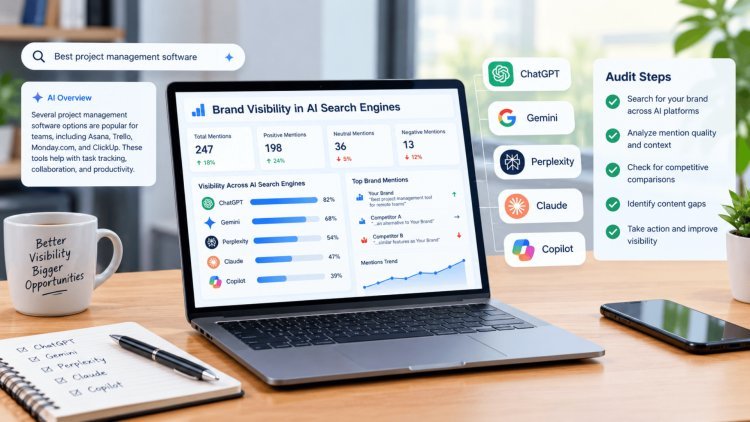
The search landscape has undergone a seismic shift. Platforms like ChatGPT, Perplexity, Google AI Overviews, and Claude have fundamentally altered how users discover brands, compare options, and make purchasing decisions. For millions of people, these AI engines are now the first and often only touchpoint in the buyer journey — yet most brands have zero visibility into whether they appear, how they're described, or whether they're trusted by these systems at all.
How AI Search Decides Visibility
01
Why Traditional SEO Isn't Enough
Ranking on Google's blue-link results no longer guarantees you'll appear in AI-generated summaries. AI engines don't simply surface the top-ranked page — they synthesize information from sources they deem credible, structured, and entity-rich. A brand with a strong backlink profile but weak semantic clarity can be completely invisible in AI responses.
Your visibility depends on whether AI agents can access, parse, and trust your brand entity across the web. This means your structured data, your mentions on authoritative third-party domains, your Wikipedia or Wikidata presence, and even your brand's digital footprint all play a role in how AI models represent you.
02
The Unbranded Query Problem
Most marketers test AI engines by typing their own brand name and checking the response. This is a critical mistake. Real buyers don't search for you by name — they search for solutions to problems.
They ask things like "What's the best platform for managing freelance contracts?" or "Which digital marketing agency specializes in brand strategy?"
To audit your baseline visibility accurately, you must test unbranded buyer queries — the category-level, problem-aware, and comparison-stage questions your ideal customers are genuinely asking. Discover whether your services are being cited when the search is happening without your name in it. That's where real competitive intelligence lives.
Access
AI crawlers must be able to reach and index your content without technical blockers like misconfigured robots.txt, heavy JavaScript rendering, or restrictive authentication walls preventing discovery.
Parse
Your content must be structured clearly enough for AI extraction engines to identify your core claims, entity relationships, and factual assertions without ambiguity or interpretive guesswork.
Trust
AI models weight sources by authority signals — third-party mentions, structured entity data, consistent NAP information, and cross-platform credibility indicators that confirm your brand is a reliable source.
Traditional SEO Mindset
Rank for Keywords
Track Blue Links
Optimize Pages
Focus on Traffic
Search-Centric
AI Visibility Mindset
Build Entities
Earn Citations
Structure Data
Establish Trust
Ecosystem-Centric
Strategic Reality
Visibility in AI search is no longer earned solely through rankings. It is earned through accessibility, semantic clarity, and machine-verifiable trust signals.
The New Search Reality
The most important question is no longer “Do we rank?” It is “Do AI systems recognize, understand, trust, and recommend us when buyers describe the problem we solve?”
Access → Parse → Trust → Recommendation
01
AI Visibility Audit
Step 1: Benchmark Your Current Standing
Before you can improve your AI visibility, you need an honest, unbiased picture of where you stand today. This requires a disciplined testing methodology that strips away personalization, algorithmic familiarity, and confirmation bias. The goal is to see your brand exactly as a first-time AI user would — no history, no context, no favoritism. Your content strategy must earn its place organically in AI-generated answers.
⌕
Setting Up a Clean Testing Environment
Establish an unbiased baseline
01
Start with a Clean Session
Every test must be conducted in a fresh incognito or private browsing session with no account logged in. This is non-negotiable. AI platforms like ChatGPT and Perplexity personalize responses based on chat history and user preferences — without clean sessions, you'll receive flattering, self-reinforcing results that dramatically overstate your actual visibility to new users.
02
Test Across Three AI Engines
Use at least three separate AI engines for each query: ChatGPT (GPT-4), Perplexity AI, and Google's AI Overviews. Each model has different training data, citation preferences, and retrieval mechanisms. A brand that dominates ChatGPT responses may be entirely absent from Perplexity's sourcing — and vice versa. Cross-engine testing reveals the full picture.
03
Record Every Response
Document every response verbatim in a shared spreadsheet. Include the exact query, the platform, the date, and a screenshot. This timestamped record becomes your baseline benchmark — the "before" state that makes future improvements measurable and defensible to stakeholders.
Minimum Cross-Engine Scope
⌘
Building Your Query Bank
Record a minimum of 10 to 15 questions per audit cycle, deliberately spanning three distinct intent stages:
01
Learn
Definitional Queries
These reveal whether AI associates your brand with foundational concepts.
"What is [your service category]?" or "How does [your industry solution] work?"
02
Compare
Comparison Queries
These expose your competitive positioning in AI-generated shortlists.
"What are the best [your category] agencies?" or "[Your brand] vs. competitors"
03
Choose
Decision-Stage Queries
These are the highest-value queries, closest to conversion, where being cited means direct revenue impact.
"Who should I hire for [specific outcome]?"
Measure Every Result
Three Clear Visibility Outcomes
Track three clear outcome metrics for every query: are you named and cited with a link, named without attribution, or completely absent? Visibility without citation is better than nothing — but it's not enough to drive traffic or trust in the AI era.
↗
Named with Link
Your brand is named and cited with a link.
◉
Named without Link
Your brand appears without attribution.
—
Completely Absent
Your brand does not appear in the response.
3+
AI Engines to Test
ChatGPT, Perplexity, and Google AI Overviews represent the minimum viable cross-engine audit scope for accurate visibility measurement.
10+
Queries Per Audit
A robust query bank spanning definitional, comparison, and decision-stage intent provides statistically meaningful visibility data across your category.
3
Visibility Outcomes
Named with link, named without link, or completely absent — these three tiers define your AI citation health score and drive prioritization decisions.
Step 2: Optimize for Machine Extraction
Once you know where you stand, optimization begins. AI language models do not read a website like a human — they extract structured signals, identify entity relationships, and synthesize information at scale. The brands cited most consistently make that extraction process as frictionless as possible. [489][491][492]
Optimization Move
FAQ Sections & Q&A Headings
Use question-shaped H2 or H3 headings — such as “What does a brand visibility audit include?” — followed by concise, self-contained answers of two to four sentences. Each Q&A pair should stand alone, since AI systems may extract it independently. [488][495][498]
Optimization Move
Front-Load the Direct Answer
Open every page with a bold, one- to two-sentence direct answer to its core question. Use the inverted-pyramid structure: most important information first, supporting detail second. This makes the key insight easier to prioritize during extraction. [492][498]
Optimization Move
Structured HTML Tables
Convert comparisons — pricing tiers, feature matrices, service differentiators, and competitive analyses — into properly marked-up HTML tables with clear headers and concise cell values. Pair each table with a short framing sentence for both AI extraction and human readability. [489][493][498]
The Extraction Pattern
Answer first.
Evidence second.
Context third.
How to Structure a Page
Lead with a direct 40–60 word answer, then break the page into question-shaped sections with self-contained passages. Add verifiable claims with sources, use semantic HTML tables or numbered lists where appropriate, and ensure the visible content matches any structured data. [489][492][498]
Add Structured Data — Carefully
Structured data helps Google understand and classify page content, and can make pages eligible for richer search appearances. Google recommends JSON-LD, Microdata, or RDFa, and advises validating implementation with the Rich Results Test. However, Google states that special AI-specific markup is not required to appear in AI features; helpful, reliable, people-first content remains central. [489][491][492]
Organization
Schema
FAQPage
Schema
Article
Schema
The Bottom Line
Make your content the easiest, most credible source for AI to extract, verify, and cite.
Front-load the answer, structure the page, use clear tables, and keep structured data aligned with visible content.
Conclusion: Turning Findings into Authority
An AI visibility audit is not a one-time event — it is the foundation of an ongoing brand intelligence practice. The brands that will dominate AI search results over the next three to five years are not necessarily the biggest or the oldest; they are the ones that document, iterate, and build evidence of authority systematically. Here's how to transform your audit findings into durable, compounding growth.
The AI Authority Flywheel
Build a Prioritized Fix List
Stop guessing and start documenting. After completing your baseline audit, organize every gap and deficiency into a categorized, prioritized fix list with three clear buckets:
Technical Blockers
Crawl issues, robots.txt conflicts, JavaScript rendering failures, missing schema markup, and slow page load times that prevent AI agents from accessing your content reliably.
Content Gaps
Missing FAQ sections, absent comparison tables, unstructured definitional pages, and topic areas where competitors are being cited but you are not.
Entity Signals
Incomplete or inconsistent brand information across third-party directories, missing Wikidata entries, unverified Google Business Profile data, and low-authority mention profiles that weaken AI model confidence in your brand identity.
A prioritized fix list categorized this way is the only path to durable, measurable growth in AI visibility. Without it, optimization efforts remain reactive, fragmented, and impossible to attribute to outcomes.
Build a Repeatable Evidence Log
AI visibility is not a static score you achieve once and maintain passively. It is a dynamic, model-dependent measurement that shifts as AI engines update their training data, retrieval mechanisms, and citation criteria.
The brands that sustain AI presence are the ones running quarterly re-audits, tracking citation trends over time, and building a consistent, repeatable evidence log.
Your evidence log should include monthly query-by-query citation tracking across all three major AI engines, a changelog of every content optimization deployed, and a measurement of citation rate before and after each change. Over time, this log becomes your most valuable strategic asset — proof that your brand is the most authoritative answer in your market, backed by data rather than assumption.
Audit
Run clean, incognito cross-engine tests across 10+ unbranded buyer queries. Document every result with screenshots and timestamps to establish an honest baseline.
Optimize
Fix technical blockers, restructure content with FAQ headings and direct answers, add HTML comparison tables, and strengthen entity signals across the web.
Track
Re-audit quarterly. Log citation rates per query, per engine, per intent stage. Measure the impact of every optimization with before-and-after evidence.
Compound
Each audit cycle builds on the last. Over time, your evidence log proves consistent authority — making your brand the default AI citation in your market category.
Start the Journey
Begin your AI visibility audit journey with Digiverse Studio today, and leverage our expert content resources to ensure your brand is consistently the one providing the solution when AI-powered searches are happening across your category.
Final Conclusion
AI visibility auditing is not optional for brands serious about digital growth in 2025 and beyond. The window to establish early authority in AI search is open now — and it closes as competitors catch up. Start today.
Audit → Optimize → Track → Authority