Answer Engine Optimization vs Traditional SEO: A Practical Guide
The search landscape is undergoing its most fundamental transformation since Google's founding. As AI-powered answer engines reshape how people find information, marketers and SEO professionals must evolve their strategies — or risk becoming invisible. This guide breaks down the core differences between Answer Engine Optimization (AEO) and Traditional SEO, and shows you exactly how to build a hybrid playbook that wins in both systems.
Why SEO Started Missing the Mark
THE ZERO-CLICK REALITY
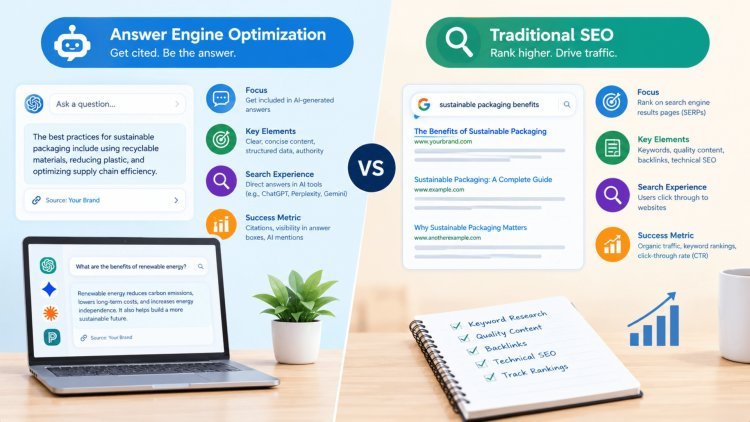
For nearly two decades, SEO was a straightforward game: rank higher in the "10 blue links," drive clicks, capture traffic. That model worked brilliantly — until AI fundamentally changed the rules. Today, AI search engines like Google's AI Overviews, ChatGPT, Perplexity, and Copilot often return a single, synthesized answer at the top of the results page. Users get what they need without ever clicking through to a website. This is the zero-click reality, and it is quietly eroding organic traffic for millions of websites worldwide.
Traditional SEO Logic
Compete for position one, two, or three among the "10 blue links." Success is measured in rankings, click-through rates, and organic sessions. Page-two is a consolation prize; page-one is the battleground.
Keyword ranking as the north star metric
Click-through rate optimization
Backlink authority building
On-page keyword density and placement
The New AEO Reality
In an AI-driven search environment, there is no "position two" inside an AI answer box. The model either cites you or it doesn't. AEO is about being selected and cited inside the answer itself — a binary outcome that traditional ranking strategies were never designed to achieve.
Citation frequency as the primary signal
Brand mention rate in AI responses
Content extractability by AI models
Structured, modular answer formatting
The Visibility Gap
The shift isn't hypothetical — studies show that AI Overviews now appear for over 40% of search queries in competitive niches. If your content strategy hasn't accounted for this, you're likely already losing visibility.
Old Search Model
Rank Higher
Earn Clicks
Grow Traffic
Measure Sessions
Optimize Rankings
AI Search Model
Earn Citations
Become The Answer
Build Authority
Measure Mentions
Optimize Extractability
A New Competitive Environment
At Digiverse Studio, we help brands rethink their digital presence from the ground up to stay competitive in this new environment. Understanding the gap between these two paradigms is the first step toward closing it.
Final Takeaway
The goal is no longer to win a click. The goal is to become the source AI systems trust, extract, cite, and recommend when your audience asks a question.
Rankings → Answers → Citations → Authority
How AI Search Works
The AEO Shift: What AI Engines Actually Reward
✦
A Different Optimization Goal
Answer Engine Optimization isn't simply "better SEO" — it's a fundamentally different discipline targeting a fundamentally different outcome. Where traditional SEO optimizes for discoverability in a list, AEO optimizes for extractability within a generated answer. AI models like ChatGPT, Google Gemini, Perplexity, and Microsoft Copilot synthesize information from multiple trusted sources and present a single, authoritative response. To be cited in that response, your content must be structured, credible, and immediately parseable by a language model.
▤
AI Overviews & Chat Answers
AEO specifically targets the AI-generated answer boxes that appear above traditional results in Google Search, as well as the conversational responses delivered by chatbased AI tools. Your content must be formatted so models can extract clear, citable statements — not just keyword-rich paragraphs.
With the rise of voice search and AI assistants, content must also be optimized for spoken delivery. This means concise, conversational answers that make sense when read aloud — complete sentences, no jargon, and a direct response to the user's question within the first two sentences.
↗
Citation Frequency as Success
AEO success is not measured in rankings or page-one positions. The defining KPI is citation frequency — how often an AI engine references your brand, quotes your content, or links to your page within a generated answer. Brand mention rate across AI tools is the new share-of-voice metric.
✓
AEO and traditional SEO are not mutually exclusive — the strongest digital strategies in 2025 run both in parallel. Think of AEO as an additional layer built on top of a healthy SEO foundation. Explore how Digiverse Studio's digital services can help you build both.
Build for Extractability
DIRECT ANSWERS + SCHEMA — The technical core of AEO comes down to one principle: make your content easy for AI models to extract, understand, and cite. This requires a deliberate combination of editorial structure, structured-data markup, and technical SEO hygiene. [94][519][520]
1
Editorial Layer
Direct Answer Blocks
Write standalone direct-answer blocks: self-contained paragraphs of 2–4 sentences that fully answer a specific question without requiring surrounding context. Place each block immediately after its question or subheading, not buried in body copy. [94][365][368]
2
Semantic Layer
Q&A Structured Data & Schema
Implement FAQPage and HowTo schema where appropriate, and add Article schema with dateModified to signal freshness. Use consistent terminology, proper nouns, and linked concepts to help models attribute citations accurately. [489][491][519]
3
Technical Layer
Crawlability & Indexation
Ensure robots.txt permits the crawlers you intend to allow, pages return a 200 status, content is indexable, and new pages are submitted for indexing through Google Search Console. A beautifully structured answer block is worthless if it cannot be crawled. [93][94][520]
Direct Answer Block
Answer first.
Context second.
Example
Each page should contain at least 3–5 direct-answer blocks targeting the most common questions in your niche. A direct answer should state the core claim, include the essential qualifier or timeframe, and stand alone if extracted from the page. [94][365][368]
Schema Markup Guidance
Structured data is a standardized format for describing page content and classifying it for machines. Google supports JSON-LD, Microdata, and RDFa, and recommends that all markup content also be visible on the page. Use FAQPage and HowTo schema only where the visible page genuinely contains that content. [489][491][493]
FAQPage
Schema
HowTo
Schema
Article
Schema
Technical Crawlability Checklist
robots.txt
Access
HTTP 200
Status
Indexable
Content
Search Console
Submission
robots.txt tells crawlers which URLs they can access; Google’s crawlers obey those rules. For AI search, ensure Googlebot is not blocked, pages return HTTP 200, and content is indexable. Decide separately whether to allow training crawlers such as GPTBot; Perplexity recommends allowing PerplexityBot for appearance in its search results. [93][520][521]
The Bottom Line
Write direct answers, confirm crawlability, and add schema markup.
These three layers work together to signal to AI engines that your content is authoritative, current, and safe to surface in a generated answer.
Your Hybrid Playbook: Win in Both Systems
The future belongs to brands running SEO and AEO as a coordinated operating system. Organic rankings protect visibility while AI citations expand reach. The strongest strategy is not choosing between them, but engineering both to reinforce one another.
1
Lock Down SEO
Audit crawlability, Core Web Vitals, internal linking, indexation, and canonical signals before layering AI-focused optimizations.
2
Layer AEO
Add direct-answer blocks, FAQ sections, schema markup, and extraction-friendly structures that AI systems can confidently surface.
3
Audit Weekly
Test target queries across AI platforms and search engines, identifying citation opportunities and competitive gaps.
Quick-Win Checklist
✓ Add FAQPage schema
✓ Rewrite answer-first introductions
✓ Allow AI crawlers
✓ Submit updated sitemaps
✓ Run weekly AI query testing
Dual Measurement Framework
SEO Metrics
Rankings
Clicks
Impressions
Organic Traffic
AEO Metrics
Citation Rate
Brand Mentions
Share of Voice
AI Visibility
Strategic Reality
SEO earns visibility.
AEO earns citations.
The brands that master both dominate discovery.