How to Structure Case Studies for AI Search Discovery
The rules of content visibility have fundamentally changed. As AI-powered search engines become the primary gateway for professional research and buying decisions, the case study format that served marketers for decades is now largely invisible to the systems that matter most. This presentation walks through a practical, evidence-based framework for restructuring your case studies so they are not just readable by humans — but retrievable, citable, and authoritative in the eyes of AI engines like ChatGPT, Perplexity, and Google's AI Overviews.
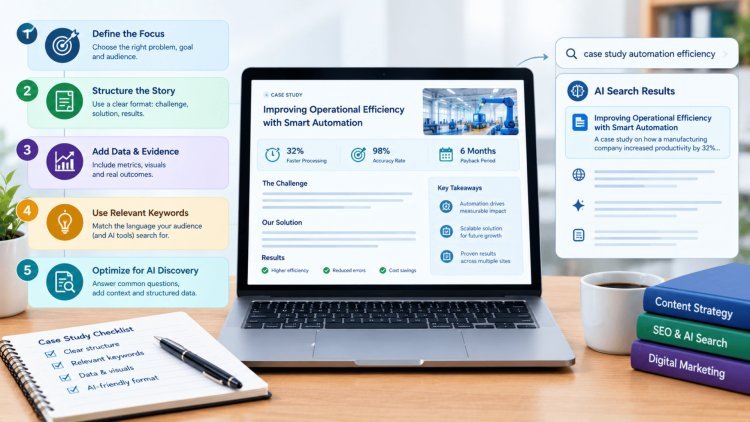
The Shift: Why AI Needs a New Blueprint
The traditional case study was built around narrative persuasion — a compelling story arc with a hero, a conflict, and a resolution. That format was designed for human readers skimming a PDF or a web page. But AI search engines do not read for emotion or narrative flow. They parse content for extractable, verifiable data points that can be surfaced in response to a specific query. If your case study is written as a prose story, it is effectively invisible to these systems — no matter how well-written or genuinely impressive the results may be.
The New AI Content Blueprint
01
Traditional Case Studies Are AI-Invisible
Narrative prose, vague superlatives, and story-driven structure are optimized for emotional persuasion — not machine retrieval. AI engines cannot reliably extract a specific metric or cite a claim buried inside a paragraph of storytelling.
Your content must be rebuilt around structured content principles that make every fact independently accessible and verifiable.
02
AI Engines Require Answerable Data Points
Platforms like ChatGPT and Perplexity are built to retrieve and synthesize factual answers. They reward content that is formatted with explicit questions, clear metrics, specific timeframes, and named tools or methodologies.
The shift from storytelling to structured evidence is not a stylistic preference — it is a prerequisite for AI citation readiness.
03
GEO Principles Demand Immediate Answers
Modern GEO / AI SEO strategy is built on a single premise: your content must provide an immediate, verifiable answer to the exact query your buyer is typing — before they ever visit your website.
This means front-loading conclusions, eliminating filler, and organizing every section around a question your ideal customer is actively asking right now. Content that buries its value at the end of a long narrative simply will not be cited.
Traditional Case Study
Long Narrative
Story First
Buried Metrics
General Claims
Human Reading Focus
AI-Ready Case Study
Structured Questions
Answers First
Visible Metrics
Verifiable Evidence
Machine Retrieval Focus
AI Content Structure
Buyer Question → Direct Answer → Evidence → Citation
The Essential Mindset Shift
The single most important mindset shift: stop writing case studies about your work and start writing case studies that answer questions your buyers are already asking AI engines.
Questions → Answers → Evidence → AI Visibility
AI Citation Readiness
The Foundation: Building for Extraction
Before a single sentence is written, the architecture of your case study must be designed with AI retrieval in mind. This means rethinking every structural element — from your opening paragraph to your section headings to the way you use lists and subheadings. The goal is to create a document where any individual section, paragraph, or bullet point can stand alone as a complete, citable answer. This is the foundational principle behind AI citation readiness.
✦
Foundational Principle
Every section, paragraph, and bullet point should stand alone as a complete, citable answer.
Technique 01 ↗
Front-Load Your Most Important Claims
The first two sentences of your case study — and the first two sentences of each major section — should answer the core question directly and completely. Do not build to your conclusion. State it immediately, then support it with evidence. AI engines prioritize content that delivers the answer at the top of the semantic unit, because this mirrors how users phrase queries: as direct questions expecting direct answers.
Example
Instead of "This project began in Q1 when our client approached us with a challenge...", write:
"Implementing a three-stage content restructuring strategy increased organic qualified leads by 47% over 90 days."
Technique 02 ?
Organize Sections Around Explicit Questions
Replace generic chapter titles like "Background," "Approach," and "Results" with question-based headings that mirror real user queries. Use headings such as "What strategy was used and why?", "What measurable results were achieved in the first 60 days?", and "What tools and platforms were involved?" This heading structure creates natural semantic anchors that RAG systems can chunk and index independently — dramatically increasing the probability that your content is retrieved and cited in response to a specific query.
Question-Based Heading Examples
What strategy was used and why?
What measurable results were achieved in the first 60 days?
What tools and platforms were involved?
Technique 03 ☷
Use Heading Hierarchies and Bulleted Lists Strategically
Clear H1/H2/H3 hierarchies signal the logical structure of your content to both search crawlers and AI retrieval systems. Bulleted lists are particularly powerful because they create discrete, self-contained semantic units. Each bullet should function as a standalone claim — including the subject, the action, the metric, and the context — so that AI systems can extract and cite it without needing the surrounding paragraph for context.
Content Hierarchy
H1 — Main Topic
H2 — Main Section
H3 — Supporting Detail
Implementation Framework
Four Principles for Extraction-Ready Content
01 — 04
01
Open with the Answer
State your primary outcome and metric in sentence one. Never bury the lead. The opening should be citable as a standalone fact by an AI engine with zero additional context required.
02
Use Question-Based Headings
Every major section heading should mirror a real buyer query. This creates direct alignment between your content structure and the prompts users type into AI search interfaces.
03
Create Discrete Semantic Units
Each paragraph, list item, and subheading should be independently extractable. Write so that any single unit delivers complete meaning without relying on surrounding narrative context.
04
Validate for RAG Chunking
Review your finished draft by reading each section in isolation. If it makes complete sense without context, it is ready for AI retrieval. If it requires surrounding text to be understood, rewrite it.
The Evidence: Hard Numbers Over Vague Claims
Vague marketing language — “significant improvement,” “dramatic growth,” “exceptional results” — is not just unhelpful to AI engines; it is actively counterproductive. AI retrieval systems are built to surface specific, verifiable claims. A statement like “we dramatically improved our client’s pipeline” provides nothing for an AI to cite. A statement like “the client’s sales-qualified lead volume increased by 62% over 14 weeks using a three-channel inbound strategy” is a citation candidate. [512][513][516]
Before-and-After Data
Turn qualitative claims
into structured evidence
Required Columns
Transform every qualitative claim into a structured before-and-after table that includes the specific metric, baseline value, outcome value, percentage change, timeframe, and tools or strategies employed. This format is machine-readable, visually scannable for humans, and provides AI engines with a clean dataset to extract from. [512][514][516]
Example: Before-and-After Data Table
| Metric |
Baseline |
Outcome |
Change |
Timeframe |
Strategy Used |
| SQL volume |
100/month |
162/month |
+62% |
14 weeks |
Three-channel inbound strategy |
| Cost per lead |
$180 |
$112 |
-38% |
14 weeks |
SEO + paid social + email nurture |
| Organic sessions |
12,000/month |
19,800/month |
+65% |
14 weeks |
Topic-cluster content system |
Only publish figures you can substantiate. Include the measurement source, methodology, timeframe, and any relevant context so the claim remains accurate when extracted in isolation. [512][514][516]
Citation Candidates
Who + Metric +
Change + Context
How to Draft Them
A citation candidate is a sentence constructed to be cited in isolation by an AI engine. It contains four elements: the who (client type or industry), the metric (what was measured), the change (the specific numerical outcome), and the context (what strategy, tool, or timeframe produced it). Draft three to five citation candidates per case study and position them at the opening of their respective sections. [512][514][516]
Schema Markup & Structured Data
Implement structured data on every case-study page. Use Article schema to define authorship, publication date, and topic. Use HowTo or FAQPage schema where applicable to signal that your content directly answers specific questions. Schema markup helps crawlers categorize your case study as an authoritative, topically relevant answer. [511][513][514]
Article
Schema
HowTo
Schema
FAQPage
Schema
Apply the Citation Candidate Test
Apply the test to every key claim: can this sentence be read aloud — completely out of context — and still function as a meaningful, verifiable fact? If not, rewrite it until it can. [512][514][516]
Weak Claim
“We dramatically improved our client’s pipeline.”
Citation Candidate
“The client’s sales-qualified lead volume increased by 62% over 14 weeks using a three-channel inbound strategy.”
The Bottom Line
The transformation of your case-study evidence into hard, structured data is the single highest-leverage improvement you can make for AI search visibility.
Replace vague claims with measurable outcomes, structured tables, verifiable sources, and citation-ready sentences.
Final Strategy: The Path to Authority
Restructuring individual case studies is tactical. Building a coordinated content system is strategic. Long-term AI authority emerges when evidence, terminology, structure, and reporting frameworks reinforce one another across an entire content ecosystem.
→
AI-Authoritative Content Engine
Consistent Content System
Standardize industry tags, metric naming, outcome categories, and evidence presentation. Consistency across the library strengthens topical authority and increases citation frequency.
Evaluate whether every page answers a specific category query clearly. Improve weak pages with question-led headings, front-loaded conclusions, schema, and extractable evidence.
Strengths-Gaps-Path
Report every case study using intellectual honesty. Highlight proven wins, acknowledge limitations, and define the next growth opportunity supported by evidence.
Strengths → Gaps → Path
Strengths
What worked and which performance metrics prove it.
Gaps
Limitations, constraints, and improvement opportunities stated transparently.
Path
Clear next-phase recommendations supported by real evidence.
Authority Principle
The brands that win AI search
don't publish the most content.
They publish the most structured evidence.