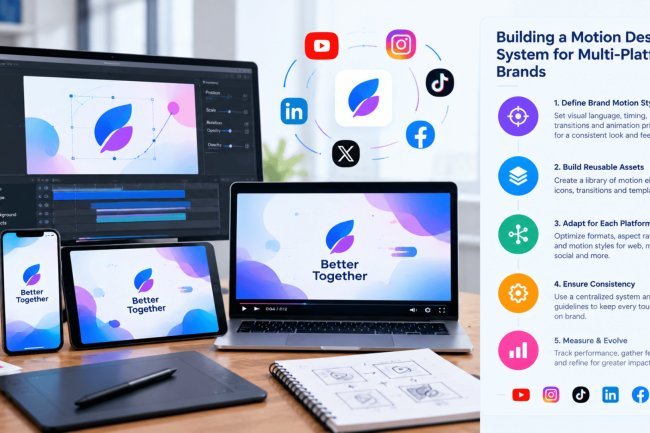
Why Motion Branding Is Becoming Essential for Digital- First Businesses
In a world where every brand competes for milliseconds of attention, stillness is a liability. Motion branding has evolved from a design trend into a strategic imperative — the new baseline for digital-first businesses that want to stay relevant, recognizable, and resonant across every screen they inhabit.

Motion & Digital Experience
The Attention Economy Is Already Animated
We don't read screens. We scan them. In a digital environment saturated with content, users make engagement decisions within moments. Motion has evolved from a decorative enhancement into a primary communication layer. A subtle animation, smooth transition, or responsive interaction instantly signals activity, relevance, and brand presence in ways static design cannot.
01 • HOW WE CONSUME CONTENT
Attention Happens Before Thought
Users evaluate digital experiences in fractions of a second. Static visuals compete using only color, typography, and composition. Motion introduces an additional dimension: timing. Small animations naturally draw attention because the human brain is wired to notice movement before conscious evaluation begins.
In crowded feeds and interfaces, motion becomes an immediate attention signal that helps important content stand out without demanding effort from the user.
02 • WHAT "ALIVE" FEELS LIKE
Motion Creates Emotional Signals
Thoughtful animation does more than entertain. It communicates responsiveness, quality, and care. A button that reacts to a click, a headline that enters smoothly, or a logo that gently animates communicates that the brand is active, modern, and attentive to detail.
These interactions create emotional reassurance. Users often perceive animated experiences as more polished, trustworthy, and intuitive because the interface feels responsive rather than static.
03 • THE COMPETITIVE REALITY
Static Feels Increasingly Invisible
As more brands adopt motion-first design systems, completely static experiences risk appearing outdated by comparison. When users move between dynamic interfaces and static ones, they often interpret the difference as a signal of innovation, relevance, or investment.
Motion is no longer a novelty. In many categories, it has become part of the expected user experience.
High-Impact Motion Principles
Subtle Over Excessive
Motion should guide attention, not compete with content.
Add Meaning
Every animation should communicate feedback, hierarchy, or progression.
Create Flow
Transitions should help users understand where they are and what happens next.
Reinforce Brand Personality
Motion style should reflect the brand's character, whether energetic, premium, playful, or professional.
Strategic Takeaway
Motion signals two things faster than almost anything else: change and aliveness. In a scroll-dominated attention economy, those are among the most valuable signals a brand can communicate. The question is no longer whether to use motion, but how intentionally and strategically you use it to guide attention, build trust, and create memorable digital experiences.
Static Identities Can't Keep Up With How Users Experience Brands
A brand is no longer a logo on a letterhead. It is a feed post at 11pm, a loading screen in a SaaS product, a digital billboard in Times Square, a push notification animation, and a microinteraction in a checkout flow — all in the same day. The surfaces have multiplied; the pace has accelerated. A static identity system simply was not designed to survive this kind of distributed, always-on exposure.
On Instagram, TikTok, and LinkedIn, content is consumed vertically and rapidly. A static frame competes against native video and animated carousels — motion is table stakes for stopping the scroll and earning even three seconds of attention.
Surface 2
Product UI
Inside digital products, brand identity lives in every transition, tooltip, and loading state. Motion here serves a dual purpose: it reinforces the brand personality while simultaneously guiding users through complex interfaces with intuitive visual cues.
Surface 3
Out-of-Home Screens
Digital OOH screens now line airports, retail environments, and transit hubs. These surfaces expect animation by default — a static frame on a digital billboard is, paradoxically, the thing that looks broken, incomplete, or unintentional.
The Unifying Problem
A traditional brand guide cannot prescribe how a brand should move, breathe, and respond in real time.
Identity must now flex across all of these surfaces simultaneously, adapting to format and context without losing coherence.
Motion Is the New Consistency
Social =
Stop the Scroll
UI =
Guide + Personality
OOH =
Expect Animation
The Shift: Motion From Decoration to a Behavioral System
Motion branding is no longer aesthetic wallpaper — it is a behavioral system. As Mitch Paone and Simon Chong argue, motion becomes powerful when it defines how a brand behaves, not just how it looks.
Motion as Brand Behavior
Every animated element communicates brand character. Precision brands use tight, mechanical easing; warm brands favor soft, organic transitions. Motion guidelines act like tone of voice — principles applied across surfaces, not just assets.
The Retrofit Mindset Problem
Motion added late produces fragmented results — inconsistent easing, mismatched logo animations, eroded recognition. The solution is to define timing, rhythm, and easing as core brand attributes from day one.
Motion Branding Benefits
What Motion-First Buys You: Recognition, Recall, and Smoother UX
The value of motion branding extends far beyond aesthetics. Thoughtfully designed animation improves how people recognize brands, navigate digital experiences, and interact with products. When motion becomes part of a structured design system, it creates a scalable advantage that strengthens both marketing performance and user experience across every touchpoint.
3×
Higher Engagement
Motion-driven content consistently attracts greater interaction than static creative.
80%
Better Recall
Visual motion helps information stay memorable long after the interaction ends.
50ms
First Impression
Motion helps fill the critical window where users form immediate perceptions.
RECOGNITION & MEMORABILITY
Motion Creates a Brand Fingerprint
Animated elements capture attention faster because the human brain naturally prioritizes movement. Over time, a brand's animation style becomes as recognizable as its logo, typeface, or color palette. The way a logo appears, a transition moves, or a headline enters the screen becomes a distinctive signature that strengthens brand recall and recognition.
NAVIGATION & UX
Reduce Friction Through Feedback
Motion helps users understand what is happening without requiring explanation. Loading animations provide reassurance, transitions communicate movement through an interface, and micro-interactions confirm successful actions. These subtle cues reduce cognitive load and make digital products feel more intuitive, responsive, and trustworthy.
MOTION SYSTEMS
Scalability Through Consistency
A documented motion system transforms animation from a creative expense into an operational asset. Instead of reinventing movement for every campaign, product launch, or platform, teams work within a unified framework that keeps the brand visually consistent at scale.
• Logo animation behavior and reveal patterns
• Standardized transition and interaction styles
• Typography and content animation guidelines
• Platform-specific motion principles for future formats
Strategic Takeaway
Motion-first branding creates three compounding advantages: stronger recognition, smoother user experiences, and scalable brand consistency. In a world where attention is won in milliseconds, motion does more than decorate a brand. It makes the brand easier to notice, easier to remember, and easier to engage with across every digital touchpoint.
Conclusion: Motion Is Now Baseline Infrastructure
The era of treating motion as a creative add-on — something you commission for a product launch video or a hero banner — is over. For digital-first businesses, motion is infrastructure. It is the connective tissue between brand identity and user experience, and it needs to be engineered with the same rigor and intentionality as any other core system.
The Costly Mistake
Build the System, Not One-Off Clips
The most common and costly mistake is producing motion assets project by project, without a governing system. Each clip might be beautiful in isolation, but without shared rules for timing, rhythm, easing curves, and platform-specific nuance, the accumulated output becomes visually incoherent. A motion system — documented clearly enough for in-house teams, agencies, and freelancers to execute independently — is the only way to maintain coherence at scale. Think of it as a grammar: individual animations are sentences, and the system is the grammar book that ensures they all sound like the same brand speaking.
Reason 1
Clarifies Story
Motion gives narrative a temporal dimension that static images cannot achieve.
Reason 2
Evokes Emotion
Pacing, rhythm, and easing create emotional resonance that text and color alone cannot.
Reason 3
Keeps Identity Recognizable
Motion ensures the brand feels consistent across social, product screens, OOH, and future surfaces.
The Four Pillars of a Motion System
Define duration ranges and rhythmic patterns that reflect brand personality consistently across all surfaces.
Choose easing functions that encode the brand's character — mechanical, organic, playful, or precise.
Adapt motion rules to each context: social, product UI, OOH — same principles, platform-appropriate expression.
Codify everything so any team, anywhere, can execute motion that sounds like your brand — without a briefing call.
The Bottom Line
Build the system now, document it rigorously, and treat motion as a first-class citizen of your brand architecture.
The brands that do will feel alive. The ones that don't will feel like they're standing still in a world that has already moved on.