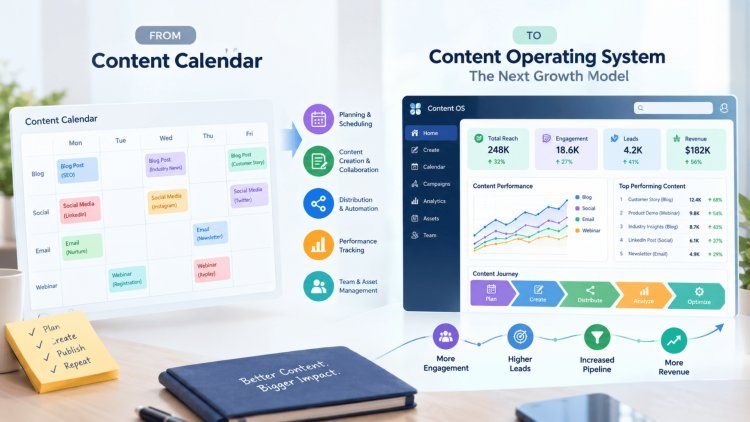
From Content Calendar to Content Operating System: The Next Growth Model
Most brands are still running content on a treadmill — producing, publishing, and repeating — without ever building anything that compounds. This presentation introduces a fundamentally different model: the Content Operating System, a unified architecture that transforms isolated content tasks into a self-reinforcing growth engine. Discover how leading digital teams are moving beyond editorial calendars and into structured, AI-augmented systems that generate measurable business outcomes.
The Era of Static Scheduling
For most organizations, content is still treated as a series of one-off deliverables: write an article, publish it, and move on. This reactive, calendar-driven model feels productive on the surface, but it masks a critical structural problem — nothing compounds, and nothing connects.
The Core Problem
Marketing blogs, support documentation, sales decks, and social content are created in isolation by different teams with different tools and different goals. Each piece of content is an island.
There is no shared taxonomy, no internal linking strategy, no unified narrative, and no feedback loop that routes audience signals back into the production process.
The result is an organization that spends enormous resources on content that delivers diminishing returns — high production costs with near-zero compounding value.
Three Symptoms of a Broken System
Marketing, support, and sales teams each manage their own content universe with no cross-functional alignment. A support article that could deflect 500 tickets a month sits invisible to the sales team that answers the same questions on calls.
Without a repurposing system, every new channel demands new original content. Teams burn budget creating from scratch rather than extracting maximum value from existing pillar assets.
Content that isn't strategically interlinked and refreshed decays in search rankings and audience relevance. Yesterday's effort doesn't serve tomorrow's pipeline.
Content Calendar Model
Isolated Assets
Team Silos
One-Time Value
High Production Demand
Declining ROI
Connected Assets
Unified Teams
Compounding Value
Strategic Repurposing
Growing ROI
Strategic Insight
Content should function like an ecosystem, not a collection of disconnected projects. Every asset should strengthen, support, and extend the value of every other asset.
Key Takeaway
The Digiverse Content Systems framework identifies fragmented silos as the single primary barrier to sustainable digital growth in modern organizations.
Connect → Repurpose → Compound → Sustainable Growth
Content Architecture
The Shift to Unified Architecture
Moving from a fragmented task list to a Content Operating System is not merely a workflow upgrade — it is a fundamental redesign of how your organization thinks about, produces, and measures content. The goal is to build a living system where every asset reinforces every other, and where the system itself becomes smarter over time.
From Fragmentation to a Connected System
Unified Content Model
▤
Static Calendar
Isolated posts with no linking
◎
Content OS
AI-ready, self-reinforcing, revenue-linked
⌘
01 / Structure
Hub-and-Spoke Architecture
At the core of the Content OS is a Hub-and-Spoke content structure. A single authoritative pillar asset — a long-form guide, a research report, or a definitive how-to — becomes the topical hub. From it, dozens of spoke assets radiate outward: short-form posts, video clips, email sequences, and FAQ pages. Every spoke links back to the hub, concentrating topical authority and dramatically improving search visibility. This structure signals deep expertise to both human readers and AI language models that increasingly power search and answer engines.
◈
02 / Accessibility
Designing for Human & AI Readers
Modern content must simultaneously satisfy human intent and AI retrieval patterns. Large Language Models (LLMs) are increasingly the gatekeepers of information discovery. A Content OS is architected with structured headings, semantic relationships, and clear entity definitions so that both a curious reader and an AI retrieval system can extract value accurately. Content that is structured for machines also tends to be clearer and more scannable for humans — a virtuous design constraint.
◎
Human Readers
Clear, scannable content that satisfies human intent.
⌘
AI Retrieval
Structured headings, semantic links, and clear entities.
↗
03 / Business Impact
Self-Service Education as Revenue Lever
One of the most underestimated benefits of a unified content architecture is its ability to deflect support volume and reduce sales cycle length. When prospects and customers can find authoritative answers independently — through strategically designed educational content — they arrive at sales conversations pre-qualified and at demos with fewer objections. This transforms content from a cost center into a measurable revenue enabler.
Unified Content Outcomes
✓ Deflect support volume
✓ Reduce sales cycle length
✓ Enable measurable revenue
The Foundation
Structured Architecture
⌘ Hub-and-spoke
◈ Semantic clusters
Mastering Agentic Workflows
The most significant competitive advantage in content over the next five years will not come from better writers or bigger budgets — it will come from superior systems design. Agentic workflows let human strategists set direction and quality standards while AI agents handle high-volume, repetitive execution. [429][430][434]
Human Role
Strategic Direction
- Define narrative pillars and topical angles.
- Set quality benchmarks and brand voice.
- Approve strategy and high-stakes decisions.
- Interpret performance data and refine the system.
Agent Role
Execution at Scale
- Generate first drafts and format conversions.
- Tag metadata and suggest internal links.
- Schedule distribution across channels.
- Extract clips, quotes, and derivative assets.
The 1-to-30+ Pipeline
One pillar asset.
A quarter of content.
Agentic Repurposing
A single 3,000-word strategic guide contains enough raw material to fuel an entire quarter of multi-channel distribution. The agentic pipeline extracts the thesis, supporting points, statistics, quotes, and frameworks, then reshapes them into platform-native assets. [463][464][466]
What the Pipeline Produces
Short-Form Video
LinkedIn clips, Reels, and YouTube Shorts with auto-generated captions. [463][469]
Social Threads
Threaded posts that surface key statistics and frameworks one insight at a time. [463][466]
Email Sequences
Newsletter sequences that drip the core argument over 4–6 weeks. [463][466]
FAQ & Support
FAQ and support articles addressing the questions the pillar raises. [458][459][461]
Sales Enablement
One-pagers that distill the value proposition for late-stage conversations. [463][466]
Podcast Prep
Talking points and interview-prep sheets for thought-leadership appearances. [463][466]
30+
Derivative assets per pillar through an agentic repurposing pipeline. [464][465]
↓40%
Potential support deflection when self-service educational content is strategically deployed; validate against your own ticket baseline. [456][458][461]
↑3x
Potential increase in content-attributed pipeline when tracking shifts from page views to deal influence. [462][453]
↓60%
Potential reduction in content debt through systematic audits and refresh cycles. [461][462]
Measure What Actually Matters
Production Velocity
Track assets produced per pillar, time-to-publish, and reuse rate. [461][466]
Pipeline Influence
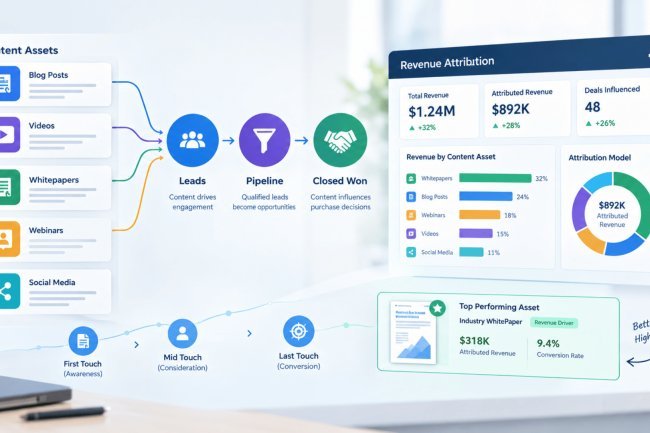
Track deals where content played a role at any stage, not just the final touch. [462][453]
Support Deflection
Measure the share of support demand resolved through self-service rather than a human ticket. [456][458][459]
The Bottom Line
Agents are not replacing creativity — they are eliminating the mechanical work that crowds it out.
Humans set direction, define quality, and interpret results. Agents generate, adapt, tag, distribute, and learn.
Content OS
The 90-Day Operating Loop
Sustainable content growth is not built in a single campaign sprint. It is built through disciplined, recurring 90-day execution cycles — each one designed to detect new opportunities, build and distribute assets, measure real outcomes, and feed those learnings back into the next cycle. This is how a Content OS compounds over time, getting smarter and more efficient with every revolution of the loop.
Detect → Design → Deploy → Measure → Prove ↺ next cycle
1
Detect
Conduct competitive gap analysis and keyword opportunity mapping. Identify where competitors are earning authority your brand should own. Flag underperforming owned content for refresh priority.
2
Design
Architect the quarter's Hub-and-Spoke clusters. Assign pillar topics, define spoke asset types per channel, and build the internal linking plan before a single word is written.
3
Deploy
Activate the agentic repurposing pipeline. Produce pillar assets, generate derivative formats, schedule distribution sequences, and publish with proper metadata and schema markup.
4
Measure
Track pipeline influence, content-assisted conversions, support deflection rates, and content debt reduction. Attribute revenue impact directly to specific content clusters.
5
Prove
Present evidence of business impact to leadership. Use data to secure budget for the next cycle and to refine the system's topical focus and channel mix.
90
Days per loop
Why 90 Days?
The 90-day cycle is long enough for content to accumulate meaningful search authority and pipeline data, but short enough to course-correct before a misaligned strategy compounds into wasted quarters. It creates a rhythm that aligns content teams with sales and product cycles, making cross-functional collaboration natural rather than forced. Each completed loop produces both assets and intelligence — the raw material for a stronger next cycle.
Organizations that commit to three or more consecutive 90-day loops consistently report that their content system begins to generate opportunities it was not explicitly programmed to capture — because the depth of topical authority attracts adjacent searches, media mentions, and inbound partnership inquiries organically.
Your Next Step
Start the Transformation
The gap between organizations running a content calendar and those operating a full Content OS is widening every quarter. AI tools are commoditizing individual content creation. The new moat is system design, strategic depth, and operational consistency — none of which can be replicated by a competitor with a better prompt.
Transform your digital marketing strategy today by integrating AI, search, and storytelling into a single, self-reinforcing business asset. Whether you are at the beginning of this journey or ready to move from a fragmented calendar to a full operating system, the architecture described here provides a proven path to compounding, measurable growth.
The organizations that will dominate their categories over the next decade are not those that publish the most — they are those that build the best systems. Your Content OS starts with a single 90-day loop. Begin today.