Virtual Product Photography: When CGI Beats a Physical Photoshoot
Physical photography used to be the unquestioned gold standard for product imagery — the studio, the lights, the stylist, the retoucher. But ecommerce changed the rules of the game entirely. Today, the real competitive advantage isn't just image quality — it's speed, consistency, and scalability delivered simultaneously across hundreds or thousands of SKUs. CGI and virtual product photography have quietly crossed a threshold: they no longer merely compete with traditional photoshoots. In many scenarios, they decisively outperform them. This presentation explores why that shift is happening, what it means for your catalog pipeline, and how to decide when virtual photography is the smarter investment.
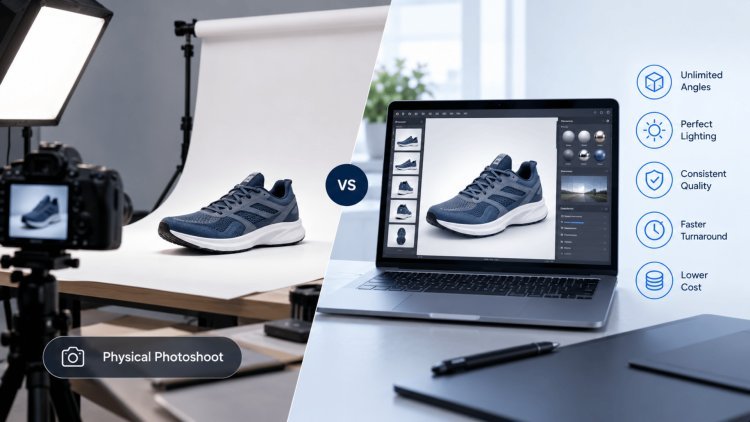
CHAPTER 1
The Old Standard — And Its Hidden Tax
For decades, physical product photography was simply how it was done. You sourced the product, booked the studio, arranged shipping and logistics, briefed the photographer, managed the shoot, and handed off to retouching — all before a single image could appear in a campaign. The process worked because catalogs were smaller, SKU counts were manageable, and the pace of retail was slower. But that world no longer exists for most brands operating at scale online.
The Traditional Photography Workflow
The Traditional Shoot Stack
Physical product must exist and be flawless before shooting
Logistics: shipping, handling, prep, and styling
Studio booking, photographer fees, and scheduling windows
Post-production retouching, color correction, and approval rounds
Repeat the entire cycle for every new SKU, angle, or finish variant
The Hidden Tax Nobody Talks About
Every new colorway, every seasonal refresh, every packaging update triggers a cascade of decisions: Do we re-shoot? Can we reuse old assets? How much will retouching cost to "fix" the differences?
These micro-decisions accumulate into weeks of delay and thousands in unplanned budget. For brands managing hundreds of SKUs, the hidden operational cost of traditional photography often dwarfs the visible line item of studio fees.
Visible Costs
Studio Fees
Photographer Costs
Retouching Charges
Styling Expenses
Hidden Costs
Launch Delays
Approval Cycles
Re-Shoots
SKU Maintenance
Lost Velocity
The Real Cost
The real price isn't the shoot — it's the drag on launch velocity that compounds quarter after quarter.
Looking Forward
Explore how CGI/VFX production services at Digiverse are designed to eliminate exactly this kind of operational friction from modern product pipelines.
Photography → Complexity → Delay → Lost Velocity
What E-Commerce Demands That Photos Can't Repeat Reliably
E-commerce catalogs have fundamentally different requirements than print catalogs or retail lookbooks. Online shoppers expect to see every color, every finish, and often every angle — on demand, instantly, at full quality. Traditional photography was not architected to deliver that. The result is a structural incompatibility between what modern retail demands and what physical shoots can sustainably provide.
THE VARIANT EXPLOSION PROBLEM
One product. Dozens of visual variations.
Theoretical production requirement
36
shoots to maintain visual consistency
!
When a manageable task becomes unscalable
In practice, teams cut corners — reusing shots with color overlays or inconsistent lighting setups — and the catalog quality suffers visibly.
Color and material swaps that should take hours instead require full reshoots, new samples, and new scheduling windows.
CATALOG-WIDE QUALITY
Consistency Breaks at Catalog Scale
Small variations. Visible impact.
Tiny variations in camera angle (even a degree or two), shadow softness, ambient color temperature, or background tone are invisible on individual images but jarring when viewed as a catalog grid. Shoppers perceive the inconsistency even when they can't name it — and it erodes trust in the brand's attention to detail.
↗
Camera Angle
Even a degree or two can create variation.
◐
Shadow Softness
Different shadows disrupt catalog uniformity.
☼
Color Temperature
Ambient lighting shifts the perceived product color.
▧
Background Tone
Subtle differences become obvious in a grid.
Physical shoots, even with careful briefs and the same photographer, introduce natural human and environmental variation that compounds across hundreds of assets.
THE SHIFT TO 3D
Why 3D Visualization Is Replacing Traditional Photography
As Digiverse's own catalog work demonstrates, this structural incompatibility is precisely why 3D visualization is increasingly the method of choice for modern product catalog needs. A 3D model is a master asset: once built, it can generate any angle, any color, any environment — with zero additional physical logistics.
01
Any Angle
Generate different product views from the same master asset.
02
Any Color
Create product color variations without repeating physical shoots.
03
Any Environment
Produce visuals in different environments without physical logistics.
THE REAL DIFFERENCE
The shift isn't about image quality anymore. It's about whether your content pipeline can keep pace with your product roadmap.
Chapter 3
Virtual Photography — Editing Time Into Your Workflow
The most misunderstood aspect of CGI product photography is not quality — it is the temporal advantage. With a validated 3D model, you are no longer dependent on product availability, sample shipping, studio schedules, or retouching queues. You are working with a reusable digital asset that can be revised, re-rendered, and repurposed across campaigns. [382][384][392]
85%
Reported potential saving on visual budgets when retailers adopt CGI at catalog scale. [383]
63%
Reported faster production cycles versus traditional photography pipelines. [383]
24–72h
Potential turnaround for new variants once the approved 3D model exists; validate against your own render pipeline.
The CGI Advantage Stack
Instant Flexibility
Adjust materials, finishes, lighting, and environments without a reshoot. [384][392]
Mathematical Consistency
Every render can share identical camera parameters, lighting rigs, and spatial relationships.
Pre-Launch Capability
Visualize products before physical samples exist — useful for pre-orders, investor decks, and launch planning.
360° & Interactive
Generate spins, animations, and AR-ready assets from the same master model. [392][393]
Long-Term Asset Value
The 3D model is a reusable investment across future campaigns and catalog updates. [384][385]
Catalog Scale
Reuse materials, lighting, and templates across variants and product families. [386][388]
The Example Workflow
From brief
to reusable asset
Define
SKUs & Shots
Build
3D Model
Approve
Materials & Light
Render
All Outputs
Select SKUs and define the shot list — angles, environments, and usage contexts. Provide technical drawings, reference photography, material swatches, and brand color standards. The 3D team builds the asset, presents a shading and lighting approval round, then renders stills, 360° spins, lifestyle composites, and channel-specific crops. [382][392][393]
One Model. Many Outputs.
Product
Stills
360°
Spins
Lifestyle
Composites
AR-Ready
Assets
The Bottom Line
Virtual photography does not just replace a photoshoot — it turns product imagery into a reusable, scalable asset system.
Build the model once, validate it carefully, and use it to produce every future angle, variant, environment, and format.
Hybrid Content Strategy
Don't "Choose CGI" Blindly — Choose the Right Pipeline
Virtual photography is a powerful tool — but like every tool, its value depends on using it in the right situations. The brands that win aren't those that wholesale abandon traditional photography, nor those that resist CGI out of habit. They're the ones who have built a deliberate, hybrid content strategy that assigns each method to the jobs it does best. Here's how to think about that decision clearly.
Virtual Photography
When to Choose CGI / Virtual Photography
✓
Pre-launch campaigns before physical samples exist
✓
Products with many color, material, or configuration variants
✓
Technically difficult materials: chrome, glass, black-on-black, translucents
✓
Long-term catalog consistency across large SKU libraries
✓
360° spins, animations, and AR/interactive content needs
✓
Global campaigns requiring localized background or environment swaps
Traditional Photography
When to Keep Traditional Photography
✓
Simple, in-stock products with minimal variation
✓
Lifestyle imagery where authentic human interaction matters
✓
Categories where tactile, real-world texture cues drive purchase confidence
✓
One-time hero shots where a small number of angles is sufficient
✓
Brand storytelling that requires genuine human emotion and spontaneity
The smartest pipeline isn't CGI vs. photography — it's knowing which product, which stage, and which channel calls for which method.
Which product → Which stage → Which channel
Map your catalog against these criteria and the right tool becomes obvious.
Ready to move your product visuals from a shoot-dependent bottleneck to a scalable content system? Visit Digiverse.studio and explore the full range of CGI and VFX production options available for product catalogs of every size.
For the full argument on why virtual photography is replacing traditional lightbox setups as the default for e-commerce, explore the broader 3D visualization work across the Digiverse portfolio — and see what a properly scaled visual pipeline actually looks like in production.