The UGC Creative Testing Framework for Paid Social Campaigns
Stop guessing which UGC will win — and start running tests that teach you what to scale. This framework gives paid social teams a repeatable, scientific system to isolate variables, interpret results, and build a compounding creative library that gets smarter with every campaign cycle.
The Problem: Testing That Can't Teach
Most paid social teams run creative tests — but very few run tests that actually generate learnable, actionable insight. The root cause is bundled variables. When you change the creator, the hook, the angle, and the format all at once, and one ad wins, you have no idea why it won. Was it the creator's energy? The opening line? The product angle? The format length? You can't know — so you can't replicate it intentionally.
Why Most Tests Fail
Creator Hook Angle Format → No Clear Learning
01
The Bundled Variable Trap
Changing multiple creative elements simultaneously — creator identity, hook copy, narrative angle, and ad format — makes results completely uninterpretable. You may know which ad won, but you have no idea why performance happened the way it did. This destroys the learning value of every test you run.
02
Ads Without a Question
When a creative test begins with "let's try a few different ads," rather than a specific testable question, the account is running a lottery — not an experiment. Without a pre-defined hypothesis, you cannot attribute outcomes to decisions. Each test must start with a clear creative question before a single brief is written or a creator is contacted.
03
The Cost of Unlearned Tests
Wasted spend is only part of the problem. The deeper cost is opportunity loss: months of ad spend that could have built a library of proven creative building blocks instead produced inconclusive data that no one can act on. Teams that test without structure repeat the same experiments and never compound their creative knowledge.
Random Testing
Multiple Variables Change
No Hypothesis
No Clear Cause & Effect
Limited Learning
Repeated Mistakes
Structured Testing
One Variable At A Time
Clear Hypothesis
Repeatable Insight
Actionable Learning
Compounding Knowledge
The Creative Learning Loop
Ask Question → Test Variable → Measure Result → Capture Learning → Scale Winner
The Fix
The fix is not to test less — it is to test smarter. A well-structured UGC testing framework treats every creative rotation as a deliberate experiment.
Learn more about how UGC creative strategy connects to performance in the full UGC Creative Testing Framework guide on Digiverse.studio.
Creative Testing Framework
The Science: Hypothesis + Isolated Variables
Scientific creative testing is not complicated — but it does require discipline. The core principle is borrowed directly from experimental design: one variable changes at a time, and the expected outcome is stated before results are seen. This transforms your creative process from intuition-driven to evidence-driven.
The Experimental Principle
01
State the hypothesis
Define what you expect before testing.
02
Change one variable
Keep other creative elements constant.
03
Keep conditions comparable
Make the results meaningful and transferable.
Three Rules for Reliable Tests
Rule 01 ↗
Write a Falsifiable Hypothesis First
Before you brief a single creator or write a single hook, write a one-sentence hypothesis that names: (1) the variable being tested, (2) the expected direction of impact, and (3) the reasoning behind that expectation.
Example Hypothesis
"A hook that opens with a problem statement will outperform a hook that opens with a product feature, because our audience identifies with the pain before they care about the solution."
This forces clarity and creates accountability for interpretation after results come in. Without this step, every test is just noise.
Rule 02 ⊙
Isolate One Variable Per Variation
Each creative variation in your test matrix should differ from the control by exactly one element — hook copy, creator identity, narrative angle, or ad format. Hold everything else constant.
✓
Testing hooks? Use the same creator, same offer, same CTA, same format length.
✓
Testing creators? Use the same hook script and same angle.
Violation of this rule produces "no usable learning" — a test outcome that cannot inform the next brief because causality is unclear. Isolation is the single most important discipline in creative testing.
Rule 03 ≋
Keep Tests Comparable
Signal pollution kills otherwise well-designed tests. To keep results interpretable, run variations under the same campaign objective and the same optimization event (e.g., purchase, not add-to-cart on one and purchase on another).
Keep Equivalent
Campaign objective Optimization event Offer Landing page message Creative context
If one variation points to a 20%-off offer and another to free shipping, you are testing offers, not creative — even if that was not your intention. Comparable conditions are what make test results transferable to future creative decisions.
5
The Takeaway
A well-written hypothesis takes 5 minutes and saves weeks of misinterpreted results.
Write it before the brief, not after the data comes in.
The System: A Repeatable UGC Test Loop
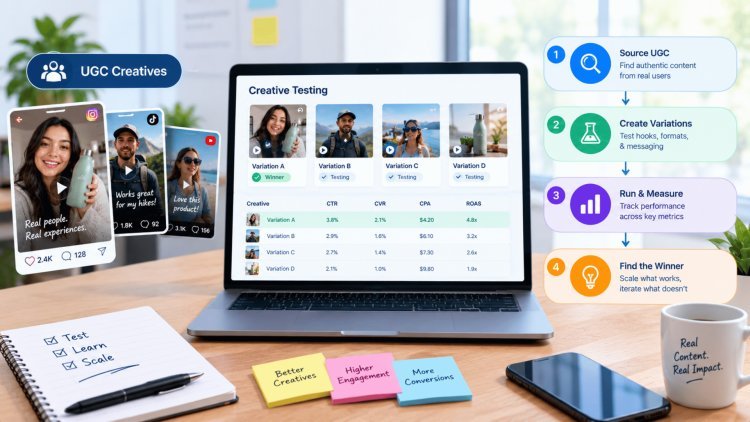
The best creative-testing programs are not one-off experiments — they are operational systems that run continuously, surface winners, and feed those learnings back into production. The UGC test loop follows a rhythm: launch, review, scale, refresh, repeat. Run consistently, it turns creative knowledge into compounding performance improvement. [314][316][321]
01
Phase 01
Launch the Initial Matrix
Start lean: 3 hooks × 2 creators = 6 variants. Test the highest-leverage variable — the hook — while controlling for creator variance. Keep non-test elements identical, launch variants under comparable conditions, and review at day 3–5 to catch clear losers before spend compounds. [314][316][325]
02
Phase 02
Apply Decision Rules Early
Define rules before launch: pause a variant at 2× target CPA with zero conversions, replace a hook when thumb-stop falls materially below baseline, and scale only when a variant reaches target CPA with enough volume to distinguish it from peers. Predefined rules reduce emotion and make reviews faster. [316][317][327]
03
Phase 03
Test Separately From Winners
Do not place new variants in the same ad set as proven, warmed-up performers. Scaled winners have accumulated optimization history and algorithmic momentum; new creative can be disadvantaged in the auction. Use a dedicated testing campaign or ad set so variants compete on more equal footing. [316][321][326]
Initial Matrix
3 × 2
Hooks × creators = 6 variants
How to Control the Test
Use identical scripts for non-test elements, launch all variants simultaneously, and keep audience, placement, optimization event, budget, and attribution settings consistent. Meta’s A/B testing approach divides audiences into random, non-overlapping groups so the tested variable is the meaningful difference. [314][316][320]
Predefined Decision Rules
Pause
Pause when cumulative spend reaches 2× target CPA with zero conversions.
Swap Hook
Replace the opening when thumb-stop is materially below the account baseline.
Scale
Scale when one variant reaches target CPA with sufficient conversion volume to distinguish it from peers.
Use thresholds appropriate to your conversion volume and account baseline. A day 3–5 checkpoint can catch obvious underperformers, but a final decision may require a longer window or more conversions depending on the objective. [317][328]
The UGC Test Loop
Launch
Matrix
→
Review
Day 3–5
→
Scale
Winners
→
Refresh
Losers
Repeat the loop. Feed winning hooks, creators, formats, and claims back into the next production cycle.
The Bottom Line
A UGC test loop does not just find better ads — it builds an compounding library of creative intelligence.
Launch controlled variants, apply rules early, isolate testing from scaling, and reinvest every learning into the next cycle.
The Payoff
Scale Winners, Build a Creative Library
The ultimate goal of the UGC creative testing framework is not just better individual ads — it is a compounding creative asset library built from proven building blocks. Every test cycle should end with at least one reusable winner: a hook that outperformed, an angle that resonated, a format that converted. When these winners are documented systematically, future creative briefs become faster, smarter, and lower-risk.
1
Variable Per Test
Isolate exactly one element per variation to ensure interpretable, actionable results.
3–5
Days to First Review
Review early enough to cut losers before spend compounds, late enough for meaningful signal.
2×
CPA Pause Rule
Pause any variant when spend reaches double target CPA with zero conversions — no exceptions.
Rotate Through the Loop
Kill, scale, whitelist, refresh — then repeat
1
Kill
Kill bottom performers quickly — do not let failing ads drain budget in hope of a late recovery.
2
Scale
Scale top performers by increasing budget incrementally (avoid large overnight budget spikes that reset optimization).
3
Whitelist
Whitelist winning creator content if your platform and creator agreements allow it, to extend reach with social proof intact.
4
Refresh
Then, critically, refresh the winning hook before fatigue sets in — swap the opening line while preserving the angle and offer structure that made it win. This preserves hold-rate and CTR while giving the algorithm fresh creative signal to optimize against.
Learning Log Mindset
Read outcomes as reusable insights
After each test cycle, log the result as a reusable creative insight, not just a performance number. Over 6–12 months, this log becomes one of your most valuable strategic assets — a library of what your specific audience responds to, built from your own data.
This is not documentation for documentation's sake; it is the institutional knowledge that allows new team members and agency partners to brief confidently from day one. Explore the full methodology at the UGC Creative Testing Framework on UGCContent.in.
What to Record
Element tested
Which single variable was changed.
Hypothesis
What the test predicted would happen.
What happened
The actual result against the prediction.
Winning element
Hook Angle Format CTA
The Growth Outcome
Modular UGC at Scale
The long-term compounding benefit of this framework is modular creative velocity. Because you have tested individual building blocks — hooks, angles, formats, CTAs — in isolation, you now know which components win. Future creative production becomes recombination of proven winners rather than blank-slate ideation.
A new campaign brief might say:
Hook A
from Q1 (problem-led)
+
Angle C
from Q2 (social proof)
+
Format 2
talking-head under 30 seconds
All of which have individual performance proof. This modular approach dramatically reduces production risk, speeds time-to-launch, and systematically improves baseline performance over time.
Start implementing this framework today and within 90 days you will have a living creative library built from real performance data — not guesswork.
Every test cycle makes the next one cheaper, faster, and more likely to win. Read the full framework breakdown on
Digiverse.studio to go deeper on creator briefing, hypothesis templates, and scaling decision trees.