The Short-Form Video Hook Science: Winning the First Three Seconds
In the attention economy, three seconds is an eternity — and a battlefield. Every scroll is a split-second verdict. This presentation breaks down the neuroscience, the mechanics, and the proven formulas behind hooks that stop thumbs dead in their tracks and compel viewers to keep watching.
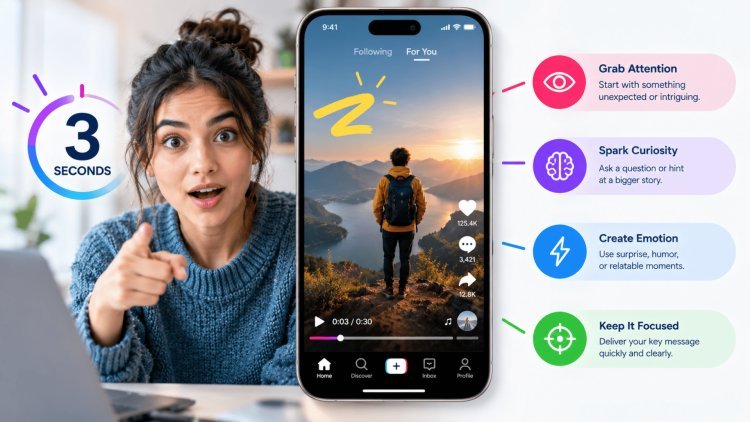
The Physics of the Scroll
Before a viewer consciously decides whether to keep watching, their brain has already made the call. Understanding the mechanics of this micro-decision is the foundation of every great hook strategy.
What Happens Inside The Scroll
01
The 0.3–0.8 Second Decision Window
Neuroscience research shows that the human brain processes visual stimuli and makes "engage or ignore" decisions in under a second — long before any rational thought kicks in. Your hook must trigger a primal emotional or curiosity response at the pixel level: movement, contrast, faces, or surprise are the raw signals that fire first. If your opening frame looks like every other video in the feed, the thumb has already moved on.
02
The Swipe Economy & Algorithmic Stakes
Platforms like TikTok, Instagram Reels, and YouTube Shorts are explicit about one metric above all others: the 3-second retention rate. This is the first algorithmic checkpoint. Content that clears this threshold gets pushed to wider audiences; content that fails gets buried in the recommendation void. Your hook isn't just for humans — it's a signal to the algorithm that your content is worth distributing. Every frame of those first three seconds is both a creative and a business decision.
03
The Cost of Failure: Drop-off Data
Platform analytics consistently show that 40–60% of viewers abandon a video within the very first second if the hook fails to land. That means the majority of your potential audience never sees your message, your offer, or your call to action — regardless of how strong the rest of the content is. A brilliant video with a weak hook is functionally invisible. The hook is not the intro; it is the content decision that determines whether everything else gets seen at all.
40–60%
Early Viewer Drop-Off
The Core Principle
The algorithm and the human brain share the same judge: the first three seconds. Win both, or win neither.
Attention → Curiosity → Retention → Distribution
SHORT-FORM VIDEO STRATEGY
The Anatomy of a Winning Hook
A great hook is not a single element — it's a precisely engineered stack of three simultaneous layers, each targeting a different dimension of human attention. Missing any one layer leaves a gap that competitors will exploit.
LAYER 01
Visual
Stop the scroll
LAYER 02
Verbal
Create curiosity
LAYER 03
Text
Win sound-off viewers
01 / VISUAL LAYER
Pattern
Interrupts
Make the brain ask, “wait, what's happening?” before it even realizes it has stopped scrolling.
The visual layer is your first line of offense against the scroll. Pattern interrupts — techniques that visually break the expected feed experience — are your most powerful tool. Starting mid-action (in the middle of a movement, gesture, or event) exploits the brain's "orienting response," a hardwired reflex to pay attention to change and incompleteness. Unexpected objects, extreme close-ups, unusual camera angles, or high-contrast color palettes all create the same neurological jolt.
VISUAL TECHNIQUES
Start Mid-Action
Open in the middle of a movement, gesture, or event.
High-Contrast Color Palettes
02 / VERBAL LAYER
Curiosity Gaps & Stakes
The verbal layer operates on the principle of the "curiosity gap" — the psychological discomfort of knowing something is incomplete. Phrases that open a loop ("The one mistake that's costing you…", "Nobody talks about this, but…") force the brain to seek closure, making continued watching feel compulsive rather than voluntary. Equally powerful is establishing stakes immediately: telling the viewer what they stand to gain or lose creates urgency. The brain is wired to prioritize threat and reward signals. A hook that activates both in the first sentence is almost impossible to ignore.
CURIOSITY GAP
“The one mistake that's costing you…”
OPEN LOOP
“Nobody talks about this, but…”
THE TWO DRIVERS
Curiosity
Creates an information gap that the viewer wants to close.
Stakes
Establishes what the viewer stands to gain or lose.
03 / TEXT LAYER
The Sound-Off Majority
Research from Meta and other platforms consistently shows that 69–85% of shortform video is watched without sound, especially in the critical first seconds before the viewer decides to unmute. This makes on-screen text not a nice-to-have, but a non-negotiable element of the hook. Text overlays must be large, legible, and immediate — appearing within the first 0.5 seconds, not as a slow fade-in. The text should mirror or amplify the verbal hook, not simply transcribe it. Think of it as a second hook running in parallel for a completely silent audience.
ON-SCREEN TEXT 0.5 SECONDS
STOP SCROLLING
ONE MISTAKE
COSTING YOU?
THREE LAYERS. ONE HOOK.
Visual
Interrupt the expected feed experience.
Verbal
Open curiosity loops and establish stakes.
Text
Deliver an immediate hook without sound.
Proven Formulas for Retention
While every great hook feels spontaneous, the best creators operate from repeatable structures. These three formulas — contrarian, outcome-anchored, and identity-call — are practical patterns for earning attention, but they should be tested against your own retention and conversion data rather than treated as universal laws. [254][258][260]
Formula 01
Contrarian Hooks
Invert a dominant belief to create immediate cognitive tension. Information that conflicts with an existing expectation can create dissonance, making the viewer want to resolve the contradiction. Keep it specific and credible: vague contrarianism reads as clickbait; precise contrarianism reads as insider knowledge. [260][263][264]
“Posting more is actually killing your reach.”
Formula 02
Outcome-Anchored Hooks
Lead with a specific, concrete result to signal real-world expertise. Specific numbers do the heavy lifting because they feel measured rather than invented. Use only outcomes you can substantiate, and show the method, timeframe, and context immediately after the claim.
“I grew my account from 0 to 47,000 followers in 61 days.”
Formula 03
Identity-Call Hooks
Name your exact target viewer in the opening line to trigger self-recognition. This trades broad reach for relevance: a smaller, well-matched audience is more likely to watch, save, share, and convert. The “cocktail party effect” describes how personally meaningful signals can capture selective attention. [254][255][259]
“This is for the introverted entrepreneur who hates cold outreach.”
How Each Hook Works
Contrarian
Creates a gap between expectation and claim. The viewer stays to see whether the claim is credible and how it is supported. [260][264]
Outcome-Anchored
Creates a credibility gap: the viewer wants the method behind a concrete, measurable result.
Identity-Call
Creates a relevance gap: the viewer recognizes themselves and expects advice tailored to their situation. [254][258]
Build It Well
Make the promise specific
Use one clear audience, one concrete tension or outcome, and one reason to keep watching. Avoid vague superlatives, unverifiable claims, and hooks that promise more than the video delivers.
Protect Trust
Pay off the hook fast
Deliver the promised insight within the first few seconds, then expand with proof, examples, and a practical next step. A hook earns attention; the payoff earns retention.
Test the Formula, Not Just the Idea
1
Write three hook variants
2
Keep the body identical
3
Compare 3-second & completion retention
4
Scale the winner
The Bottom Line
The best hooks do not chase attention — they create a specific reason to keep watching.
Contrarian hooks create tension, outcome hooks create credibility, and identity hooks create relevance. Use all three deliberately, then let retention data decide.
The Path to Mastery
Great hooks are not born from inspiration alone — they are forged through systematic testing, rigorous benchmarking, and an uncompromising editorial eye. Here is the operating framework used by the highest-performing creators across every platform.
The Mastery Framework
The single most powerful habit of elite short-form creators is systematic hook testing. The methodology is simple but rigorous: keep the body content of a video identical and produce four distinct hook variations — each using a different formula, a different opening line, or a different visual pattern interrupt. Publish all four and let the data speak. Within 24–48 hours, one hook will consistently outperform the others at the 3-second retention mark. That winning hook becomes your template for the next round of tests. Over time, this iterative process builds a personalized, data-validated hook playbook that is specific to your niche, audience, and platform — far more reliable than any intuition or trend-chasing.
Among professional creators and growth strategists, 70% retention at the 3-second mark is considered the minimum threshold for viral potential. Content above this benchmark gets favorable algorithmic treatment — broader distribution, higher placement in recommendation queues, and increased likelihood of appearing on Explore or For You pages. Content below it is effectively deprioritized regardless of quality. Monitor your 3-second retention rate in platform analytics obsessively. It is the single most actionable leading indicator of whether a piece of content will reach beyond your existing followers.
3
The Editorial Rule: Earn Every Word
The final and most demanding principle of hook mastery is also the simplest to state: every word in your hook must earn its place by adding tension, curiosity, or stakes. If a word, phrase, or sentence does neither — cut it without mercy. Filler language ("Hey guys, so today I'm going to be talking about…") is not just neutral; it is actively destructive. Every syllable of dead air or wasted text is an opportunity cost measured in drop-off percentage. The best hooks in the world are almost always shorter than their first draft. Edit like a poet. Treat silence and empty words as the enemy of retention.
Hook Performance Benchmarks
70%
3-Second Retention Threshold
The gold standard for viral potential — content above this mark receives priority algorithmic distribution.
40%
First-Second Drop-Off
The minimum viewer loss from a failing hook — underscoring why the opening frame is the highest-leverage creative decision.
85%
Sound-Off Viewers
Up to 85% of short-form video is consumed without audio, making on-screen text a non-negotiable hook element.
The Creator Testing Loop
Create 4 Hooks → Publish → Measure Retention → Keep Winner → Repeat
The Ultimate Lesson
The takeaway: Master the first three seconds and the algorithm becomes your distribution partner. Neglect them and even your best content stays invisible.
Testing + Retention + Editing Discipline = Hook Mastery