Advertising Transformation
The Great Shift: From Polished to Proven
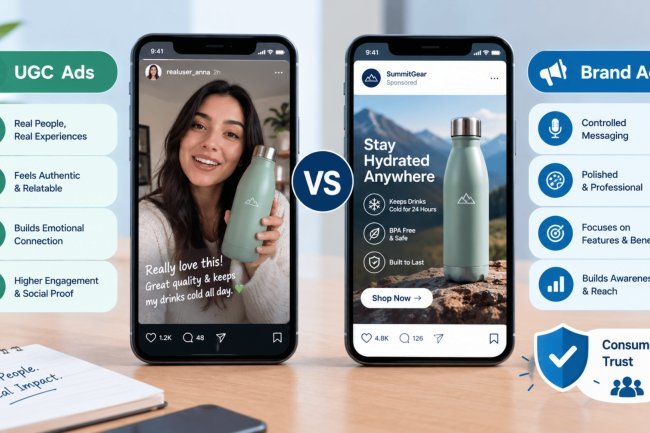
For decades, advertising was built on the belief that higher production value automatically created stronger credibility. Expensive shoots, professional actors, elaborate sets, and polished post-production became the standard formula for brand communication. Today, that assumption has fundamentally changed. Audiences increasingly trust content that feels human, relatable, and authentic over content that feels perfectly manufactured.
TRADITIONAL ADVERTISING
Built for Control
• High production value used as a credibility signal
• One-way brand-to-consumer messaging
• Studio-created and highly scripted execution
• Optimized for broadcast and passive viewing
• Long production timelines and large teams
UGC-STYLE ADVERTISING
Built for Connection
• Authenticity and imperfection build trust
• Conversational, recommendation-style messaging
• Real-person delivery and relatable storytelling
• Native to social feeds and mobile consumption
• Rapid production and continuous iteration
Why UGC-Style Content Wins
Consumers increasingly trust people who feel like real users more than highly polished spokespersons.
Natural delivery creates stronger emotional connection and higher engagement across social platforms.
Lower production costs make rapid testing and creative iteration possible at scale.
Content feels native to modern feeds rather than an interruption competing for attention.
2026 Reality
3–6%
UGC-Style Conversion Rates
Why Consumers Developed an Ad Filter
Modern audiences have been exposed to tens of thousands of advertisements across their lifetimes. That exposure has produced something brands didn't anticipate: a finely tuned psychological filter that identifies and dismisses commercial content almost instantly. Understanding this filter — and how UGC bypasses it — is the foundation of high-performance creative strategy.
!
Psychological Response 1
The Skepticism Trigger
The moment a consumer recognizes studio production hallmarks — perfect lighting, a scripted voiceover, celebrity endorsement, or branded motion graphics — their brain shifts into a defensive mode. Decades of exposure to polished advertising have conditioned audiences to associate high production value with persuasion intent. That association breeds distrust. Traditional spots don't just fail to convince; they actively signal “this brand is trying to sell me something,” triggering resistance before the message even lands.
Psychological Response 2
The Peer Recommendation Response
UGC-style content triggers an entirely different psychological pathway. When a video looks like it was shot by a real person in a real environment — shaky handheld camera, natural ambient sound, unscripted delivery — the brain processes it as a peer recommendation rather than a paid advertisement. Nielsen research consistently shows that 92% of consumers trust recommendations from people they know over any form of brand advertising. UGC aesthetics tap into that trust by mimicking the visual language of genuine personal sharing.
✓
Psychological Response 3
Bypassing Ad Blindness
Platforms like TikTok and Instagram Reels have trained users to scroll past anything that doesn't feel native to the feed. UGC-style ads are virtually indistinguishable from organic content — they use the same aspect ratios, the same editing rhythms, the same informal speech patterns. This native camouflage allows UGC ads to earn attention before the viewer's ad filter engages, giving the message a critical extra few seconds to hook the audience and deliver the core value proposition.
92%
Nielsen Research
Consumers trust recommendations from people they know over any form of brand advertising. UGC aesthetics mimic the visual language of genuine personal sharing to activate this trust.
Strategic Implication
UGC bypasses the ad filter by looking like a peer, not a brand.
The goal is not to hide that content is sponsored, but to earn enough initial attention and trust that the message lands before skepticism kicks in.
Metrics That Matter
UGC-style creatives consistently outperform traditional brand assets on every metric that drives revenue. Here’s what the data shows when brands make the switch.
4x
Higher Click-Through Rate — UGC ads generate four times the CTR of standard brand creative.
50%
Lower Cost-Per-Click — stronger engagement signals earn better distribution and lower auction costs.
20–50%
Reduction in CPA — Meta and TikTok campaigns report dramatic drops in cost-per-acquisition.
Why the Gap Exists
Platforms like Meta and TikTok reward engagement signals. UGC-style ads earn higher watch time, saves, shares, and comments — leading to preferential distribution, lower CPMs, and compounding advantages.
The Trust-to-Conversion Pipeline
UGC compresses the trust-building timeline. Genuine-feeling product reviews from relatable creators move viewers into consideration faster, narrowing the gap between impression and purchase intent.
Performance Marketing Reality
The Modern Bottleneck: Creative Fatigue
Even brands that have successfully embraced UGC-style creative face a growing challenge: creative fatigue. In the attention economy of 2026, audience attention decays rapidly, platform algorithms move faster, and high-performing ads have increasingly shorter lifespans. The brands winning at scale are not creating a single great ad. They are building systems capable of generating fresh creative before performance begins to decline.
CHALLENGE 01
The Fatigue Curve Is Getting Steeper
Social platforms repeatedly serve successful ads until audience engagement begins to decline. The problem is that users consume more content than ever before, causing recognition and dismissal to happen much faster. A creative asset that performs exceptionally during launch can become largely ignored only weeks later.
High-performing brands now treat creative rotation as an operational requirement, continuously introducing fresh concepts, hooks, and messaging variations to maintain performance momentum.
CHALLENGE 02
Why Traditional Production Can't Keep Up
Traditional production workflows were built for campaign perfection, not creative velocity. Long approval cycles, large crews, expensive shoots, and extended post-production timelines make it difficult to respond quickly when audience behavior changes.
By the time many traditional campaigns reach the market, the consumer attention window they were built for has already shifted. Production speed itself becomes a competitive disadvantage.
ADVANTAGE 03
The UGC Velocity Advantage
UGC-style production enables rapid experimentation at a scale traditional models cannot match. Multiple creative variations can be produced from a single brief, tested simultaneously, and optimized based on real audience feedback. Instead of betting on one concept, brands can continuously improve performance through iteration.
Test Hooks Rapidly
Identify which opening moments create the strongest watch time and engagement.
Iterate on Angles
Experiment with different problems, benefits, outcomes, testimonials, and audience motivations.
Refresh CTAs
Adapt offer language and calls-to-action to match changing market conditions and campaign goals.
Scale Winners Fast
Double down on proven creative while performance is still climbing, before fatigue begins to reduce results.
2026 Competitive Advantage
The winning brands of 2026 are not defined by a single viral ad. They are defined by their ability to learn, adapt, and launch new creative faster than competitors. In a market shaped by creative fatigue, sustained performance comes from velocity, iteration, and continuous testing rather than production perfection.
The New Era: AI and the Hybrid Engine
The convergence of UGC creative strategy and AI-powered production tools is creating the most significant shift in performance advertising since the rise of social media. For brands willing to build the right systems, 2026 represents an opportunity to turn creative output into a compounding competitive moat.
AI
Capability 1
AI-Powered UGC Production
AI video generators and synthetic avatar tools can now produce authentic-looking UGC-style ads in minutes. Scripts can be generated, tested, and refined at machine speed. Voice cloning and avatar synthesis enable endless creative variations without additional talent costs. What once required a full creator roster can now be executed by a single strategist with the right toolstack — enabling the volume of creative that modern paid social demands.
Capability 2
The Hybrid Creative Strategy
The winning formula for 2026 is not purely AI-generated nor purely human-made — it is hybrid. Strategic creative direction and authentic human moments combine with AI-assisted production and data-backed iteration cycles. This means using real creators for trust and relatability, AI tools for velocity and variation, and performance data to continuously feed learnings back into the creative brief. The result is content that feels genuinely human but is built and optimized with machine precision.
★
Capability 3
Creative as Competitive Advantage
In a media environment where CPMs are rising and audience attention is fragmenting, creative quality is the last remaining lever that brands can pull without increasing spend. The brands that build high-volume testing engines — shipping 15 to 30 creative variants per month, analyzing performance at the hook level, and iterating weekly — will compound their advantages over time while competitors who rely on quarterly campaigns fall further behind.
Your Next Move
Build a high-velocity creative testing engine that treats UGC-style content as a systematic, data-driven discipline — not a one-off experiment.
In 2026, creative is your primary competitive advantage. The brands that systematize it will win.
The Hybrid Engine in Practice
Real creators for
trust & relatability
AI tools for
velocity & variation
Performance data to
feed creative briefs