

We set out to build a practical, technical playbook for Instagram Ad Design Strategy that engineers, educators, and students can use right away. This guide focuses on making scroll-stopping ads that balance data-driven rigor with creative craft.
Instagram’s formats—Reels, Stories, and the Feed—shift how attention is captured. Platforms like Facebook Ads Manager let us control placements; Instagram Insights reveals what works. With social media ads increasingly rewarded by algorithmic engagement, well-designed creatives deliver measurable ROI.
Throughout this article, we will cover the psychology of attention, how to define audiences, core visual principles, copy techniques, and format-specific tactics for short video marketing. We’ll also show testing frameworks, compliance checks, and ways to measure creative-driven lift.
Key Takeaways
- We aim for ad designs that capture attention in the first two seconds.
- Use Instagram Insights and Facebook Ads Manager to align placements and metrics.
- Short video marketing (Reels) often boosts organic reach for social campaigns.
- Testing and iteration are essential: isolate variables and scale winners.
- Design with mobile-first rules, clear copy, and measurable objectives.
Understanding the Psychology Behind Scroll-Stopping Content
We study how viewers decide what to watch in the feed and apply that insight to create scroll-stopping ads. Research in visual cognition shows users form impressions in 50–150 milliseconds; the thumbnail or first frame often decides whether a user pauses. Clear composition and high visual contrast give immediate clarity on small screens, which improves the odds that social media ads get a second look.

Why first impressions matter on Instagram
The first 150 milliseconds act like a gatekeeper: if the creative reads fast, the viewer stays. We favor bold silhouettes, legible copy, and one dominant focal point so the brain can parse intent at a glance. This approach raises initial attention and improves subsequent metrics such as view-through rate and click-through rate for scroll-stopping ads.
Visual attention cues that trigger engagement
Human faces, especially eye gaze, redirect attention inside a frame. Close-up product shots beat busy scenes when conversion is the goal: they reduce cognitive load and highlight benefits. Movement—subtle pulls, parallax, or a changing color patch—signals novelty to an otherwise static feed.
High color saturation and contrast help creatives pop on mobile. We test a mix of close-ups, contextual lifestyle shots, and surprising placements to balance conversion and shareability. Novel contexts tend to increase shares, while clear product focus improves purchases for social media ads.
Emotional triggers and decision-making in short video marketing
Emotions drive fast choices. Curiosity, urgency, belonging, and aspiration are reliable triggers we use to craft micro-narratives. In 2–15 second reels the arc is compact: problem, hint of solution, and call to action. That arc maps to the affect heuristic—viewers rely on feeling to shortcut complex judgments.
Social proof works as a decision shortcut. Short testimonial clips or on-screen counts of users create trust quickly. We pair emotional triggers with clear visual cues so the creative aligns with both instinctive reaction and the advertiser’s conversion goals for short video marketing.
Defining Your Target Audience for Better Ad Relevance
We begin by grounding creative work in data. A clear sense of who we speak to sharpens every choice: imagery, copy, placement, and budget. Use measurable signals to turn intuition into precise targeting.

Using Instagram insights to build audience personas
We extract actionable audience data from Instagram Insights and Ads Manager: age, gender, location, active hours, saved posts, and engagement patterns. These fields reveal when users scroll, what content they save, and which posts spark comments.
Next we map those data points to technical audience personas. For example: a 25–34 urban shopper who saves product reels and engages after 7 p.m.; a suburban parent who clicks promos in the morning. Each persona becomes a targeting blueprint for social media ads and informs the Instagram Ad Design Strategy.
Segmenting by intent, demographics, and behaviors
Segmentation mixes demographics with behavioral signals. We layer past purchases, ad engagement, and website events tracked by the Meta Pixel atop age and location.
Intent markers sharpen the split: recent searches, cart adds, and time-on-site imply high intent. We recommend funnel-stage segments: awareness, consideration, and conversion. That structure aligns creative treatments with user readiness.
| Segment | Key Signals | Creative Focus |
|---|---|---|
| Awareness | Broad demographics, high reach, low site events | Bold visuals, brand hooks, short loops |
| Consideration | Saved posts, high engagement, product page visits | Benefit-driven messaging, demos, testimonials |
| Conversion | Cart adds, past buyers, email subscribers | Clear CTAs, offers, scarcity cues |
Testing creative variations for different audience segments
We assign tailored creatives to each segment and keep tests clean: change a single variable per experiment—visual, headline, or CTA. That discipline isolates what moves metrics for that group.
Measure segment-specific KPIs: engagement rate for awareness, CTR for consideration, and cost per conversion at the bottom of the funnel. Use iterative learning: promote top-performing segments into lookalike audiences to scale wins.
When we combine Instagram insights, precise audience personas, and disciplined testing, our social media ads reach becomes more relevant and efficient. That approach anchors an Instagram Ad Design Strategy built to learn fast and spend smarter.
Core Principles of High-Impact Visual Design
We focus on three foundational pillars that make Instagram ads stand out: visual hierarchy, readable type on small screens, and consistent brand cues that still allow creative play. These principles guide every creative decision so social media ads perform and scale.

Contrast, color, and composition to grab attention
Use contrast and color to separate the subject from the background: a bold foreground against a muted backdrop speeds eye capture. Warm tones like orange and red create urgency for limited offers; cool blues build trust for service-led messages.
Compose with rule of thirds and clear focal hierarchy. Place the hero where the gridlines intersect and lead the eye with implied lines. A single strong focal point reduces cognitive load and improves recall in Instagram ads.
Typography best practices for mobile screens
Design for small displays: choose fonts with high x-height and generous counters so letters stay distinct at 320–480px widths. Keep minimum on-image font sizes large enough to read at arm’s length—think 16–20 px visual equivalent for body text.
Limit typefaces to one or two per creative and avoid tight tracking. Short, bold headlines and restrained supporting text help scanning. Follow Meta’s readable text guidance and keep on-image copy concise to preserve clarity in social media ads.
Brand consistency without sacrificing creativity
Define core visual elements: logo spacing rules, primary palette, and hero treatment. Use these anchors to keep brand recognition high across formats and placements.
Allow experiments in layout, motion, and context so creative teams can test new approaches while preserving those anchors. For example, rotate background patterns or swap motion styles but keep color accents and logo placement constant to maintain coherence in Instagram ads.
| Design Area | Practical Rule | Expected Impact |
|---|---|---|
| Contrast and color | High subject-background contrast; warm colors for urgency, cool for trust | Faster attention capture; clearer CTA response |
| Composition | Rule of thirds, single focal point, visual hierarchy | Improved engagement; better recall and click-through |
| Mobile typography | High x-height fonts; 16–20px visual equivalent; 1–2 typefaces | Higher legibility; lower drop-off on small screens |
| Brand consistency | Fixed logo treatment, palette, and hero styling | Stronger brand recognition across campaigns |
| Creative flexibility | Experiment with layout, motion, and context within brand rules | Continuous creative improvements without brand erosion |
Crafting Compelling Copy That Complements Visuals
We focus on copy that amplifies design and drives action. Short, clear lines pair best with striking imagery in Instagram ads and short video marketing. Below we break down practical tactics for hooks, CTAs, and the balance between clarity and curiosity.

Writing effective hooks for captions and on-image text
A strong hook is concise, benefit-led, and visible within the first two lines of the caption or on-image text. Use one of three formats: a direct question, a bold statement, or a time-sensitive offer. Example hooks:
- Question: “Ready to cut your build time in half?”
- Bold statement: “This tool saves engineers two hours per sprint.”
- Time-sensitive: “Offer ends tonight: 20% off professional courses.”
For ad copywriting Instagram, place the core benefit in the first few words so the algorithm and the user grasp value instantly.
Call-to-action phrasing that improves conversion rates
CTAs must use action verbs and state the next step: Shop, Learn, Book. Match CTA phrasing to the campaign goal: awareness CTAs invite exploration, conversion CTAs reduce friction with incentives or micro-commitments. Tests often show clear CTAs can lift CTR by 12–25% when paired with an aligned offer.
- Awareness: “Explore the case study” — invites discovery.
- Consideration: “See the demo” — lowers commitment barriers.
- Conversion: “Start your free trial” — removes friction with a low-cost step.
When writing CTA phrasing for Instagram ads, be explicit about what happens after the click and, when possible, add urgency or a small reward.
Balancing clarity and curiosity in short-form messaging
Clarity must come first: users should instantly know the value. Curiosity can then nudge them to engage. Use teasers like “see how” or “watch what happened” after a clear benefit statement.
For Reels, align spoken lines, on-screen text, and caption hooks for redundancy and accessibility. In short video marketing, this redundancy increases retention and reduces misinterpretation on mute autoplay.
We recommend rapid experiments: swap three hook types and two CTA phrasings across small runs. Track engagement and conversion metrics to find the best mix for your audience.
Instagram Ad Design Strategy
We set the creative brief so it ties directly to business outcomes. A clear Instagram Ad Design Strategy keeps teams focused on measurable goals: awareness, engagement, or conversions. That focus guides every design decision and speeds up production.

We translate business goals into SMART creative objectives Instagram ads can use. For awareness we track CPM and reach. For engagement we measure engagement rate and video views. For conversions we track CPA and ROAS. Each metric maps to a design choice: bold thumbnails for reach, motion and hooks for engagement, and clear CTAs for conversion.
We choose ad formats with intent in mind. Reels work best for reach and organic-style storytelling. Carousels suit step-by-step demos or product catalogs. Static images win for single-offer clarity. Matching visual density, creative length, and CTA placement to the goal improves performance across social media ads.
We run a tight creative workflow to keep output fast and consistent. The sequence is brief → concept → rapid prototyping → internal review → A/B test launch → iterate. Templates in Figma or Canva let us produce multiple cuts: vertical edits, teaser stills, and caption variants. Modular assets reduce handoffs and save time.
We design A/B tests that isolate one variable at a time. Swap a thumbnail, change a CTA, or shorten a video by three seconds. Track engagement, CTR, and conversion to see which creative objective performs. Use winners as new templates so the next cycle starts faster.
We prioritize reusable systems: consistent grids, color tokens, and type scales. These systems support quick ad format selection and keep brand standards intact when teams scale. The result: higher output, clearer insights, and creative that meets measurable goals across social media ads.
Best Formats: Static Images, Carousels, and Reels
We choose formats by matching message, audience intent, and platform strengths. A concise format plan helps teams execute faster and measure what matters for Instagram ads and wider social media ads campaigns.

When to use static images for maximum clarity
Static images work when the goal is a single, clear message: a launch announcement, a limited-time offer, or a retargeting creative aimed at high-intent users. They load fast and reduce friction for users on slow connections.
Use bold headlines, a single visual focal point, and a direct CTA. For product launches at Apple, Nike, or Tesla, a single strong frame can outperform complex creatives by cutting cognitive load.
Leveraging carousels for storytelling and product demos
Carousels for storytelling shine when you need sequence: show a problem, demo a feature, then close with proof or a CTA. Keep the card count tight—four to six cards is ideal for maintaining momentum.
Design each card as a micro-story: headline, supporting visual, short caption. Track swipe-through rate and per-card engagement to spot where interest drops and refine the narrative.
Short video marketing with Reels to increase organic reach
Reels short video marketing taps Instagram’s algorithm for organic amplification. Use a hard hook in the first one to two seconds and aim for six to fifteen seconds for higher completion rates.
Include captions, natural sound, and a human element to mimic UGC. Best use cases: brand awareness, quick how-to snippets, and authentic testimonials that blend paid reach with organic momentum.
We recommend mixing formats across funnels: static images for conversion-focused retargeting, carousels for mid-funnel education, and Reels for top-funnel discovery. This blend optimizes spend and creative impact within Instagram ads and broader social media ads strategies.
Optimizing Visuals for Mobile-First Consumption
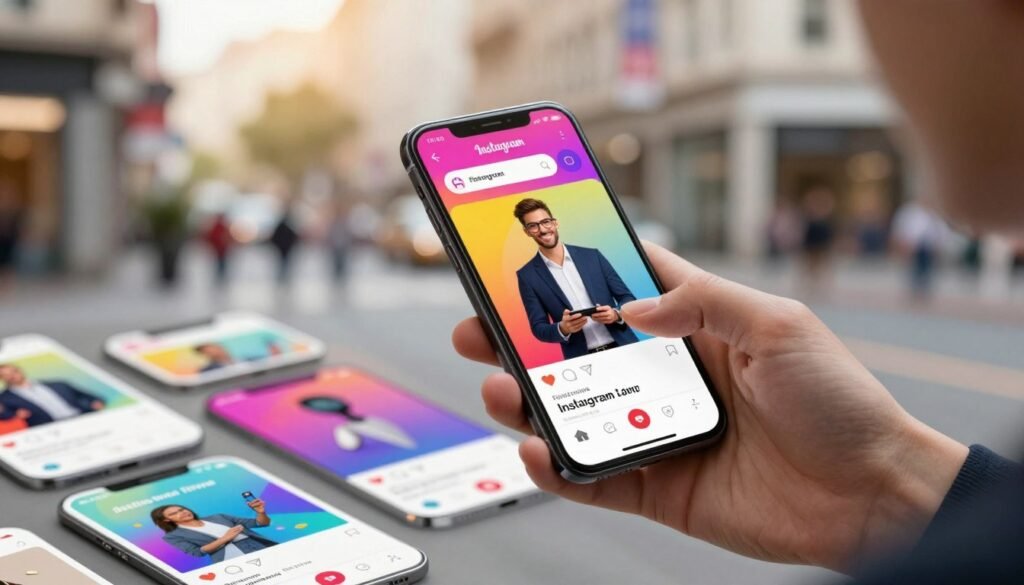
We design Instagram creatives with a mobile-first mindset: visuals must load fast, read clearly, and fit the screen without being cropped by interface elements. This short guide covers practical specs, performance tips, and thumb-friendly layouts so our Instagram ads work where attention is shortest and competition is highest.
Aspect ratios, safe zones, and on-screen text limits
Use 9:16 for Reels and Stories, 4:5 or 1:1 for Feed placements. These aspect ratios Instagram favors prevent unexpected crops across placements and ensure key content stays visible.
Keep important elements inside a 4:5 central safe zone for Feed and avoid placing logos or CTAs near the edges where the UI can overlap. Limit on-image text to one short line or a few words for legibility on small screens.
Always preview creatives on actual iPhone and Android devices. Real-device checks catch issues simulators miss: cropping, font size, and contrast problems that reduce impact.
Speed and filesize considerations to prevent drop-offs
Choose efficient codecs and formats: H.264 or HEVC for video, WebP or optimized JPEG for images. Good file size optimization reduces load time without obvious quality loss.
Balance bitrate and resolution: a 720–1080p video encoded with a moderate bitrate often outperforms a heavy 4K file by lowering buffering and keeping viewers in the experience. Faster load times directly reduce drop-off rates for social media ads.
Compress assets in production pipelines and test on mobile networks: 4G and constrained Wi‑Fi reveal how files behave in real conditions. Track load time versus engagement to tune compression settings.
Designing for thumb-driven navigation and attention spans
Compose vertical-first layouts that prioritize the top third of the frame: that area captures the eye during quick swipes. Place primary messaging and the main visual cue there.
Position tappable elements where thumbs naturally reach: lower-center and lower-right for Android, lower-center for most iPhone users. Make touch targets large enough to avoid mis-taps.
Use bold contrast, tight copy, and a single clear CTA to match short attention spans. For campaigns that blend organic and paid, design creatives that look native in feeds but drive measurable responses when tapped.
Using Movement and Sound to Enhance Engagement
We focus on practical ways to use motion and audio to make Instagram ads feel immediate and relevant. Small choices in the opening frames and in audio mixing change whether viewers keep watching. Below we outline tactics that work in short video marketing and for static assets turned into motion pieces.
Capturing attention in the first two seconds of video
The attention window is tiny: the video attention first two seconds often decides if a viewer scrolls on. Start with a bold visual cut, an unexpected action, or a close-up face that makes eye contact. For engineering teams, pay attention to frame-rate and motion continuity: 24 fps gives cinematic motion, 30 fps smooths quick actions, and 60 fps helps with slow-motion clarity.
Use a rapid onset of contrast or movement in that opening frame to trigger the brain’s orienting response. Test 0–2s variants to see which hook improves watch-through and click-through rates for Instagram ads.
When to include captions and accessible audio design
Most mobile viewers browse with sound off. Captions for Reels are essential: they boost comprehension and retention, and they increase CTR when paired with clear visual cues. Keep captions concise, readable on small screens, and synchronized with key frames.
Design audio for optional listening: normalize levels so voice, effects, and music maintain a consistent balance across placements. Use a clear vocal mix when sound-on is critical to the message. Follow accessibility best practices: offer captions, use descriptive audio when necessary, and avoid rapid-fire dialogue without visual support.
Subtle motion techniques for static creatives
Animate static ads with subtle parallax, micro-animations, or animated overlays to imply depth and life. Micro-movements—like a soft camera push, a gentle shimmer on product highlights, or a looping interaction—grab attention without distracting from the core message.
Production notes: keep animations under 3–4 seconds, design seamless loops, and preserve brand colors and typography. Optimize export settings to limit file size while maintaining motion fidelity so load times do not harm performance on Instagram ads.
Leveraging User-Generated Content and Social Proof
We rely on user-generated content to bring authentic voices into Instagram ads. Customer photos, testimonial clips, and unboxing footage carry higher perceived authenticity and often lift engagement in social media ads. When we mix these real moments with clear calls to action, we create social proof Instagram that nudges viewers toward trust and clicks.

Authenticity signals that drive trust and clicks
We prioritize raw moments over polished perfection: candid smiles, honest product demos, and short testimonial clips. These signals reduce skepticism and increase click-through rates for Instagram ads. Short-form UGC feels like a peer recommendation, which boosts the persuasive power of social proof Instagram.
Curating UGC for brand-safe advertising
We run a vetting workflow to protect the brand: check visual quality, confirm no trademark misuse, and verify tone aligns with our voice. Permission workflows and model/property releases are non-negotiable steps before any asset goes live. UGC curation helps us maintain creative control while preserving authenticity for social media ads.
Incentivizing customers to create shareable content
We design incentive programs that spark participation: product-based contests, time-limited discounts, and the promise of a feature on the brand’s Instagram profile. Clear submission guidelines and measurable goals—UGC submission rate, engagement uplift, and conversion tracking—turn casual contributors into reliable content sources for user-generated content Instagram ads.
We track performance and iterate: compare UGC variants against studio shots, measure lift in engagement and conversions, then scale the highest performers. A steady pipeline of vetted UGC keeps creative fresher and social proof Instagram stronger across campaigns.
Testing Creative Elements with A/B Experiments
We run systematic creative experiments to learn what truly moves our audience. A clear test plan saves time and budget: pick one variable, set sample-size and duration rules, and align the hypothesis with campaign goals. This approach fits into an Instagram Ad Design Strategy that prioritizes measurable gains and repeatable wins.
Design tests to isolate single creative variables: headline, thumbnail, CTA, color, or layout. Change only one element per experiment so differences in results map back to that variable. We recommend running tests long enough to hit statistical significance—use estimated traffic to set sample sizes and avoid premature decisions.
When we plan A/B testing Instagram ads, we set minimum cell sizes and run time windows based on expected impressions. Small audiences need longer runs; large audiences need fewer days. A rule of thumb helps: estimate variance, calculate needed conversions, then pick a test duration that balances learning speed with confidence.
Key metrics differ by objective. For awareness, prioritize view-through rate and engagement. For consideration, track click-through rate. For direct response, monitor conversion rate, CPA, and ROAS. Weight these ad metrics Instagram according to the campaign goal to avoid chasing vanity numbers.
We track a concise dashboard of ad metrics Instagram: engagement rate, view-through rate, CTR, conversion rate, CPA, and ROAS. Pair these with qualitative signals—heatmaps, comments, and retention curves—to understand why one creative outperforms another. This mix gives a fuller picture than any single KPI.
Interpreting test results requires statistical care. Use confidence intervals and lift analysis to assess winners. Look for consistent lift across multiple metrics, not just a single spike. When a creative shows reliable improvement, scale it—but continue to monitor for drop-offs.
Scaling winners is a staged process: increase budget in steps, introduce fresh variations, and rotate assets to prevent ad fatigue. Build rulebooks with thresholds that tell us when to pause, scale, or iterate: for example, pause at CPA above target or scale when CTR and conversion lift exceed set margins.
We treat creative experiments as a learning loop. Capture learnings in playbooks, map which design choices drove lift, and fold insights into the broader Instagram Ad Design Strategy. Over time, this disciplined approach to A/B testing Instagram ads sharpens creative quality and improves performance across all social media ads campaigns.
Ad Policies, Compliance, and Brand Safety on Instagram
We navigate a complex landscape when creating social media ads that perform and protect reputation. Clear understanding of rules and practical controls keeps campaigns running and brands credible. Below we outline policy red lines, accessibility steps, and brand safety measures that every team should adopt.
Common ad policy pitfalls to avoid
Meta’s advertising rules forbid misleading claims, discriminatory targeting, and copyright violations. We watch for exaggerated promises in health and finance offers and avoid before-and-after images that imply guaranteed results.
Restricted categories—dietary supplements, credit offers, medical products—require careful copy and substantiation. We check creative and landing pages for accurate product representation to prevent disapprovals and lost spend.
Ensuring accessibility and inclusive design in ads
Accessibility in ads broadens reach and reduces legal risk. We add captions to videos, provide descriptive alt text for images, and use high-contrast palettes guided by WCAG thresholds.
Readable fonts and clear audio make content usable for more people. Inclusive design also means avoiding exclusionary targeting and verifying that ad copy remains respectful to diverse audiences.
Maintaining brand safety across placements and partners
Brand safety Instagram requires proactive controls: placement exclusions, inventory filters, and vetted partners. We use Meta’s brand safety tools alongside third-party verification for large buys.
Contracts with agencies and publishers should state creative standards, ad compliance checkpoints, and escalation paths for incidents. Ongoing monitoring of placements prevents mismatches between brand values and contextual content.
| Risk Area | Common Pitfall | Practical Safeguard |
|---|---|---|
| Prohibited Content | Misleading health claims and unlicensed copyrighted material | Use legal review, require citations, and restrict creative that shows unrealistic results |
| Restricted Categories | Unsubstantiated finance or medical offers | Follow specific targeting rules, supply required disclaimers, and store documentation |
| Accessibility | No captions, low contrast, missing alt text | Add captions, follow WCAG contrast ratios, and include descriptive alt text |
| Placement Safety | Ads appearing beside harmful or irrelevant content | Set placement exclusions, apply inventory filters, and use third-party brand-safety verification |
| Partner Risk | Unvetted publishers and unclear contractual terms | Vet partners, mandate transparency, and include performance and compliance SLAs |
Measuring ROI and Iterating on Creative Strategy
We measure creative impact by linking clear metrics to design changes and by choosing attribution methods that match campaign complexity. A concise framework keeps teams aligned: pick an attribution model, run incremental tests, track cost per conversion trends, and refresh creative on a predictable cadence.
Attribution models relevant to social media ads
We compare last-click, multi-touch, data-driven attribution, and media mix modeling to understand how touchpoints contribute to outcomes. Last-click may undercount social influence for consideration-driven purchases. Multi-touch credits multiple creatives across the funnel. Data-driven attribution—used by Meta—weights signals from your account data and campaign patterns. Media mix modeling helps when offline channels matter.
Choose the model that fits purchase cycles and reporting needs: simple direct-response campaigns can use last-click for speed. Complex journeys require multi-touch or data-driven attribution to avoid misallocating budget.
Calculating creative-driven lift and cost per conversion
We isolate creative effects with incrementality tests: holdout groups, split tests, or Brand Lift studies. These experiments reveal creative lift and show how variations move metrics such as cost per conversion.
Key formulas we use:
- CPA (cost per acquisition) = Total ad spend ÷ Conversions
- ROAS = Revenue attributed to ads ÷ Ad spend
- Incremental lift (%) = ((Conversion rate_test − Conversion rate_control) ÷ Conversion rate_control) × 100
Link creative changes to cost per conversion by comparing CPA before and after a creative update while keeping targeting and bid strategy stable. Use control groups to avoid confounding factors.
Building a cadence for creative refresh and seasonal updates
We set refresh cycles between two and six weeks based on spend, fatigue signals, and performance decay. High-spend accounts may refresh every two weeks; smaller programs can stretch to six weeks.
Seasonal planning ties creative to product cycles and holidays. Create a calendar that aligns testing plans, budget windows, and distribution dates.
Log learnings in a creative library with notes on audience, format, and measured lift. This repository accelerates iteration and informs future Instagram Ad Design Strategy choices.
| Metric | Purpose | How to test | Action threshold |
|---|---|---|---|
| Cost per conversion | Measure direct efficiency | Compare CPA across creatives with identical targeting | Increase or refresh creative if CPA rises 15% vs baseline |
| Creative lift | Isolate creative effect | Holdout group or Brand Lift study | Adopt creative if incremental lift > 5% |
| Engagement rate | Signal creative resonance | A/B test visual and copy variations | Iterate when engagement drops 20% over cycle |
| Attribution alignment | Ensure reporting matches buyer journey | Compare last-click, multi-touch, and data-driven models | Move to multi-touch or data-driven if discrepancies exceed 10% |
| Refresh cadence | Prevent creative fatigue | Monitor performance decay weekly | Schedule refresh every 2–6 weeks based on signals |
Conclusion
We have mapped a clear path for strong Instagram Ad Design Strategy: start with the psychology of scroll behavior, define precise audiences, and apply core visual and copy principles that work on mobile. Choose formats—static, carousel, or Reels—based on your objective, and treat short video marketing as a primary channel rather than an afterthought.
Next, build scalable workflows: use modular assets and templates, prioritize accessibility, and run disciplined A/B tests so your creative strategy is data-informed. Leverage user-generated content and subtle motion to boost authenticity in social media ads while ensuring compliance and brand safety across placements.
Mastery is a craft that combines technical rigor with creative experimentation. We invite practitioners across engineering, education, and marketing to adopt iterative practices, measure creative-driven ROI, and share learnings. By doing so, we advance our mission to transform technical education through imagination and innovation—and raise the bar for Instagram ads everywhere.