

We created this guide to teach engineering professionals, students, and educators how to design social video ads that actually convert. Our focus is practical: Video Marketing Design principles that span strategy, creative, production, measurement, and compliance across Facebook, Instagram, TikTok, Snapchat, LinkedIn, and YouTube.
Throughout this how-to, we blend technical depth with clear examples so teams can move from concept to launch. We explain ad design choices, show patterns in video marketing and social media ads, and outline metrics that signal success. Our mission is to transform technical education through imagination and innovation—making complex creative and measurement topics accessible and actionable.
In the sections that follow, we break down audience analysis, scripting for short attention spans, visual storytelling, format specs, testing frameworks, and budgeting. By the end, you will be able to plan, produce, and optimize high-converting video ads with reproducible methods and templates you can scale.
Key Takeaways
- Video Marketing Design connects creative decisions to measurable outcomes.
- Effective ad design starts with audience insight and platform-specific formats.
- Short, clear hooks and mobile-first visuals boost engagement on social media ads.
- Testing and analytics turn assumptions into repeatable improvements.
- Compliance and brand safety are integral to scaling high-converting video ads.
Why Video Ads Matter in Modern Video Marketing
We see a clear shift toward short-form, mobile-first content. Meta reports rising watch time for Reels, TikTok shows steady user growth, and YouTube highlights short video consumption in its analytics. These social media video trends push brands to prioritize quick, scannable stories that work on phones.
Short vertical clips now dominate feeds. Average daily time spent on video content has risen, driven by on-the-go viewing and algorithmic recommendations. This rise favors creative formats that respect attention limits while delivering a strong message.
Trends in social media video consumption
Vertical formats outperform landscape on mobile, producing higher completion rates on TikTok and Instagram Reels. Platforms emphasize in-stream discovery, so content that hooks in the first seconds gains the most reach. Viewers expect fast pacing, subtitles, and bold visuals suited for sound-off environments.
Brands that adopt native editing styles—quick cuts, captions, and product overlays—see improved engagement. We watch platform reports and case studies from Meta and TikTok to guide creative decisions.
How video ads impact brand awareness and conversions
When creative aligns with intent, video ads accelerate brand recall and lift consideration. View-through rates and lift studies from platform advertisers show measurable gains in recall and conversion metrics when storytelling is clear and relevant.
Video marketing tightens the path from discovery to purchase. A strong hook raises recognition, persuasive messaging raises consideration, and an optimized call to action shortens conversion cycles. We recommend tracking view-through rate and post-view conversions to quantify performance.
Comparing video ads to static social media visuals
Motion grabs the eye. Eye-tracking studies show higher dwell time for moving imagery than for static posts. Video enables richer storytelling: pacing, tone, and demonstration are easier to convey in thirty seconds than in a single image.
Trade-offs exist: production cost and the need for sound-off optimization are real constraints. Static social media visuals remain efficient for broad testing and tight budgets. Use images for clear product shots and early funnel awareness where resources demand scale.
Practical takeaway: prioritize video when you need storytelling, higher recall, or mid-to-lower funnel performance. Choose static visuals for rapid A/B tests, low-cost reach, and simple messages that sell on sight.
| Use Case | Recommended Format | Primary Benefit | Key Metric |
|---|---|---|---|
| Top-of-funnel brand awareness | Short vertical video (6–15s) | High reach and recall | View-through rate |
| Consideration and education | 30–60s demo video | Stronger understanding of product value | Watch time and lift studies |
| Conversion and retargeting | Personalized short video or carousel stills | Higher conversion lift with tailored messaging | Post-view conversions |
| Low-budget scaling | Static social media visuals | Cost-effective reach and fast iteration | Click-through rate |
| Sound-off platforms or silent browsing | Subtitled vertical video | Accessibility and message clarity | Completion rate |
Understanding Your Audience for Higher Conversions
We begin by framing audience analysis as the foundation of any high-converting campaign. Clear data makes creative choices easier: who watches, on what device, and why they engage. This focus helps us align video marketing design and social media visuals to real motivations rather than assumptions.

Defining buyer personas for social platforms
We build data-driven buyer personas from demographic attributes, device usage, content preferences, and motivational drivers. Start with CRM exports to pull age, location, purchase history, and average order value. Combine that with surveys and customer interviews to capture goals and pain points.
Keep each persona short and actionable: core need, preferred platform, typical session length, and common objections. Use these profiles to choose tone, CTA, and visual style in your social media visuals.
Using platform analytics to identify viewer behavior
We rely on native dashboards to reveal viewer patterns. Facebook Insights and Instagram Insights show reach and engagement by post. TikTok Analytics highlights trending videos and completion rates. YouTube Studio reports watch time and retention curves. LinkedIn Campaign Manager surfaces professional demographics and conversion paths.
Focus on metrics that map to intent: watch time, retention by timestamp, click-throughs, and engagement spikes. Export retention curves to spot drop-off moments. Match those moments to creative beats in your video marketing design.
Segmenting audiences for tailored ad creative
We recommend three practical segmentation approaches: interest-based groups, behavioral segments built from past watch and engagement, and lookalike audiences modeled on top customers. Add retargeting layers for users who watched 25–75% or who clicked but did not convert.
Map creative variables to each segment. For cold lookalikes, use awareness-style visuals and broad benefit messaging. For engaged viewers, serve solution-focused ads with clear next steps. For high-intent retargeting, show proof points and a concise CTA tailored to device and session length.
Prioritize segments by lifetime value potential and test creative variations per group. Run small A/B tests to measure lift in conversion rate, then scale the winners into your standard video marketing design templates.
We treat audience analysis as iterative: refine buyer personas, recheck platform metrics, and rebalance segments by performance. This loop keeps social media visuals relevant and improves conversion over time.
Setting Clear Objectives and KPIs for Video Ad Campaigns
We begin by naming a single primary goal for each social video effort: awareness, consideration, or conversion. Clear campaign objectives shape creative choices and determine which ad design metrics we track.

Common objectives: awareness, consideration, conversion
Awareness targets reach and impressions. For these we favor broad creative: bold visuals, short hooks, high frequency. Consideration drives engagement and deeper watching. For that objective we test longer cuts and product demos. Conversion aims for clicks, signups, or purchases. Creatives here include a direct CTA and a friction-free landing path.
Choosing the right KPIs for each objective
Match KPIs to goals: for awareness use CPM, reach, and ad recall lift. For consideration track average watch time, 3s/6s/15s view rates, and engagement rate. For conversion monitor cost per conversion, conversion rate, and ROAS. We recommend primary and secondary KPIs so teams monitor both reach and downstream impact.
How to set realistic performance benchmarks
Build benchmarks from three inputs: historical campaign data, platform reports from Facebook, YouTube, and industry sources, and controlled cohort tests. Create three tiers of targets—conservative, realistic, aspirational—and assign a timeframe for evaluation.
Set alert thresholds for each KPI and define pivot triggers: if CPM or average watch time falls below the conservative tier after the test window, pause the creative and iterate. If conversion rates miss the realistic tier but CPM is strong, shift focus to landing page optimization.
We track ad design metrics alongside KPIs for video ads to keep creative and performance aligned. This pairing helps us rapidly identify whether a problem lies in creative, targeting, or offer.
Operational steps: record baseline metrics, run short A/B cohorts, document benchmarks, and review at fixed intervals. That process keeps video marketing efforts measurable, repeatable, and aligned with broader business goals.
Crafting Compelling Messaging for Short Attention Spans
We know social feeds demand rapid clarity. A tight messaging strategy paired with smart hook techniques turns a scroll into attention. Start by planning the first one to three seconds as a discrete experiment: a bold visual, a provocative question, or an unexpected motion that matches viewer intent.

Use hooks proven in high-performing campaigns: an overhead drone reveal for product context, a close-up of a problem being solved, or a quick counterintuitive fact that prompts curiosity. These moves work because they interrupt automatic scrolling and invite a micro-commitment: watch one more second.
For short formats we recommend a simple four-part script structure. Keep on-screen text and voice lines tight to aid comprehension and speed testing.
- Immediate hook: 1 shot, 1 question, or 1 striking motion.
- Concise value proposition: one clear benefit in 3–6 words on-screen.
- Social proof or demonstration: 3–5 seconds showing real use or a metric.
- Clear CTA: single verb phrase that tells the viewer what to do next.
Character and line guidance for on-screen text and voiceover: for 6s spots keep text under 30 characters; for 15s allow up to 60 characters; for 30s aim for 90–120 characters while breaking lines so each reads in 2–3 seconds. For voiceover, use 6–10 words for 6s, 12–18 words for 15s, and 25–40 words for 30s.
Emotional and rational appeals must work together. We open with emotion—aspiration, curiosity, mild surprise—to secure attention. Follow with rational benefits—specs, savings, performance data—to justify a decision, especially for engineering audiences who need proof.
Test variations of tone and complexity across segments: one test uses aspirational language with minimal specs; another leads with a data point then shows the human outcome. Track micro-conversions and time-to-click to see which messaging strategy performs best by audience slice.
Here are micro-script templates you can adapt for ad design and video marketing:
| Length | On-screen Text | Voiceover | Visual Cue |
|---|---|---|---|
| 6s | Cut build time in half | “Save hours now.” | Quick before/after fast cut |
| 15s | Faster prints. Better parts. | “Trim tool time 40%—see it in action.” | Close-up demo, speed overlay |
| 30s | From CAD to prototype—one workflow | “Integrate design, print, test. Cut cycles by 3x.” | Sequence: design screen → machine → user test |
When we craft messaging for short attention spans we balance urgency and clarity. Precise hook techniques, lean scripts, and measured emotional plus rational appeal create ad design that performs in modern video marketing.
Visual Storytelling Techniques for Social Media Visuals
We focus on tight, purposeful narratives that fit short attention spans. Visual storytelling for social media visuals must map to clear outcomes: pique interest, explain value, prompt action. Below we outline compact arcs and practical rules for video marketing design and ad design that work across feeds and stories.

Problem → solution → result: best for 15–30 seconds. Start with a one-line problem, show the solution in context, end with the measurable result. Use a fast rhythm and one strong visual per beat.
Moment-in-time: ideal for 6 seconds. Capture a single, surprising instant that implies a wider story. Use this for punchy hooks in feeds or bumper ads.
Before / after: great for 10–20 seconds. Show the gap, then reveal the transformation with a simple split or wipe. This arc works well for product demos and engineering use cases.
Curiosity-driven reveal: use 8–18 seconds. Tease with an odd detail, then reveal the benefit. This arc keeps viewers watching and boosts shareability.
Visual metaphors and motion
We translate complex systems into simple visuals: gears and schematics to imply efficiency, animated overlays to show data flow, and line graphs that animate to reveal progress. Metaphors make engineering concepts instantly graspable.
Kinetic motion guides attention: have key elements move toward the viewer, use subtle parallax to separate foreground and background, and apply easing to highlight causality. Motion reduces cognitive load and clarifies technical messages.
Layer animated callouts and micro-interactions to show cause-and-effect. For example, animate fluid lines to represent network throughput while a product shot remains steady. That contrast tells a technical story without lengthy narration.
Maintaining brand consistency
Define a concise identity kit: a core color palette, primary logo lockup, and a clear type hierarchy. Use the same logo treatment and color accents across every short spot to build recognition within two impressions.
Adapt pacing and framing without losing identity. Keep typography sizes legible at phone scale, preserve contrast for small screens, and use consistent voice and tone in captions and CTAs.
Create rules for variations: permit faster cuts for TikTok, steadier pacing for LinkedIn, full-screen bold graphics for Instagram stories. Each rule preserves brand signals while fitting platform constraints.
Practical checklist and transitions
- Check readability at 9:16 and 1:1 crops: large type, high contrast, short text lines.
- Limit on-screen text to three reading stops per 15 seconds.
- Use three transition types: snap cuts for energy, dissolves for continuity, and wipes for before/after comparisons.
- Keep the logo visible but unobtrusive for no more than 20% of runtime.
- Test thumbnails with the first frame and a branded badge to improve click-through.
Applying these techniques aligns video marketing design with measurable goals. When we pair crisp arcs with intentional motion and strict brand rules, ad design becomes efficient, repeatable, and effective across social platforms.
Video Marketing Design
We focus on design choices that lift performance without adding friction. Clear visual hierarchy guides the eye: strong headlines, contrast for calls to action, and consistent alignment. Using brand palettes with accessible contrast ratios keeps imagery emotional and legible across platforms. These principles of layout and typography form the backbone of effective ad design for social feeds.

Principles of layout, color, and typography for ads
Start with a grid to anchor composition: left-to-right flow for Western audiences and anchor points for key messages. Prioritize contrast between text and background to meet WCAG ratios so captions read on mute. Choose a primary typeface for headlines and a neutral secondary for body copy; limit weights to preserve clarity on small screens.
Motion rhythm matters: short, predictable movement draws attention without causing cognitive overload. Use color to signal emotion—blue for trust, orange for urgency—and reserve high-contrast accents for CTAs. These layout and typography choices help ad design convert under time pressure.
Designing for mobile-first viewing
Design in vertical frames first: 9:16 and 4:5 are primary for modern feeds. Keep logos and essential text inside safe zones to avoid cropping on different placements. Scale type so body text stays legible at typical phone viewing distances.
Optimize load speed by compressing assets and limiting layered effects. Shorter runtimes win: 6–15 second cuts often deliver higher completion rates on mobile. Test assets at 1:1 and 9:16 preview sizes to catch framing issues early. Mobile-first design means fewer surprises in real-world viewing.
Creating templates to scale ad production
Build modular templates in Adobe After Effects, Premiere Pro, Figma, or Canva. Create interchangeable hooks, overlay text modules, and swap-able CTAs to speed iterations across campaigns. Tag components for localization so teams can replace copy and assets without rebuilding layouts.
Adopt a versioning strategy: label locale, objective, and test variables so engineers and designers can A/B test quickly. Templates ensure consistency in social media visuals while enabling rapid experimentation and precise control over ad design.
| Design Area | Key Action | Tooling | Benefit |
|---|---|---|---|
| Visual hierarchy | Establish grid and anchor points | Figma, Sketch | Faster viewer comprehension and stronger CTAs |
| Color & contrast | Use brand palette with WCAG checks | Adobe Color, Contrast Checker | Improved legibility and emotional signaling |
| Typography | Limit families; set legible sizes | Google Fonts, Adobe Fonts | Consistent reading on small screens |
| Motion & rhythm | Short, consistent animation beats | After Effects, Lottie | Higher attention retention in short spots |
| Mobile-first framing | Design 9:16 first; test safe zones | Premiere Pro, Figma | Reduced cropping and better UX on phones |
| Template system | Modular components and versioning | Canva, After Effects, Figma | Scalable production and fast localization |
Ad Formats and Specs Across Major Platforms
We map platform formats and ad specs so production teams spend less time guessing and more time creating. Below we summarize the practical requirements for feed, stories, vertical-first channels, and B2B destinations. Keep this as a living reference in your production workspace to reduce rework and keep ad design consistent.

Facebook and Instagram feed and stories
Feed spots perform best at 1:1 for mixed placements. Stories and Reels demand 9:16 vertical files. Use MP4 or MOV with H.264 encoding. Keep file sizes under 4GB for safety; many teams target 500MB or less to speed uploads. For duration, aim for 6–15 seconds for Stories and up to 30 seconds for feed ads, depending on objective.
Place your visual hook within the first 3 seconds and select a clear thumbnail that reads on mute. Captions should stay concise: primary text under 125 characters and headlines near 40 characters to avoid truncation. These ad specs balance creative freedom with platform constraints and improve viewer retention in video marketing workflows.
TikTok and Snapchat vertical video considerations
Both platforms prioritize 9:16 vertical video and native, full-screen experiences. TikTok favors high frame rates and trend-aligned pacing; Snapchat values rapid cuts and native transitions. File types remain MP4 or MOV; target bitrates that preserve motion without inflating file size.
Sound is often on by default, so plan audio-first mixes while still adding captions for accessibility and silent impressions. Edit natively when possible: use in-app pacing, quick cuts, and on-trend transitions to match viewer expectations. These choices shape social media visuals that feel organic rather than overtly produced.
LinkedIn and YouTube format differences for B2B
LinkedIn leans toward professional framing and longer intros: 15–60 seconds is common when educating decision-makers. Use subtitles and conservative motion to keep attention. File types: MP4 with high bitrate for clarity. Thumbnail images should display the brand and a readable headline.
YouTube supports longer-form creative and higher resolutions: 16:9 is standard, 4K when quality matters. Understand skippable versus non-skippable in-stream ad specs: skippable ads perform well with a strong early CTA; non-skippable demands tighter storytelling under 15–20 seconds. For conversion-focused B2B campaigns, place CTAs both visually in the first 5 seconds and as end cards to guide action.
| Platform | Aspect Ratio | File Type | Recommended Duration | Creative Notes |
|---|---|---|---|---|
| Facebook / Instagram Feed | 1:1 (feed), 4:5 supported | MP4 / MOV | 6–30s | Hook early, clear thumbnail, captions for mute viewing |
| Instagram Stories / Reels | 9:16 | MP4 / MOV | 6–15s | Full-screen vertical, bold opening frame, native stickers ok |
| TikTok | 9:16 | MP4 / MOV | 6–60s (short preferred) | Trend-driven, sound-on expectation, native transitions |
| Snapchat | 9:16 | MP4 / MOV | 3–10s | Quick cuts, AR-friendly, high frame rate |
| 16:9 (preferred), 1:1 supported | MP4 | 15–60s | Professional framing, subtitles, educational tone | |
| YouTube | 16:9 (standard), vertical for Shorts 9:16 | MP4 / MOV | 6s bumper, 15–30s skippable, long-form for content | High resolution, clear CTAs, end cards for conversion |
Practical checklist: keep one living spec sheet per platform that lists aspect ratios, max file sizes, caption limits, and CTA placement. Train teams to consult the sheet before edit, frame, or export steps. This preserves time and aligns ad design with real-world ad specs.
We recommend regular audits of platform formats and a simple versioning protocol: tag masters by platform and date. That approach preserves quality across channels and makes scaling video marketing predictable and repeatable.
Optimizing Thumbnails, Captions, and Visual Cues
We focus on three creative levers that lift click-through and completion rates: thumbnails that stop the scroll, captions that work without sound, and visual cues that nudge action. Each element ties back to strong video marketing design and precise ad design decisions.
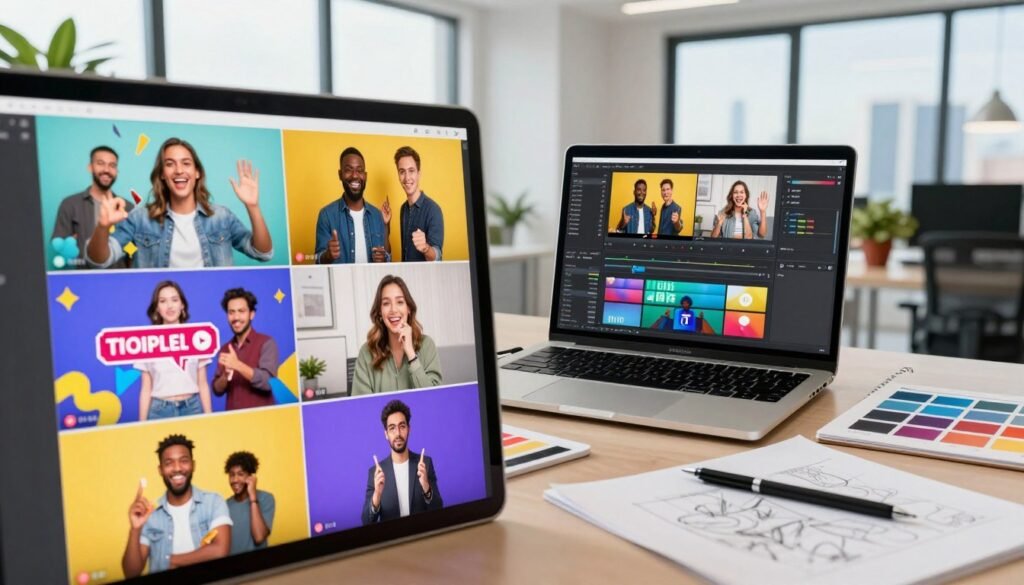
Designing clickable thumbnails for social scroll
Thumbnails must read fast on small screens. Use high contrast, bold typography, and a clear product shot or expressive face to create instant context. When platforms allow custom frames, upload a tailored image rather than relying on an auto-generated still.
Test intrigue elements: close-ups, mystery lighting, or a single short word. These drive curiosity without overpromising the creative inside. We aim for clarity and a single visual story so the thumbnail performs as a mini promise of value.
Using captions and text overlays for sound-off viewing
Captions need timing and accuracy. Keep on-screen text legible on mobile: large type, high contrast, and short phrases. Limit each overlay to two or three words when you use card-style frames to speed comprehension.
Align caption style with brand voice. For technical content, use plain language so engineers and students absorb the point in one glance. Ensure captions follow accessibility readability guidelines and consider audio descriptions for longer placements.
Visual cues and CTAs that guide viewer action
Motion cues like arrows, subtle pulses, and eye-line direction guide attention without distracting. End-frame CTAs should repeat that cue: a consistent button look, a clear command, and matching microcopy for the campaign goal.
Match CTA wording to intent: “Learn More” for consideration, “Get Demo” for lead capture, “Shop Now” for direct conversion. We structure visual cues so they work within fast scrolls and reinforce the ad design framework across placements.
| Element | Key Principle | Mobile Best Practice |
|---|---|---|
| Thumbnails | High contrast, single focal point, readable type | Custom frame, face or product close-up, bold text |
| Captions | Accurate timing, short phrases, accessible styling | Large font, 2–3 words per card, sync with edits |
| Visual Cues | Directional motion, consistent button styling, repeat CTA | Subtle pulses, clear end-frame button, concise command |
| Measurement | CTR, view-through rate, CTA clicks | Segment by placement, compare auto vs custom thumbnails |
| Accessibility | Readable captions, consider audio descriptions | Contrast ratio checks, caption accuracy validation |
Leveraging Sound, Voiceover, and Music
We shape audio to lift short-form spots into memorable experiences. Good sound design steers emotion, clarifies intent, and makes social media visuals feel professional. Below we break down when to use music, when to use voiceover, and how to balance both for engineering and technical audiences.

When to prioritize music versus voice
Music-driven pieces work best for emotional hooks, trend-led content, or brand awareness pushes. A tight track can drive tempo and keep viewers engaged during the first three seconds.
Voiceover becomes essential when explaining technical features, demonstrating processes, or guiding viewers through product benefits. Engineering audiences respond well to clear narration that reduces ambiguity.
Use both when you need warmth and clarity: music sets the tone, voiceover delivers the message. Mix levels so the narration remains intelligible without killing musical impact.
Choosing soundtracks that fit brand tone
Match tempo and instrumentation to brand personality: brisk electronic beats for innovation, organic acoustic layers for human-centered design, subtle synth pads for enterprise software. Thoughtful music selection preserves brand identity across campaigns.
Avoid overused stock tracks that dilute distinctiveness. Check licensing: use vetted libraries or platform-approved catalogs to prevent takedowns. Consider native tracks from Epidemic Sound, Artlist, or premium platform options when budgets allow.
We recommend mixing at -18 LUFS for online video and keeping peak levels below -1 dBFS. Export voiceover as 48 kHz WAV at 24‑bit when possible; MP3 at 192–320 kbps works for most ad platforms.
Accessibility: subtitles and audio descriptions
Captions must be standard for social feeds: they improve comprehension when viewers watch sound-off and boost retention for users with hearing loss. Use verbatim captions for dialogue and clear labeling for speaker changes.
Audio descriptions are valuable for longer or more complex videos. They narrate visual actions so blind or low-vision users understand nonverbal cues. Offer them where feasible to widen reach and comply with inclusive practice.
Measure sound-on versus sound-off performance in your analytics. Split tests that compare music-only, voiceover-only, and combined mixes reveal what drives conversions for each platform and audience segment.
| Element | When to Use | Mixing Guideline | Recommended File Specs |
|---|---|---|---|
| Music-only | Emotional hooks, brand awareness, trend content | Prominent but not overpowering; room for future VO if needed | WAV 48 kHz / 24-bit or MP3 320 kbps |
| Voiceover-only | Technical demos, instructions, B2B explainer ads | Clear, upfront; ambient bed at -10 to -15 dB under VO | WAV 48 kHz / 24-bit; mono acceptable |
| Music + Voiceover | Product storytelling with emotional and explanatory needs | Music at -20 LUFS, VO at -18 LUFS; sidechain for clarity | Mixdown WAV 48 kHz / 24-bit; deliver MP4 audio codecs per platform |
| Captions & Descriptions | All social placements; must for accessibility | Accurate timecode alignment; readable font size in visual design | SRT for captions; separate audio description file or extended track |
Testing Creative: A/B Testing and Multivariate Approaches
We design experiments that turn intuition into repeatable gains. In video marketing, a clear test plan frames what we want to learn: one variable per experiment when possible, sample size that supports statistical confidence, and success metrics defined before launch. Platform split-testing tools like Facebook A/B Test and Google Ads experiments help enforce clean splits and minimize bias.
Structuring tests for reliable insights
We isolate variables: change the hook while keeping script, soundtrack, and ad design constant. We calculate required impressions up front and pick primary KPIs—CTR for engagement, CPA for conversions, or ROAS for revenue impact. We run tests long enough to avoid daily noise and stop based on confidence intervals, not gut feeling.
Key creative elements to test (hook, CTA, visuals)
- Opening frame and hook — test attention-grabbing first two seconds versus contextual starts.
- Thumbnail and social media visuals — compare stills that show product use against lifestyle shots.
- CTA copy and placement — try direct CTAs versus softer nudges and measure lift.
- Ad design treatments — color, typography, and pacing changes that affect brand recall.
- Soundtrack and captions — test music-led spots versus voiceover-first executions for sound-off environments.
Analyzing results and iterating quickly
We interpret outcomes with lift percentages, confidence intervals, and cost metrics such as CPA and ROAS. Rolling tests keep learning continuous: move a winning creative into scale campaigns, then introduce a new hypothesis to the next test window. We document each run in a testing calendar so the creative testing program matures into an internal playbook.
Using Data and Analytics to Improve Ad Performance
We treat data as a design brief: numbers tell us where ad design succeeds and where it stalls. Good analytics cut through vanity signals like raw impressions and likes and point to actions that lift conversions. This section shows which performance metrics matter, how attribution clarifies impact, and ways to turn insights into better video marketing design.
Which metrics matter beyond vanity numbers
Track conversion rate and cost per action to measure direct returns. Add view-through conversions and incremental lift to capture influence beyond clicks. Watch time and retention curve shape reveal engagement quality: a flat retention drop at three seconds flags a weak hook.
Follow downstream metrics such as customer lifetime value and repeat purchase rate. These link short-term ad performance to long-term business impact. Impressions and likes are useful signals, but they rarely explain whether an ad moved a user toward purchase.
Attribution models for social video ads
Last-click attribution credits the final touch: it’s simple but often misleading for multi-touch journeys. Multi-touch and data-driven attribution share credit across touchpoints, delivering a fuller picture. Platform lift studies—like Facebook lift tests—measure incremental impact by comparing exposed and control groups.
Cookie-based tracking faces limits with browser changes and privacy rules. We prioritize first-party data and server-side tracking to preserve signal fidelity. Use platform APIs and clean room approaches when integrating data from Meta Ads Manager or Google Analytics 4.
How to translate data into creative changes
Turn metric insight into a repeatable workflow: insight → hypothesis → creative test → result. For example, a retention heatmap that shows a sharp drop at five seconds suggests moving the core value proposition to the first three seconds.
Use cohort analysis to find high-LTV segments and tailor messaging for them. If a cohort responds to technical proof points, shift ad design to emphasize product specs and use clear visual cues. If another cohort prefers emotional storytelling, rework pacing and soundtrack to match.
| Metric | What it shows | Creative action |
|---|---|---|
| Conversion rate | Direct purchases or signups from the ad | Simplify CTA, reduce friction in landing flow, test alternate CTAs |
| Cost per action (CPA) | Efficiency of spend per desired outcome | Reallocate budget to higher-performing creative and placements |
| View-through conversions | Influence without immediate clicks | Test longer-view formats and mid-roll CTAs in ad design |
| Retention curve / watch time | Where viewers drop off during the video | Re-time hooks, tighten edits, experiment with pacing in video marketing design |
| Incremental lift | True causal impact vs. organic behavior | Run lift studies before scaling creative investments |
| Customer lifetime value (LTV) | Long-term revenue from acquired users | Prioritize cohorts with higher LTV in creative targeting |
Recommended analytics stack: Google Analytics 4 for site behavior, Meta Ads Manager for platform metrics, and platform APIs for raw event data. Pair these with server-side tracking and a simple data warehouse to run cohesive attribution modeling.
We test small changes rapidly: A/B a new hook, measure shifts in retention and CPA, then roll winners into scaled campaigns. That cycle tightens the loop between analytics and creative, improving both ad design and ROI over time.
Budgeting, Bidding Strategies, and Ad Placements
We start with a clear rule for budgeting for video ads: reserve 10–30% of the budget for continuous creative testing, then allocate the rest to scale top performers. This balance keeps experiments running while funding winners on platforms like Facebook, Instagram, TikTok, and YouTube. Channel-specific budgets should reflect audience concentration and early performance data.
Allocating budget between testing and scaling
We break allocation into phases: discovery, validation, and scaling. In discovery, small CPC campaigns probe hooks and ad design. In validation, CPA or ROAS targets confirm which creatives convert. In scaling, higher spend goes to placements and formats that delivered reliable returns.
We recommend granular placement-level tracking so we can reassign funds quickly. Stories and Reels often deliver strong engagement. Feed and in-stream placements tend to drive consistent conversions for longer-funnel offers.
Bidding strategies for cost-per-click vs. cost-per-conversion
We use CPC bidding for traffic-focused tests when the goal is to sample multiple ad designs fast. For conversion-focused efforts, CPA or target ROAS minimizes cost-per-conversion and improves profitability. When campaign data reaches platform thresholds, automated bidding tools like Meta’s Advantage+ can boost efficiency.
Set bid caps to protect margins on high-volume buys. Dayparting helps with time-sensitive offers: increase bids during peak conversion windows and lower them off-hours. Geo-targeting and device segmentation refine bids by region and platform.
Placement optimization across feeds, stories, and in-stream
Placement optimization requires placement-level reporting: compare CPM, CTR, and conversion rates for feeds, stories, reels, and in-stream. We expect trade-offs: stories and Reels may show higher engagement but different conversion behavior than feed or in-stream spots.
Use experiments that hold creative constant and vary placement. If a creative converts better in-stream, shift more budget there. If Stories drive awareness but low conversions, pair them with retargeting in-feed ads. Small, frequent reallocations keep ROI moving upward.
We emphasize tactical controls: bid caps, dayparting, geo and device splits, and placement exclusions when quality is low. This mix of budgeting for video ads, smart bidding strategies, and precise placement optimization turns creative testing into scalable video marketing success.
Production Workflow for Efficient Ad Creation
We streamline the production workflow so teams move from brief to publish with fewer revisions and clearer checkpoints. Clear objectives, platform specs, and roles cut days from timelines and reduce costly reshoots. Below we map practical steps for pre-production, low-budget production, and post-production that align with modern video marketing design and the needs of social media visuals.
Pre-production checklist
Start with a tight brief: objective, target audience, and primary KPI. Draft a short script, sketch a storyboard, and build a shot list that matches each scene to an outcome. Confirm talent, location, and a full asset list—logos, fonts, product imagery—and capture platform specs for aspect ratios and durations. Create a timeline with approval gates for legal, brand, and platform compliance before rolling camera.
Low-budget production tips that look high-end
Use smartphone cameras paired with a compact external microphone to achieve crisp sound and sharp image. Employ practical lighting: softboxes, LED panels, and reflectors yield cinematic depth without studio costs. Build simple DIY rigs from tripods and gimbals for steady motion. Combine original clips with tasteful stock footage and lightweight motion design for polish. Apply an engineering mindset: iterate, test mounts and exposures, and solve framing or lens issues on set to elevate ad production on a tight budget.
Post-production best practices for mobile delivery
Work from a high-quality master file and export multiple aspect ratios from that master to fit feed, story, and vertical placements. Optimize resolution and bitrate per platform to balance quality and load times. Apply consistent color grading for brand cohesion across spots. Burn in captions and CTAs so social media visuals perform in sound-off environments. Use clear export presets and a file naming convention that encodes campaign, version, aspect ratio, and date for fast deployment.
We recommend collaboration tools such as Frame.io, Dropbox, and Google Drive for review and version control. Keep versions numbered and notes concise so editors and creatives iterate quickly. This approach tightens the ad production loop and improves delivery speed for campaigns built on modern video marketing design.
Compliance, Brand Safety, and Platform Policies
We treat compliance as a core part of creative strategy: it protects reputation, reduces risk, and keeps campaigns running smoothly across channels. Clear checks in the creative process help us meet platform policies from Meta, TikTok, YouTube, and LinkedIn while preserving strong brand safety standards. This short guide lays out common pitfalls, legal and brand checks, and practical monitoring steps for video marketing design and ad design teams.
Common policy pitfalls
- Prohibited content categories: violent, hateful, or adult material that violates platform policies and halts ad delivery.
- Misleading claims: unverified performance or health assertions that trigger account review under advertising rules.
- Intellectual property infringements: using third-party music, logos, or footage without licenses can cause takedowns.
- Restricted products: tobacco, certain supplements, and regulated goods require special handling or are disallowed.
Legal and brand compliance steps
- Substantiate claims with data and citations when required by FTC guidelines for endorsements and testimonials.
- Include mandatory disclaimers and terms in captions or on-screen text when legal or regulatory rules demand them.
- Maintain consistent logo usage, trademark spacing, and color treatments to protect brand identity in every ad design.
- Keep audit logs for approvals and any policy correspondence to support disputes and internal reviews.
Monitoring brand safety and placement quality
- Set placement exclusions and block lists to prevent adjacency to risky content categories.
- Work with vendors such as Integral Ad Science or DoubleVerify to verify contextual suitability and measure safety scores.
- Watch performance anomalies: sudden spikes in low-quality placements often signal unsafe adjacency or misaligned targeting.
Operational checklist for teams
- Create a creative review checklist that covers compliance checkpoints, copyright clearance, and required disclosures.
- Run a pre-launch policy scan against platform policies for Meta, TikTok, YouTube, and LinkedIn to catch platform-specific issues.
- Document approvals and maintain versioned assets so creative changes trace back to accountable reviewers.
- Schedule regular audits of live placements to confirm ongoing brand safety and to refine video marketing design choices.
We aim to make compliance and brand safety integral to the art of ad design. That approach reduces friction with platform policies and ensures creative performance scales without risking reputation or delivery interruptions.
Conclusion
We distilled the core of effective video marketing into a few practical rules: align objectives to creative, design for mobile-first viewing, and make Video Marketing Design a strategic priority. When ad design starts from a clear KPI, every element—hook, visual cue, soundtrack—serves a measurable purpose for social media visuals and conversion.
We encourage teams to adopt template-driven production and a disciplined testing cadence. Build repeatable assets, run controlled A/B and multivariate tests, and let analytics close the loop between performance and creative change. Measuring deeply beyond vanity metrics ensures we learn what truly moves the funnel.
Platforms and viewer habits will keep changing, so maintain a culture of experimentation and curiosity. As a next step, launch a pilot campaign using the checklist and templates from this guide and measure it against the KPIs you set earlier. Together, we accelerate learning, sharpen ad design, and make video marketing more efficient and impactful.