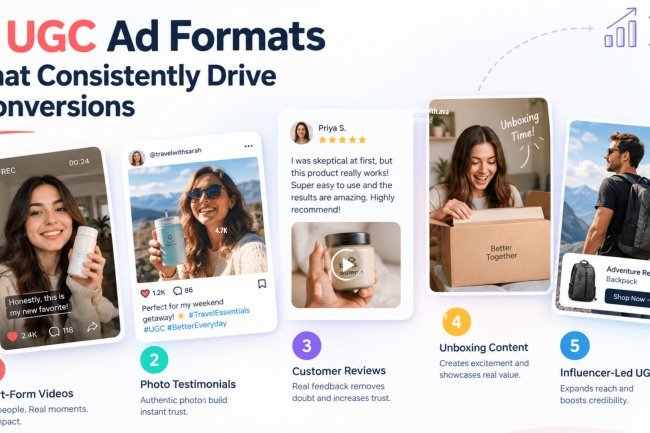
The Psychology Behind High- Converting UGC Campaigns
Why authentic, user-generated content outperforms polished studio production — and the cognitive science that explains every click, conversion, and sale.

Consumer Psychology
The Trust Crisis: Why Polish Fails
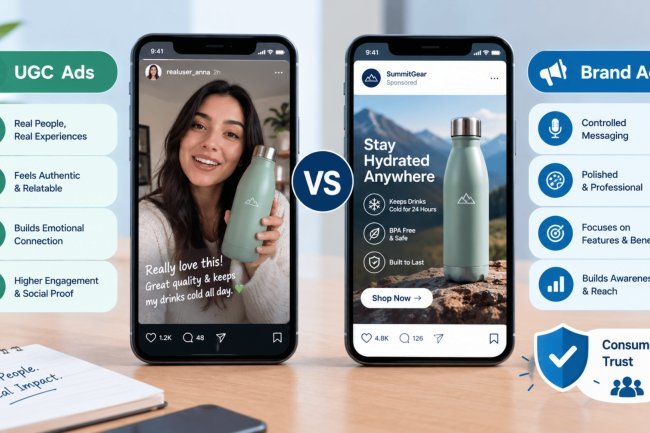
Modern consumers have developed an almost unconscious immune response to traditional advertising. The more polished and professionally produced a piece of content appears, the more clearly it communicates commercial intent. This creates one of the defining paradoxes of modern marketing: the budget invested in perfection can reduce the very attention brands are trying to earn.
01 • THE AD FILTER
Consumers Recognize Ads Instantly
Audiences have trained themselves to identify traditional advertisements within seconds. Perfect lighting, scripted dialogue, branded graphics, and highly controlled visuals now act as signals that activate skepticism. In many cases, the viewer dismisses the content before the actual message has a chance to be heard.
02 • COGNITIVE FLUENCY
Why UGC Feels More Trustworthy
User-generated style content blends naturally into social feeds because it resembles content people already consume from friends, creators, and communities. This reduces mental resistance and allows the message to be processed with less friction. The result is stronger retention, longer watch duration, and higher engagement levels.
03 • THE DATA SPEAKS
Performance Follows Perception
The advantage of authentic content is not merely theoretical. When audiences perceive content as genuine rather than overtly promotional, engagement improves and conversion costs decline. The performance gap reflects a deeper psychological reality: people trust recommendations and real experiences more than polished brand messaging.
4×
Higher CTR
Authentic UGC-style creatives consistently outperform traditional branded ads in attracting viewer engagement.
50%
Lower CPA
More relatable creative often reduces acquisition costs by increasing trust before the conversion moment.
Key Takeaway
The modern challenge isn't producing more polished content. It's producing content that feels believable. In a feed dominated by social interactions, authenticity has become a stronger trust signal than production quality. The brands that win are the ones that look less like advertisers and more like people worth listening to.
The Five Cognitive Levers of Conversion
High-converting UGC doesn't happen by accident. Behind every viral testimonial or breakout creative is a deliberate psychological mechanism. Understanding and intentionally activating these five cognitive levers is what separates campaigns that scale from those that plateau.
1
Lever 1
Social Proof Cascade
The bandwagon effect
When potential buyers see that people like them — same demographics, same struggles — have already adopted a product, the perceived risk of purchase collapses. UGC creates an ongoing cascade: each new piece of authentic content reinforces that adoption is the norm, not the exception. The brand stops being a choice and becomes a consensus.
Lever 2
Pattern Interrupts
Counterintuitively, “ugly” content performs. Shaky handheld footage, imperfect framing, and ambient background noise all function as pattern interrupts — they break the scroll rhythm precisely because they don't look like ads. The brain, wired for novelty and social relevance, pauses to evaluate. High-resolution, perfectly-lit creative gets filtered; the slightly-off, candid clip demands attention. Imperfection is a feature, not a flaw.
2
Lever 3
Similarity Bias
People trust people who remind them of themselves. Aspirational casting — flawless models in idealized scenarios — creates psychological distance that suppresses conversion. UGC campaigns that cast for genuine resemblance to the target audience activate similarity bias, making the viewer think “if it worked for someone like me, it will work for me.” Strategic casting and creator selection is as important as the script itself.
4
Lever 4
Authority Anchoring
Micro-influencers operating in specific niches carry a disproportionate trust premium. A fitness coach with 12,000 followers recommending a supplement brand anchors that brand within an expert context — authority transfers by association. This is far more powerful than celebrity endorsements, which consumers correctly read as transactional. Niche credibility is earned, not purchased, and audiences can tell the difference.
Prospect theory tells us that losses feel approximately twice as painful as equivalent gains feel pleasurable. The most effective UGC hooks don't just sell the dream — they illuminate the cost of inaction. Scripts and concepts that frame the product as the solution to ongoing, compounding pain force a different decision calculus: what am I losing every day I don't act? This urgency is authentic, credible, and psychologically irresistible when delivered by a real person who has experienced the pain firsthand.
Design Principle
Activate these levers deliberately, not by accident.
High-converting UGC is engineered psychology — each lever pulls the viewer closer to a confident, low-risk decision.
Architecting the Emotional Arc
Every high-converting UGC piece follows an emotional arc: a pain state the viewer recognizes, a desired identity they aspire to, and credibility signals that make the transformation believable.
Pain State
Viewer’s current frustration or insecurity
Transformation
Desired identity the product enables
Credibility
Specific lived-experience details prove authenticity
Beauty & Skincare
Insecurity → Confidence. Product delivers visible, socially validated transformation.
Tech & Productivity
Frustration → Capability. Pain of inefficiency resolves into control, speed, and competence.
Fitness & Wellness
Stagnation → Transformation. Product becomes catalyst for becoming someone new.
UGC Performance System
Engineering for Performance: The Testing Framework
Great UGC creative is not discovered by luck. It is engineered through systematic testing. The highest-performing brands treat every creative asset as a hypothesis and optimize one variable at a time, ensuring that insights compound rather than conflict. This framework moves from core psychology to execution, creating a repeatable process for scaling performance.
1
Phase 1: Hook Bias Testing
The first three seconds determine whether a viewer continues watching or scrolls away. Begin by testing competing hook biases against the same audience, offer, and landing page. Compare curiosity-driven openings against loss-aversion openings to identify which psychological trigger creates the strongest engagement. The winning bias becomes the strategic foundation for future creative in that audience segment.
2
Phase 2: Angle & Arc Testing
Once the strongest hook bias has been identified, test the emotional angle driving the body of the video. Different audiences respond to different motivations: financial loss, missed opportunity, convenience, status, achievement, or risk reduction. The winning angle defines the emotional core of future creative, ensuring consistency across campaigns while maximizing relevance.
3
Phase 3: Persona & Format Testing
Only after psychology is validated should you test execution. Evaluate different creator personas such as experts, customers, peers, or skeptic-turned-believers. Then compare content formats including tutorials, testimonials, walkthroughs, reactions, and product demonstrations. With the winning hook and angle already established, format becomes a multiplier rather than a variable clouding the data.
4
Continuous Refresh: Managing Creative Fatigue
Every winning creative eventually loses effectiveness. Frequency saturation, declining click-through rates, and rising acquisition costs signal that creative fatigue is emerging. Refresh surface-level elements such as hooks, visuals, creators, and editing patterns while preserving the psychology, emotional angle, and conversion framework that already proved successful. Refresh the execution, not the strategy.
Testing Sequence
Hook Bias → Angle & Arc → Persona → Format → Refresh & Scale
Performance Principle
The strongest paid social programs are built on structured experimentation. Test one variable at a time, preserve winning psychology, and refresh creative before fatigue appears. Sustainable growth comes from a repeatable testing system, not occasional creative breakthroughs.
Conclusion: From Art Project to Science Experiment
The brands winning with UGC in 2024 and beyond are not the ones with the biggest creative budgets or the most aesthetically refined feeds. They are the ones that have internalized a fundamental reframe: UGC is not a content strategy — it is a psychological engineering discipline. Every creative decision maps to a cognitive mechanism, every test generates learnable data, and every scaling decision is evidence-based.
✕
Imperative 1
Stop Decorating
A single polished hero shot built for brand aesthetics contributes almost nothing to conversion at scale. What converts is a gallery of authentic UGC — diverse creators, diverse formats, diverse angles — each piece targeting a specific psychological lever for a specific audience segment. Build volume deliberately. The winning ad is rarely the most beautiful one; it's the one that made someone feel seen at exactly the right moment.
Imperative 2
Stop Polishing
Production quality has an inverse relationship with credibility at the volume and velocity that paid social demands. The offhand framing, the ambient room noise, the creator glancing away before they find their words — these are not imperfections to be edited out. They are the credibility signals that tell the viewer's brain: this is real. When you smooth these moments away, you sand off the very texture that makes UGC work. Embrace the rough edges — they are the product.
→
Imperative 3
The Call to Action
Audit your conversion funnel for trust gaps. Systematize your creative testing — treat every new UGC piece as a hypothesis in a running experiment. Scale only what the data confirms — not what feels right, but what the psychological testing framework has proven converts the target audience at the lowest possible cost.
The Bottom Line
The shift from art project to science experiment is not a creative downgrade — it is the highest form of creative discipline.
When psychology guides production and data guides scale, UGC becomes the most powerful performance asset a brand can own.