UGC Ads vs Brand Ads: Which Builds More Consumer Trust?

In the era of algorithm-driven feeds and ad-fatigued audiences, trust has become the ultimate marketing currency. The question is no longer just what you say — it's who says it and how it's delivered. Brands are investing millions in polished creative, yet a shaky smartphone video from an everyday consumer often outperforms it. Why? Because trust isn't created by better production values — it's created by perceived realness and social proof. When a consumer sees someone like themselves talking about a product, the psychological filters that block traditional advertising simply don't activate the same way. This presentation unpacks the science, the evidence, and the strategy behind UGC vs. Brand Ads — so you can make smarter decisions about where to invest your creative budget for maximum consumer trust.
UGC Ads vs Brand Ads: Which Builds More Consumer Trust?

The Trust Gap: Why "Real People" Land Differently

There's a fundamental psychological reason why user-generated content resonates more deeply than brand-produced advertising — and it goes far beyond aesthetics or production style. Consumers are wired to seek out peer validation before making decisions, particularly when a purchase feels personally relevant or carries risk. This is rooted in diagnosticity theory: people process peer-made content as more informative and more reliable than brand claims, because the source appears to have nothing to gain from the endorsement.

How Trust Is Formed
Peer Experience
→
Credibility
→
Trust
01

Why UGC Feels More Trustworthy

True UGC — content created voluntarily by real customers with no material connection to the brand — carries an implicit credibility signal. There's no financial incentive distorting the message. Consumers instinctively recognize this, even when they can't articulate it. The result is a perception of unfiltered honesty that polished brand ads simply cannot replicate. Explore how authentic UGC advertising leverages this psychology to drive real results.

02

The Role of Personal Relevance

Trust is not a static, one-size-fits-all response. Research consistently shows that the more personally relevant a purchase decision feels — whether it's a skincare product, a software subscription, or a high-ticket item — the more strongly consumers rely on peer-sourced signals to guide evaluation. In high-involvement scenarios, brand claims are actively discounted in favor of social proof. This means that the trust advantage of UGC isn't just a "vibe" — it's a measurable shift in how people think through their decisions. A platform's content strategy, from organic posts to paid ads, must account for this if it wants to convert at scale.

Peer Validation
Reduces perceived purchase risk and builds confidence before a decision is made.
No Material Connection
Higher perceived objectivity because the creator has nothing obvious to gain.
Personal Relevance
The more important the purchase decision, the greater the trust advantage of UGC.
Brand Skepticism
Brand claims face active skepticism in high-involvement categories.
Brand Advertising
Company-Controlled
Promotional Intent
Expected Messaging
Higher Skepticism
Authentic UGC
Peer-Controlled
Personal Experience
Honest Perspective
Higher Trust
Ethical & Legal Requirement

True UGC must have no material connection between the creator and the brand. When a relationship exists — gifting, payment, or affiliation — disclosure is legally and ethically required.

Authenticity → Credibility → Trust → Conversions
UGC Research & Consumer Behavior

What the Evidence Shows on YouTube Decisions

The debate between UGC and brand advertising isn't just theoretical — it has been put to the test in controlled experimental settings with clear, compelling results. A landmark YouTube experiment compared User-Generated Vlogs (UGV) against Brand-Generated Advertisements (BGA) across a range of consumer segments and product categories. The findings were unambiguous and strategically important for any advertiser running video campaigns today.

✦
Finding 01

Stronger Brand Attitudes

Viewers who watched UGC vlogs developed significantly more favorable brand attitudes compared to those who saw polished brand ads. The authenticity of the format — imperfect lighting, conversational tone, genuine reactions — created a connection that scripted creative could not match. This effect was most pronounced among viewers who felt personally invested in the product category.

Core Insight

Authenticity can create a stronger connection than polished, scripted creative.

↗
Finding 02

Higher Purchase Intent

Beyond attitude shifts, UGC vlogs generated measurably higher purchase intent scores — especially under high-involvement conditions. When the decision mattered to the viewer, the trusted peer format moved them significantly closer to buying. This is the metric that connects creative strategy directly to revenue outcomes and justifies UGC investment at scale.

Core Insight

Trusted peer-style videos can move interested viewers closer to a purchase decision.

◎
Finding 03

Involvement as a Multiplier

The study revealed a critical nuance: involvement level moderated the trust effect. Under low involvement, the gap between UGC and brand ads narrowed. But as personal relevance increased, UGC pulled further ahead. This means high-consideration categories — health, finance, tech, beauty — stand to gain the most from integrating authentic UGC into their paid media mix.

Core Insight

The more personally relevant a decision becomes, the more UGC can stand out.

The Strategic Implication

Match the Creative to the Decision

The strategic implication is clear: trust is not just a vibe — it shifts evaluation pathways when people genuinely care about the product. Brands that understand this can architect their creative mix to leverage UGC where involvement is high, and deploy brand creative where awareness and reach are the primary goals.

Explore the Intersection

To understand how AI and human creativity intersect in modern ad strategy, explore Human-Centered AI Marketing at Digiverse Studio.

Explore Digiverse Studio →

Where UGC Wins, Where Brand Ads Still Matter

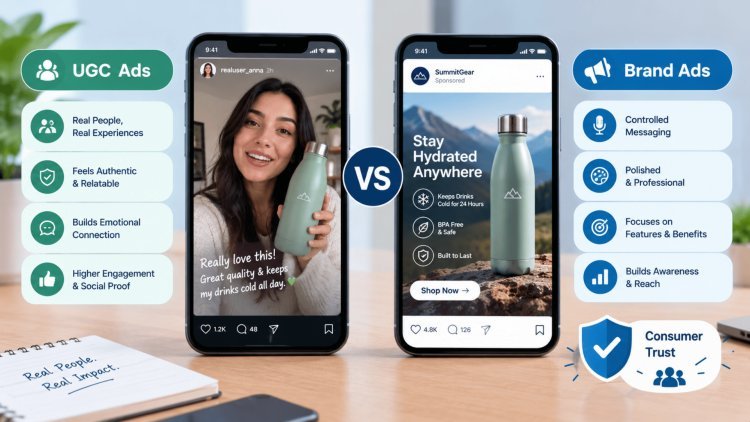
Understanding the trust advantage of UGC is essential — but so is recognizing where polished brand creative still earns its place. The smartest media strategies do not choose one format over the other; they deploy each where it creates the most value. UGC is often perceived as more authentic and relatable, while polished brand creative remains important where professional execution itself signals credibility.

Where UGC Outperforms
Authenticity, social proof & native discovery
  • Social commerce and conversion-stage campaigns.
  • High-involvement, personally relevant categories.
  • TikTok, Reels, and Stories environments.
  • New-customer acquisition through social proof.
  • Community building and loyalty reinforcement.
Where Brand Ads Still Matter
Precision, premium positioning & high-stakes trust
  • B2B and enterprise-software marketing.
  • Luxury goods and premium services.
  • High-contract or high-risk purchase decisions.
  • Brand positioning and category education.
  • Controlled messaging, compliance, and global consistency.
The UGC Advantage

Across categories, UGC is often rated as more memorable and authentic than traditional video advertising. Consumers may describe brand ads as staged or too perfect, while UGC is described as real, relatable, and honest. That perception can strengthen engagement, recall, and conversion — especially in social-native environments. [299][303][309]

2.4x
Consumers are reported to be more likely to view UGC as authentic than brand content. 
+29%
Reported average conversion lift associated with UGC; results vary by category and campaign design.
+73%
IAB-reported increase in positive comments for ads featuring UGC versus traditional ads.
The Counterweight
Polish can be
a trust signal
When Professional Execution Matters

The UGC advantage is real, but it is not universal. In B2B, enterprise software, luxury, and premium services, audiences may expect professional execution; a shaky smartphone video can undermine confidence rather than build it. Brand ads remain valuable where the buyer is assessing a high-stakes contract, a major purchase, or long-term brand reliability.

The Authenticity Warning

“UGC-style” creative is not automatically authentic. Brands that manufacture faux-UGC without genuine creator relationships risk the worst of both worlds: the production cost of polished creative without the trust signals of real customer or creator voices. Authenticity is an audience perception, not a filter applied in post-production. [299][302][311]

Real
Creator Relationships
Clear
Disclosure
Genuine
Customer Proof
The Optimal Media Mix
Use UGC for
Social proof, product demonstrations, community stories, social commerce, and conversion-stage creative where relatability drives action.
+
Use brand creative for
Premium positioning, complex value propositions, compliance-sensitive claims, enterprise credibility, and high-stakes purchase journeys.
The Bottom Line
The winning strategy is not UGC versus brand ads — it is the right creative in the right context.
Use UGC to earn relevance and social proof. Use brand creative to establish precision, authority, and confidence where the purchase risk is high.

The Winning Takeaway: Build Trust with a UGC-to-Brand Hybrid System

The evidence is in, and the answer isn't binary. The brands winning the trust game in 2024 and beyond are those that architect a UGC-to-Brand Hybrid System — strategically deploying each format at the right stage of the consumer journey, on the right platform, for the right audience. Here's what that looks like in practice, and how to do it with integrity.

The Hybrid Trust Engine
UGC Trust
+
Brand Authority
=
Sustainable Growth
1

Deploy UGC for Conversion-Stage Social Proof

At the bottom of the funnel — where consumers are actively evaluating options and seeking validation — UGC is your highest-leverage asset. Run authentic creator content and real customer testimonials as paid social ads on Meta, TikTok, and Instagram. These formats align with platform-native content, reduce ad fatigue, and deliver the peer-sourced social proof that moves high-involvement audiences from consideration to conversion. Prioritize UGC with specific, relatable use cases rather than generic praise. Discover how UGC advertising at Digiverse is built around authentic, conversion-focused content strategy.

2

Reinforce with Polished Brand Credibility

Once a consumer has been touched by UGC and is primed to trust your brand, reinforce that trust with polished brand creative on channels where professionalism signals legitimacy — YouTube pre-roll, Connected TV, LinkedIn, and display. This is where brand storytelling, production quality, and consistent visual identity build the long-term credibility that UGC alone cannot sustain. Think of brand ads as the foundation that makes UGC believable at scale — the institutional authority behind the peer recommendation.

3

Keep Authenticity Compliant and Scalable

A hybrid system only works if it maintains the trust signals that make UGC effective in the first place. True UGC must have no material connection between the creator and the brand. The moment compensation, gifting, or a brand relationship enters the equation, FTC disclosure requirements apply — and failing to disclose is both a legal risk and a trust liability. Build your UGC program with clear creator agreements, transparent disclosure practices, and a commitment to genuine creator voices. Explore human-centered AI marketing practices that keep creativity and compliance aligned at Digiverse Studio.

79%
Consumers Trust UGC
Nearly 4 in 5 consumers say UGC highly impacts their purchasing decisions, more than influencer or brand content.
6x
Higher Engagement
UGC-based ads generate up to 6x higher engagement rates compared to standard brand-produced creative on social platforms.
2.4x
More Authentic
Consumers find UGC 2.4x more authentic than brand-created content, according to Stackla's consumer content report.
The Winning Strategy

UGC creates trust. Brand creative creates authority. The highest-performing marketing systems intentionally combine both to move audiences from awareness to confidence to conversion.

Ready To Build Your Hybrid Trust System?

Digiverse Studio specializes in human-centered digital marketing that blends authentic UGC with strategic brand creative.

Visit Digiverse.studio to explore the full suite of services — from UGC strategy to AI-powered campaign delivery.

Authenticity + Authority + Compliance = Hybrid Trust System

What's Your Reaction?

like

dislike

love

funny

angry

sad

wow