Motion Branding Beyond the Logo: Designing a Moving Brand Language
How forward-thinking brands are building fluid, expressive identity systems — where motion is the message, the personality, and the strategy.
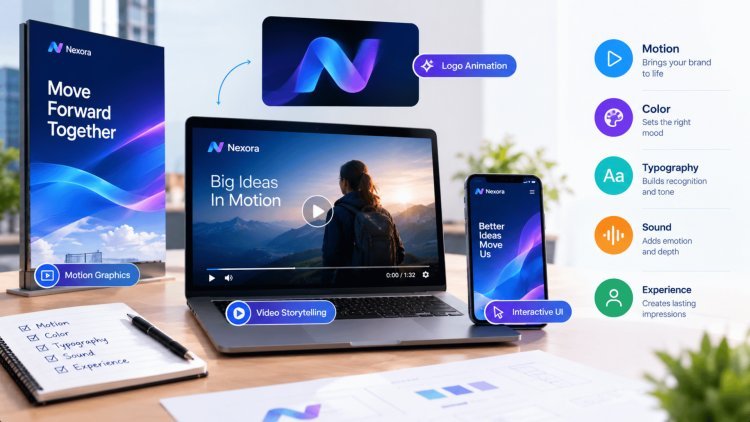
Why Motion Becomes the Brand
In a content-flooded digital landscape, brands that move don't just stand out — they stick. Motion is no longer a luxury add-on reserved for broadcast campaigns; it has become the primary language through which modern brands communicate identity, values, and personality in real time. Every scroll, swipe, tap, and transition is an opportunity for your brand to speak — without a single word.
How Motion Builds Recognition
Research consistently shows that viewers retain approximately 80% of what they see and experience versus only 20% of what they read. Motion transforms passive viewers into active participants — creating emotional imprints that static assets simply cannot achieve. When a logo pulses with purpose, or a transition carries brand rhythm, the audience doesn't just see your brand — they feel it.
02
Identity as Behavior, Not Just Appearance
Static branding defines what a brand looks like. Motion branding defines how a brand behaves. The way an element eases into frame, the pace at which text reveals itself, the micro-interaction that greets a user on hover — these behavioral signals communicate character, confidence, and culture. Brands like Apple, Nike, and Spotify don't just have visual identities; they have kinetic personalities that audiences recognize across every platform and context.
80%
Visual Retention
Viewers retain 80% of what they see and experience in motion-rich content.
20%
Text Retention
Compared to just 20% retained from reading static text alone.
3×
Brand Recall
Motion-first brands achieve up to 3× higher brand recall than static-only identities.
Static Branding
Defines Appearance
Visual Recognition
Fixed Expression
What The Brand Looks Like
Motion Branding
Defines Behavior
Emotional Recognition
Dynamic Expression
How The Brand Behaves
Motion Branding Framework
Movement → Emotion → Memory → Brand Equity
The Competitive Advantage
In a world where attention spans are measured in milliseconds, motion is not decoration — it is the brand's first and most powerful handshake with the audience.
As explored in Digiverse.studio's brand strategy resources, the brands that invest in motion systems today are building compounding recognition advantages for tomorrow.
Motion → Memory → Recognition → Brand Growth
Brand Identity Systems
Static vs. Motion-First Identity
The distinction between a static brand and a motion-first brand is not simply about adding animation — it is a fundamental shift in how identity is conceived, structured, and experienced. Understanding this difference is the first step toward building a brand that lives and breathes across every medium.
The Foundation
Static Identity
What the Brand Looks Like
Logos Color palettes Typography Layout grids
A static identity is built around fixed visual assets — logos, color palettes, typography, and layout grids. These elements define the brand's visual language with precision and consistency. They answer the question: What does our brand look like?
Static assets are essential and irreplaceable, forming the foundation of any identity system. However, they communicate at a single moment in time. A business card, a billboard, a PDF — these assets cannot convey pace, personality, or emotional rhythm. They show the brand's face, but not its character in motion.
The Living System
Motion-First Identity
What the Brand Does
Timing / Easing / Choreography
A motion-first identity goes further, asking: How does our brand behave? Motion communicates identity, personality, and intent simultaneously — through timing, easing, transitions, and choreography.
Slow + Deliberate
Confidence and luxury
Snappy + Energetic
Playfulness and accessibility
These are not arbitrary choices; they are brand decisions that must be as intentional as choosing a typeface or a primary color. As Digiverse.studio's motion design services demonstrate, a true motion identity is a living system — not a collection of one-off animations.
The Core Principle
"Motion" isn't decoration — a motion identity is a system with rules for how the brand moves, not merely an animated logo.
Every transition, reveal, and micro-interaction should be governed by a defined motion grammar.
Timing as Tone
Fast transitions communicate urgency and energy. Slow, weighted movements communicate authority and depth. Your brand's pace is as recognizable as its color palette — define it intentionally.
Easing as Emotion
Linear motion feels robotic and cold. Natural easing curves — ease-in-out, spring physics, overshoot — create motion that feels organic, alive, and emotionally resonant with human perception.
Transitions as Narrative
How elements enter, exit, and transform between states tells a micro-story. A seamless morphing transition signals evolution; a sharp cut signals decisiveness. Every transition carries brand intent.
Building Your Motion System — Not One-Off Animations
The most common mistake brands make when adopting motion is treating it as a series of individual animations rather than a unified, scalable system. A motion system is to animation what a design system is to visual design: it provides principles, rules, and reusable components that let motion scale consistently across every touchpoint without fragmenting the brand experience. [350][353][355]
01
Extract Brand DNA
Translate values into pace and tone.
02
Define Motion Grammar
Document timing, easing, and transitions.
03
Build Component Library
Create reusable animated components.
04
Scale & Govern
Deploy across platforms with governance.
Step 01
Translate brand DNA
into motion principles
The Kinetic Language
Every brand has a personality; the motion system translates that personality into kinetic language. An innovation-led brand might use forward momentum and asymmetric reveals, while a heritage brand may favor deliberate, measured transitions. Map brand values to pace, weight, energy, and directionality so every animation — from a button hover to a full-screen hero — feels unmistakably yours. [350][353][356]
Step 02 — Define Rules That Flex Without Fragmenting
⏱️
Duration
Set standard ranges for micro-interactions, navigation, and page transitions.
〰️
Easing
Approve curves that express the brand’s personality and physical logic.
↔️
Choreography
Define entrance, exit, sequencing, and hierarchy rules.
????
Context
Adapt intensity for social stories, product UI, and enterprise dashboards.
A practical motion specification documents the brand’s kinetic personality, timing and easing presets, interaction specifications, transition logic, and accessibility requirements. Rules should be flexible enough to fit context, but consistent enough to preserve recognition across touchpoints. [350][355][356]
Accessibility
Design for reduced motion
Limit motion intensity for users with vestibular disorders. Implement prefers-reduced-motion support through CSS media queries or platform settings; accessibility is a brand value, not a technical checkbox. [342][343][345]
Motion Types
UX motion vs. brand motion
Distinguish functional UX motion — feedback, loading states, navigation — from expressive brand motion such as hero animations, transitions, and identity reveals. Both must coexist harmoniously within the system. [346][351][352]
Build a Component Library
Headers
& Navigation
Cards
& Modules
Buttons
& States
Loaders
& Transitions
Document and store reusable animated components so every team and platform draws from the same motion vocabulary. This accelerates production, protects brand integrity, and makes motion easier to govern as the product and campaign ecosystem grows. [350][355][356]
The Bottom Line
A motion system turns animation from decoration into a scalable expression of brand identity.
Define the principles, codify the grammar, build reusable components, and govern deployment across every platform.
Audit, Deploy, Measure — Then Turn Observers into Advocates
A motion identity is only as powerful as its strategic implementation. Building the system is the beginning — the real competitive advantage comes from systematically auditing where motion is missing, deploying with measurable intent, and iterating based on real performance data. Brands that treat motion as a measured growth lever — not just a creative exercise — are the ones that turn passive viewers into loyal, vocal advocates.
1
???? Audit Every Touchpoint
Map your entire brand ecosystem: website hero sections, app onboarding flows, social media content, email templates, packaging, and physical environments. For each touchpoint, ask: Is static the right choice here, or is this a missed motion moment? Document gaps where animation could increase engagement, clarity, or emotional resonance. Common high-impact opportunities include loading states, empty states, form feedback, and product showcases.
2
???? Deploy with A/B Testing
Never deploy motion changes without a measurement framework. Define your KPIs before launch: dwell time (are users staying longer?), scroll depth (are they exploring more?), click-through rate (is motion driving action?), and conversion uplift (is engagement translating to revenue?). A/B test motion variants against static controls — even a 200ms animation on a CTA button can measurably shift conversion rates. Iterate aggressively based on what the data reveals.
3
???? Measure, Iterate, Advocate
Motion branding compounds over time. Each optimized touchpoint builds recognition, each recognition event builds preference, and each preference event builds advocacy. Track brand lift studies quarterly alongside performance metrics. Share motion performance data internally to build organizational momentum and secure investment for the next phase of your motion system. The goal is to move from observers — people who notice your brand — to advocates who actively share and champion it.
At Digiverse.studio, the approach to motion branding goes beyond aesthetics — it is integrated with AI video production, AI search optimization, and performance analytics to create brand motion systems that generate measurable growth. This means your motion identity isn't just beautiful; it is discoverable, scalable, and tied directly to business outcomes.
From crafting the initial motion principles to deploying AI-generated video content that maintains brand consistency at scale, the Digiverse methodology transforms motion from a creative investment into a compounding strategic asset.
Whether you are a startup defining your motion identity for the first time or an established brand auditing and upgrading a fragmented animation library, a systematic, data-driven approach to motion branding is what separates brands that look good from brands that grow fast. Explore the full suite of brand identity and motion services at Digiverse.studio to begin building your moving brand language today.
Key Takeaways
Motion communicates identity as behavior, not just appearance — define how your brand moves, not just how it looks.
A motion identity is a system with rules, not a collection of one-off animations — scalability is the goal.
Translate brand DNA into motion principles: pace, easing, weight, and directionality.
Design for accessibility from day one — "Reduce Motion" support is non-negotiable.
Measure everything: dwell time, scroll depth, CTR, and conversion uplift are your motion KPIs.
Motion compounds — consistent investment in your motion system builds recognition, preference, and advocacy over time.
Strategic Outcome
Brands that audit systematically, deploy intentionally, and measure relentlessly don't just capture attention — they create advocates who carry the brand forward through every interaction, recommendation, and shared experience.
Recognition → Preference → Loyalty → Advocacy