UGC Performance Framework
The Power of Native Trust
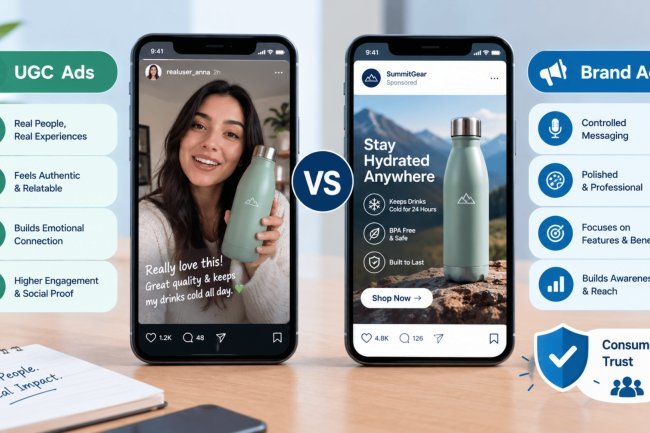
User-generated content has fundamentally changed the rules of digital advertising. Where polished, studio-produced creative once dominated, today's highest-performing ads often feel more like recommendations from real people than traditional commercials. Modern consumers have become highly effective at filtering out obvious advertising, yet they remain deeply receptive to content that feels authentic, relatable, and socially native.
86%
Consumer Engagement
Consumers engage with creator-led content before making purchase decisions.
NATIVE
Feed Integration
UGC blends into user behavior rather than interrupting it.
5
Core Formats
Proven UGC styles aligned to different buyer stages.
Looks Like a Recommendation
UGC creative succeeds because it mirrors how people naturally consume content on social platforms. Instead of feeling like a sales message, it feels like advice, experience sharing, or peer-to-peer recommendation. This lowers psychological resistance and increases trust.
Format Matching Is Everything
The most effective UGC strategy is not finding one perfect format. It is matching creative to audience awareness. Someone discovering your brand for the first time requires completely different content than someone already comparing solutions or preparing to purchase.
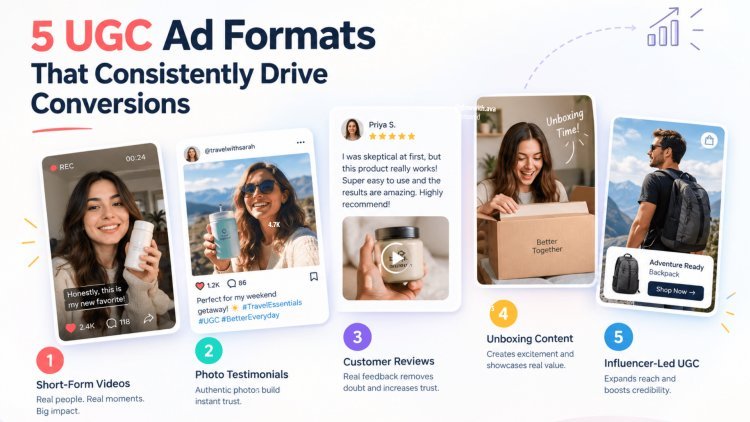
The Five High-Performance UGC Formats
01. Problem-Solution Videos • Capture attention by identifying a pain point before introducing the solution.
02. Testimonials & Reviews • Build trust through real-user experiences and outcomes.
03. Product Demonstrations • Show exactly how the product works and what makes it valuable.
04. Before-and-After Stories • Highlight transformation and measurable results.
05. Founder or Creator Narratives • Humanize the brand through authentic storytelling and purpose.
Strategic Takeaway
UGC succeeds because it earns trust before it asks for action. The brands generating the strongest performance understand that authenticity alone is not enough. Results come from matching the right UGC format to the
1. The Problem/Solution Testimonial
Format #1
Direct Response Workhorse
The Problem/Solution Testimonial is the foundational format of direct-response UGC advertising — and for good reason. It follows the most natural human storytelling arc: conflict, then resolution. The creator names a specific pain point the target audience recognizes immediately, introduces the product as the turning point, and then demonstrates the outcome. This three-act structure mirrors the viewer's own internal monologue, which builds trust far faster than any brand-speak ever could.
The Hook Formula
Start with a hyper-specific frustration
Vague pain points get ignored. Specific ones stop the scroll.
"I spent two years trying to fix my skin before I found this..."
The specificity signals authenticity — it sounds lived-in, not scripted. That credibility gap is what separates a converting testimonial from one that gets swiped past.
Why It Works Psychologically
Recognition primes acceptance
When a viewer hears their own frustration articulated by someone who looks like them, they experience a moment of recognition that primes them to accept the solution being offered. The creator becomes a proxy for the viewer's own transformation story.
•
Names the pain with precision and empathy
•
Introduces the product as a natural discovery, not a hard sell
•
Closes with a concrete, believable result that the viewer can project onto themselves
•
Works especially well for beauty, wellness, SaaS, and supplements
The Three-Act Structure
Act 1
Name the Pain
Specific, recognizable frustration
Act 2
Introduce the Product
Natural discovery, not a hard sell
Act 3
Demonstrate the Outcome
Concrete, believable result
Key Takeaway
Specificity in the problem statement is what makes the solution feel inevitable.
Unboxing and First Reactions
Unboxing content taps into primal curiosity. The sealed package triggers an involuntary question — *what’s inside?* — creating a tension loop that keeps viewers engaged. Genuine reactions of surprise and delight build trust that scripted testimonials cannot replicate.
Stop the Scroll
The visual of a sealed box mimics organic consumer behavior, sparking curiosity across every platform.
Ideal for Cold Audiences
Introduces products through discovery, not persuasion — perfect for reaching people unfamiliar with the brand.
Best Use Cases
New launches, seasonal drops, and products with strong visual or sensory appeal — packaging, texture, and color amplify the reveal.
Format #3 • High Purchase Intent
Before/After Transformation
If the Problem/Solution Testimonial tells the story of change, the Before/After Transformation shows it. And in marketing, showing is often more persuasive than telling. This format delivers one of the strongest purchase-intent signals available because viewers can immediately see the difference between the starting point and the outcome. The visual proof becomes the evidence, reducing the amount of persuasion required from the copy itself.
Why This Format Converts
Transformation content works because it compresses the buyer's evaluation process. Rather than asking viewers to imagine the outcome, it presents visible evidence of progress. Whether the result is physical, financial, operational, or lifestyle-based, viewers naturally compare the "before" state to the "after" state and begin projecting those same results onto themselves.
Where It Works Best
Fitness & Body Composition
Weight loss, muscle development, posture correction, mobility, and performance improvements.
Skincare & Beauty
Acne reduction, skin texture improvement, pigmentation correction, and anti-aging outcomes.
Home & Lifestyle
Room makeovers, organization systems, renovation projects, and decluttering transformations.
Pet Care
Coat improvements, training results, health progress, and behavioral development.
SaaS & Productivity
Manual workflows transformed into streamlined, automated, and measurable business processes.
The Trust Calibration Rule
The biggest mistake brands make with transformation content is exaggeration. When results look unrealistic, audiences stop believing the message. An unbelievable transformation creates skepticism instead of desire.
Performance Principle
A believable 60% improvement will usually outperform an unbelievable 200% transformation. Trust is built through realism, not exaggeration.
Add Context, Not Just Results
The highest-converting transformation ads do more than display the outcome. They explain how it happened. Include timelines, effort levels, usage frequency, routine changes, or process details that make the result feel achievable. Specificity turns skepticism into belief because viewers can clearly understand the path from before to after.
Key Insight
Before/After Transformation content works because it replaces claims with evidence. The most effective executions combine visible results with believable
4. The "I Was Skeptical" Story
Format #4
Mid-Funnel Conversion
Every potential buyer carries a set of objections: Is this too good to be true? Will it actually work for me? What's the catch? The "I Was Skeptical" format is engineered specifically to dismantle those objections by letting the creator voice them first — before the viewer even has a chance to raise them internally. This preemptive objection handling is one of the most sophisticated conversion techniques in direct response marketing, and UGC is the perfect delivery mechanism for it.
Psychological Mechanism
Why Doubt Converts
When a creator opens with “I honestly thought this was just another overhyped product…” they are doing something remarkable: they are siding with the viewer's skepticism. This alignment of perspective creates psychological safety. The viewer thinks, “This person was just like me.” That identification is the foundation of the conversion narrative that follows.
Funnel Strategy
Best Placement in the Funnel
This format is most powerful in the mid-funnel consideration stage, where potential customers have awareness of the product category but haven't committed. They know they need a solution — they're just not sure this is the right one. The “skeptic turned believer” arc resolves that uncertainty in a way that feels earned rather than manufactured.
!
Execution Rule
The Authenticity Requirement
For this format to convert, the skepticism must feel real. Scripted doubt reads as performative immediately. The most effective executions pair genuine hesitation with specific proof — a measurable result, a specific experience, or a side-by-side comparison. Social proof layered inside a conversion narrative is a powerful combination.
Sample Narrative Arc
1
Open with honest doubt: “I thought this was another overhyped product…”
2
Show the turning point: a specific moment, measurement, or side-by-side that changed your mind.
3
Close with earned belief: “Now I get why everyone recommends this.”
Key Takeaway
Voice the objection before the viewer does — then resolve it with specific, earned proof.
Format #5 • High Watch Time + Utility
The Tutorial Demo
The Tutorial Demo is one of the most underrated formats in the UGC playbook and consistently delivers strong watch time, completion rates, and acquisition efficiency. Its advantage comes from a simple principle: the viewer receives immediate value. Instead of leading with a sales pitch, the content teaches a useful skill, shortcut, or outcome, allowing the product to naturally become part of the solution.
The Non-Salesy Sales Pitch
The strongest Tutorial Demos never feel like advertisements. The creator focuses entirely on helping the audience achieve a specific result, while the product naturally demonstrates its value throughout the process.
The emphasis shifts from "buy this" to "here's how to do this." As a result, viewers engage with the content as education rather than promotion, lowering skepticism and increasing trust.
Why Watch Times Are Higher
Tutorial content creates a built-in reason to keep watching. Viewers want the complete process, not just the opening step. This natural curiosity drives stronger completion rates, longer session duration, and higher engagement metrics.
Platforms reward these signals, allowing educational content to earn additional distribution and helping paid campaigns benefit from increased organic reach.
Tutorial Demo Playbook
01. Focus on One Quick Win
Teach a single outcome that can be understood in less than 60 seconds.
02. Show the Product in Action
Demonstrate the product as part of the process rather than simply displaying it.
03. End with the Result
Let the completed outcome provide the persuasion rather than relying on a hard sales pitch.
04. Prioritize Utility
The more genuinely helpful the content, the more likely viewers are to share, save, and revisit it.
Where This Format Excels
Kitchen Products • Recipes, cooking shortcuts, and preparation techniques.
Skincare & Beauty • Daily routines, application methods, and result-focused walkthroughs.
Productivity Software • Workflow improvements, automation tips, and time-saving processes.
Fitness Equipment • Exercises, form corrections, and performance-enhancing techniques.
Strategy Tip
The more useful the tutorial, the more valuable it becomes. Great Tutorial Demos earn saves, shares, and repeat views because they solve a genuine problem. When education leads and promotion follows, paid creative can evolve into organic content that continues generating reach, trust, and conversions long after the advertising budget has been spent.
The Winning Loop: Scaling Without Burnout
Understanding the five formats is the foundation. Building a system to produce, test, and scale them consistently is what separates brands that win on paid social from those that exhaust their teams chasing a single elusive “perfect” creative. The secret is velocity, structure, and data discipline — not creative genius alone.
1
Hook (0–3s)
Stop the scroll with a specific pain point, bold claim, or visual trigger. No context-setting — open with the tension.
2
Problem
Articulate the frustration with precision and empathy. The viewer should feel understood before the product is ever mentioned.
3
Product Reveal
Introduce the product as a discovery, not a pitch. The transition from problem to solution should feel natural and inevitable.
4
Proof
Deliver the transformation — visual, statistical, or testimonial. Make the result specific and credible. Vague proof doesn't convert.
5
CTA
Close with a single, clear action. Reduce friction by telling the viewer exactly what to do next and why now is the right moment.
Test Velocity
The Weekly Creative Rhythm
The brands that consistently win on paid social treat creative testing like a scientific process. Run 3 to 5 variations of your top-performing concepts every single week.
The variation doesn't need to be radical — swap the hook, change the creator, adjust the opening line. Keep the proven structure intact and isolate what you're testing. Over four to six weeks, this discipline produces a body of data that tells you exactly what your audience responds to — not what you think they respond to.
The Final Takeaway
Stop agonizing over the one perfect ad.
Launch a variety of formats across the five proven structures, monitor performance with clear KPIs, kill the losers fast, and concentrate budget aggressively behind the data. The goal is a self-reinforcing loop: winning creative funds more testing, which produces the next winner. That loop — not any individual ad — is the real conversion engine.
The Self-Reinforcing Loop
Launch
Multiple Formats
Monitor
Clear KPIs
Kill Losers
Fast
Scale Winners
Aggressively