Human + AI Advantage
The False Choice: AI vs. Human
The debate around AI often starts from the wrong premise: technology versus people. In reality, the most effective creative organizations are not replacing human judgment with AI. They are combining strategic thinking with machine execution to create systems that are faster, smarter, and more effective than either could achieve alone.
THE MYTH
AI Will Replace Creative Teams
The dominant narrative suggests that AI is simply a replacement technology and that creative work can be automated entirely. This perspective pushes organizations toward two equally damaging extremes: resisting AI altogether or surrendering strategic decisions to algorithms. Both approaches leave significant value untapped.
THE REALITY
Collaboration Outperforms Replacement
The winning model is collaborative. AI accelerates production, research, testing, optimization, and execution. Humans provide context, judgment, creativity, positioning, and strategic direction. AI generates possibilities at scale. Humans decide which possibilities deserve investment and amplification.
AI Alone
• Massive speed and output volume
• Rapid optimization and testing ability
• Efficient execution at scale
• Lacks cultural context and intuition
• Cannot reliably protect brand identity
Humans Alone
• Strategic thinking and judgment
• Cultural awareness and empathy
• Strong creative direction
• Limited production capacity
• Slower iteration and optimization cycles
The Winning Flywheel
Human Strategy → AI Execution → Performance Data → Human Refinement → Scale
Where the Advantage Lives
AI Alone: lacks cultural intuition, audience empathy, and brand judgment.
Humans Alone: cannot match AI's speed, production scale, and optimization power.
Human + AI: combines strategic intelligence with executional efficiency, creating a durable competitive advantage.
Strategic Takeaway
The future does not belong to AI-only organizations or human-only organizations. It belongs to teams that understand the division of labor: AI executes, humans direct. The machine generates at scale. People determine what is worth creating, publishing, and scaling
The 80/20 Collaboration Model
The most effective Human-AI creative teams have converged on a clear division of labor — one that plays to the genuine strengths of each. It is not a 50/50 split. It is a deliberate asymmetry that produces outsized results.
AI Domain
Owns 80% of Execution
Artificial intelligence handles the high-volume, iterative, and data-intensive work that would otherwise bottleneck human creative teams. This includes generating hundreds of ad variations, running multivariate tests across platforms, and performing real-time optimization based on performance signals. AI never gets tired, never has creative block, and can process feedback loops in milliseconds.
Generate 200+ creative variations per campaign
Continuous A/B and multivariate testing
Real-time budget and placement optimization
Audience segmentation and dynamic personalization
Human Domain
Owns 100% of Strategy
Human creatives retain complete ownership of the decisions that cannot be delegated to pattern recognition alone. Strategy, emotional architecture, brand voice, and cultural context are irreducibly human domains. A human creative director sets the emotional hooks that make people stop scrolling — and defines the guardrails within which the AI operates.
•
Defining the emotional “permission to stop” moment
•
Setting and protecting brand voice and identity
•
Reading cultural context, timing, and tone
•
Making judgment calls on creative risk
43%
More Creative Output
Human-AI teams vs. human-only
42%
Higher ROAS
Collaborative vs. AI-only campaigns
200+
Variations Per Campaign
Generated by AI in minutes
Operating Principle
Deliberate asymmetry: AI executes at scale, humans direct with intent.
Where AI Fails — Your Competitive Moat
Every limitation of AI is a domain where human judgment becomes irreplaceable. These boundaries form the moat that protects creative leadership from commoditization.
Cultural Context
AI lags behind culture. It cannot reliably interpret emerging memes, regional taboos, or shifting social contracts. Only humans immersed in culture can judge authenticity in real time.
Emotional Resonance
AI can optimize clicks but not design authentic emotional architecture. The "permission to stop" moment — when a viewer feels seen or moved — is uniquely human.
Risk Judgment
The edgy-vs-offensive line shifts constantly. AI moderation flags keywords but misses nuance. Human creatives make contextual, empathetic calls with accountability.
Human + AI Operating System
The Modern Creative Workflow
High-performing creative teams are not using AI as a bolt-on tool. They are redesigning their entire workflow around a structured Human-AI partnership. Each phase is intentionally assigned to the side best equipped for the task, creating a repeatable system that combines strategic judgment with speed, scale, and continuous optimization.
1
Strategy
Human creative leaders define the foundation. They analyze previous performance, identify audience tensions, determine emotional hooks, establish positioning, and set the brand voice guidelines that shape every future creative asset.
This is the highest-judgment phase of the workflow and remains fundamentally human-driven.
2
Generation
Once the strategic guardrails are established, AI becomes the execution engine. Hundreds of creative variations can be generated across copy, visuals, video formats, headlines, and platform-specific assets in a fraction of the time required by traditional methods.
The objective is not perfect creative. The objective is creating a large pool of possibilities for human evaluation.
3
Curation
Human creatives re-enter the process to curate, refine, and elevate the strongest concepts. This stage introduces taste, cultural awareness, editorial judgment, audience empathy, and brand consistency.
The role of the human is not approval. It is selection, enhancement, and strategic refinement.
4
Optimization
AI continuously tests creative combinations across audiences, placements, devices, and timing variables. Performance signals are gathered in real time and routed back into the strategic layer, creating a self-improving system.
Every campaign becomes a source of insights that makes the next campaign stronger.
Workflow Loop
Strategy → Generation → Curation → Optimization → Repeat
Key Insight
The most effective creative organizations place humans at the moments requiring judgment and place AI at the moments requiring scale. Humans own strategy and curation. AI owns generation and optimization
Your Competitive Advantage
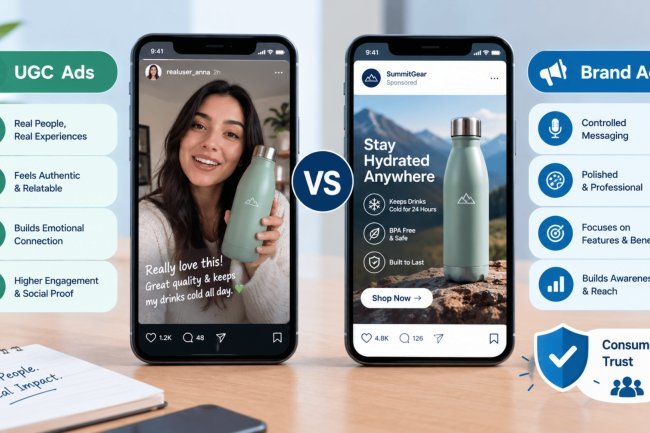
The AI content deluge is already here. Feeds are flooding with algorithmically generated copy, AI-produced visuals, and automated creative that is optimized to the decimal point — and increasingly indistinguishable from one another. In this environment, the scarcest and most valuable resource in advertising is not production capacity. It is human authenticity, judgment, and connection.
The Counterintuitive Truth
Human-led, “imperfect” creative outperforms synthetic polish
As AI content floods social feeds, research is showing that “imperfect,” human-led creative — ads that feel personal, idiosyncratic, and genuinely authored — drive measurably higher trust and purchase intent. Consumers are developing a finely-tuned radar for synthetic content, and the brands that lead with humanity are the ones that cut through. The competitive moat is no longer production speed; it is the irreplaceable human signal that AI cannot replicate.
Truth 1
Emotional Recall
Human-authored brand stories drive higher emotional recall than AI-generated narratives.
Truth 2
Authenticity Signal
“Imperfect” creative signals authenticity in an AI-saturated feed.
Truth 3
Scarcest Resource
Trust is the scarcest commodity in modern advertising.
Your Action Plan
1
Stop using AI to replace your creative director. Start using it to amplify your human insights and scale what works.
2
Invest in human creative strategy as your core differentiator. Deploy AI at the execution and optimization layer — not the ideation layer.
3
Build feedback loops that make every campaign smarter than the last. Protect brand voice as a human-owned asset, not an AI output.
The Bottom Line
AI makes content, but humans make connections.
That distinction is your competitive advantage — and it compounds with every campaign you run.