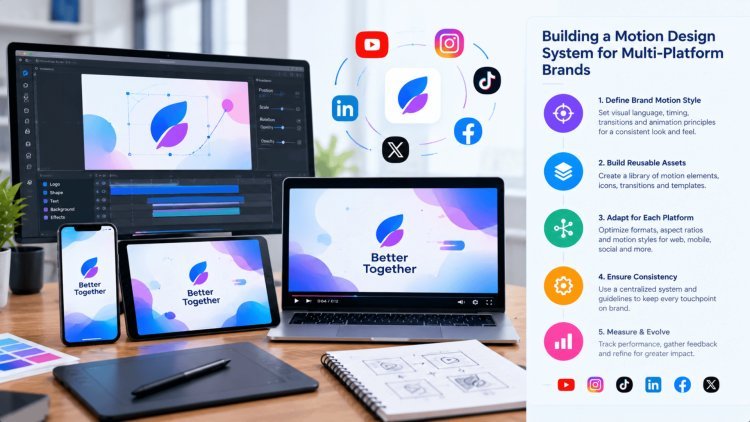
Building a Motion Design System for Multi-Platform Brands
Building a Motion Design System for Multi-Platform Brands
In an era where digital experiences define brand perception, motion is no longer optional — it is the primary differentiator. This guide explores how forward-thinking brands can architect a unified motion design system that scales seamlessly across every platform, device, and touchpoint — from mobile apps to broadcast, social media to web.
The era of static brand identities is ending. Today, motion is the primary language of identity — replacing rigid logo lockups with kinetic personalities that breathe, respond, and evolve. Brands that cling to stillness risk feeling inert in a world of perpetual scroll, autoplay, and interactive surface.
The Identity Evolution
Static Identity
→
Motion Behavior
→
Living Brand
01
Motion as Behavior, Not Decoration
Industry leaders like Apple and Spotify have mastered this shift. Their motion does not merely ornament the interface — it communicates brand character. Apple's transitions feel precise and premium; Spotify's animations pulse with cultural energy.
The movement itself becomes the message, encoding values of quality, confidence, and creative vitality directly into the user's subconscious experience. Motion that feels like behavior builds trust faster than any tagline.
02
The Memory Multiplier Effect
The cognitive science is unambiguous: viewers retain 80% of what they experience through motion, compared to just 20% of what they read in static form. This is the memory multiplier — the compounding return on every investment in animated brand moments.
When your brand moves with intention, it does not just catch attention; it lodges itself in long-term memory, driving recall at the precise moment of purchase decision. Explore Digiverse.studio's full brand services to understand how motion strategy fits into your broader identity architecture.
80%
Motion Retention
Viewers retain information experienced through motion versus just 20% from static text.
3×
Engagement Lift
Animated brand content generates up to 3× more engagement than static equivalents on social platforms.
68%
Brand Preference
Consumers prefer brands that use fluid, intentional motion in their digital product experiences.
Brands using motion consistently report stronger recall, higher engagement rates, and deeper emotional resonance with their target audiences.
Motion → Recall → Preference → Growth
Motion Identity System
The Motion Grammar: Codifying Your Brand DNA
Just as typography and color palettes define visual identity, a motion grammar defines how your brand behaves in time. Codifying this grammar means moving beyond ad hoc animation decisions and establishing a principled, scalable system that every designer, developer, and creative partner can apply consistently — from a loading spinner to a full-screen hero transition.
A Unified Framework
Three Dimensions of Motion
One coherent identity
Duration
Timing
Defines the emotional pace of movement.
Easing
Shapes how movement accelerates and settles.
→→
Consistency
Connects individual animations into one system.
01 / DURATION
Timing as Tone
Duration is not just a technical parameter — it is an emotional signal. Fast transitions (100–200ms) communicate energy, responsiveness, and modernity, aligning with brands that want to project agility and forward momentum. Slow, weighted movements (400–700ms) project authority, deliberateness, and premium quality — ideal for luxury, finance, or healthcare brands. Defining your timing scale in a shared token system ensures every animated moment communicates the same emotional register, whether it appears on iOS, Android, or a connected TV interface.
Fast transitions100–200ms
Slow, weighted movements400–700ms
02 / MOVEMENT FEEL
Easing as Emotion
Linear motion feels mechanical and lifeless — it does not exist in the natural world. Easing curves are the grammar of organic movement, mimicking the physical laws of inertia and acceleration that our brains are wired to find trustworthy. Ease-in-out curves feel conversational; spring physics feel playful and alive; custom cubic-bezier curves can encode brand personality with extraordinary specificity.
Linear motionMechanical
Natural easing curvesOrganic
As detailed in Digiverse.studio's motion branding resources, choosing the right easing family is as important as choosing the right typeface — both shape how audiences emotionally experience your brand.
03 / System Thinking
Consistency Strategy
The most common failure in brand motion is treating every animation as a one-off creative decision. True system thinking means defining a scalable motion token library — duration scales, easing presets, choreography rules, and transition patterns — that governs how your brand moves across every touchpoint.
Motion Token Library
01Duration scales
02Easing presets
03Choreography rules
04Transition patterns
This is analogous to a color system: instead of picking a shade every time, designers reference a defined palette. When motion follows the same discipline, brands achieve the rare quality of feeling coherent in time — recognizable not just by how they look, but by how they move. Visit Digiverse.studio's motion branding blog to explore deeper frameworks for building this consistency into your workflow.
Motion Grammar
Operationalizing Your System
A motion grammar is only as powerful as its implementation. Operationalizing your system means embedding motion principles into the tools, workflows, and governance structures that your team uses every day — ensuring that brand motion is systematic, scalable, and inclusive, rather than dependent on individual creative memory.
Step
1
Audit and Align Touchpoints
Begin with a comprehensive audit of every digital and physical surface where your brand appears:
Map each touchpoint against your motion grammar and identify the static gaps — moments where motion could replace a passive experience with an active one.
Review your Digiverse.studio ecosystem holistically. These are all opportunities to inject brand personality:
Navigation transitions
Loading states
Micro-interactions
Hero animations
Prioritize by impact and implementation effort, creating a phased roadmap that teams can execute without disrupting existing workflows.
Document findings in a shared motion audit template so stakeholders from design, engineering, and marketing can align on priorities before production begins.
2
Build Component Libraries
Reusability is the engineering principle that makes design systems scalable — and it applies equally to motion.
Where it lives
Create a motion component library inside your design tooling:
FigmaAfter EffectsLottieRive
What it contains
Pre-built, preapproved animation components:
Button state transitions
Modal entrances
Loading indicators
Data visualization reveals
Scroll-triggered sequences
Each component should be parameterized so teams can adjust duration and scale without breaking brand integrity.
Tag every component with its corresponding motion token — the same way a UI kit references color tokens — so that any future updates to the core grammar propagate automatically across the library.
This approach preserves brand integrity at scale, even as your ecosystem grows to hundreds of screens and surfaces.
From Observers to Advocates
A motion design system is not a creative expense — it is a strategic growth engine. When motion is measured, intentional, and systematically deployed, it can help convert passive scrollers into emotionally engaged brand advocates who return, refer, and convert at higher rates. The key is to treat motion as a testable product system, not a decorative add-on. [371][378][379]
Measurement & Iteration
Close the loop from motion to outcome
Start With High-Leverage Tests
Begin with A/B tests comparing static CTAs against animated state changes. Track conversion uplift, dwell time, and scroll depth. Expand into onboarding flows, feature-announcement banners, and checkout animations. Use session recordings alongside quantitative analytics to understand not just what users click, but how motion shapes their path. [378][379][381]
The Motion Test Framework
Define Hypothesis
State the user need, motion behavior, and expected outcome.
Run Control
Compare static versus animated versions under equivalent conditions.
Measure Impact
Track conversion, dwell time, scroll depth, and completion.
Update Tokens
Feed validated learnings into the motion-token library.
Establish a quarterly motion-performance review. Feed findings back into the motion-token library as evidence-based refinements so every iteration makes the system smarter, more effective, and more precisely tuned to audience response. [378][379]
Intentionality
Every transition needs a reason
Motion That Earns Its Place
The difference between motion that delights and motion that distracts is intentionality. Every transition should trace back to a brand value or user need — never novelty. When a loading animation reflects brand personality, a frustrating wait becomes a brand moment. When an exit transition feels deliberate, users leave with a sense of completeness rather than abandonment. [371][375][376]
Accessibility Is Part of Intentionality
Respect user motion preferences by implementing prefers-reduced-motion support. Provide static or minimal-motion alternatives, and give users control over non-essential moving, blinking, or scrolling elements. Accessibility is a brand value, not a technical checkbox. [371][372][375]