How Sound, Motion and Micro- Interactions Shape Brand Recognition
In an era where every brand competes for a fraction of a second of attention, the brands that win aren't just visually distinct — they're sensorially unforgettable. Sound, motion, and micro-interactions are the invisible architecture of modern brand identity, working below conscious awareness to create recognition, trust, and emotional resonance at every touchpoint.
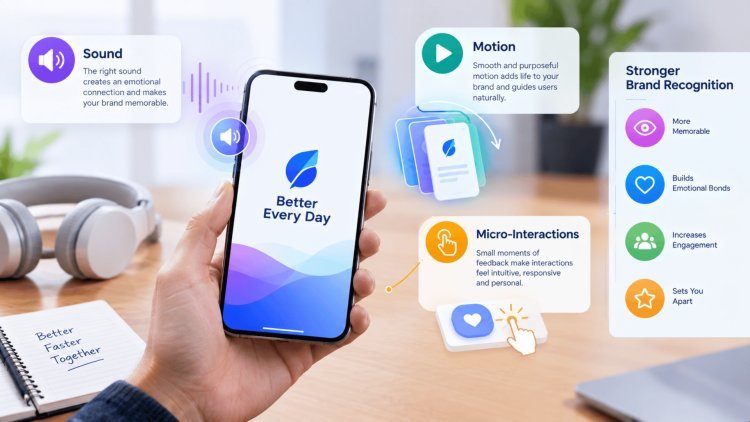
The Brand Texture People Actually Feel
Most conversations about branding stop at the visual: the logo, the color palette, the typography. But what separates a brand that gets recognized once from one that lingers in memory is something far more layered — it's texture. Not the kind you touch, but the kind you experience as a user moving through a digital product.
01
What Brand Texture Really Means
Texture is the accumulation of movement, tone, rhythm, and micro-responses that happen constantly as a user interacts with your brand. It's the way a button responds when pressed, the sound that plays when a task completes, the animation that greets a new visitor. These are not decorative flourishes — they are the substance of lived brand experience.
02
Why Texture Is the Modern Differentiator
As the digital landscape becomes increasingly saturated — more apps, more ads, more content competing for the same eyeballs — pure visual branding is no longer sufficient. Users are bombarded with polished interfaces daily. What cuts through is not another clean sans-serif logo, but the coherent sensory personality that a brand expresses through every interaction.
Texture is the layer that transforms a brand from something a user sees into something a user knows and returns to.
Visual-Only Brand
Seen Once
Static Experience
Limited Memory Encoding
Easy To Forget
Textured Brand
Felt Repeatedly
Dynamic Experience
Emotional Memory
Easy To Recall
The Four Components Of Brand Texture
Sound
Audible signatures that trigger recognition before a single visual is processed.
Motion
Animated personality that communicates brand values in milliseconds.
Micro-Interactions
Moment-by-moment dialogue between brand and user at every click and hover.
Coherence
All three working together across every touchpoint to compound recognition.
Core Insight
Think of it this way: two brands can have near-identical visual identities yet feel entirely different in use.
The brand with intentional texture — designed motion, purposeful sound, and consistent micro-responses — creates a depth of presence that the flat, static alternative simply cannot match.
Final Perspective
In a noisy world, texture is what makes a brand linger, not just register.
Sound + Motion + Interaction = Brand Texture
Sonic Branding & Audio Identity
Sound — Recognition Before You See Anything
Sound is the most underestimated branding tool in the digital designer's arsenal. While most brand guidelines dedicate entire chapters to color ratios and logo clearance, sonic identity is often an afterthought — or absent entirely. Yet audio is neurologically processed faster than visual information, meaning a well-designed sonic signature can trigger brand recognition before the user's eyes have even registered the screen.
01 / The Audible Signature
Sonic Logos: The Audible Signature
Consider Netflix's iconic "ta-dum" — a two-note sequence that has become one of the most recognized audio marks in entertainment. Or the Intel chime, a five-note melody so embedded in consumer consciousness that it survives decades of product evolution. These are not accidents. They are the result of deliberate sonic branding strategy: short, distinctive, emotionally resonant audio marks that pair seamlessly with visual identity.
A sonic logo functions like a shortcut in the brain's recognition network. Once associated with a positive brand experience, the sound alone is enough to activate brand recall — even in a podcast, a TV ad heard from another room, or a notification ping on a phone. This is the power of audio as identity.
A Signature in Sound
Short. Distinctive. Memorable.
Audio becomes a recognizable brand cue, even when no visual identity is present.
Functional Audio & Ambient Soundscapes
Beyond the logo, sound operates throughout the user experience in two critical ways. Functional audio — the subtle chime when a file uploads successfully, the gentle tone when an error occurs, the confirmation sound when a payment clears — makes interfaces feel complete and trustworthy.
These sounds communicate system status and outcome in a way that visual indicators alone cannot fully achieve, especially for users who may be multitasking or visually impaired.
✓ Successful upload chime
! Error notification tone
✓ Payment confirmation sound
Ambient Soundscapes
Ambient soundscapes take this further by creating an environmental personality for digital spaces. Productivity apps that offer focus-enhancing audio, wellness platforms with calming tonal environments, or gaming interfaces with immersive audio layers — all of these are extending brand identity into the acoustic dimension.
The result is an interface that doesn't just look like the brand; it sounds like it too.
The Acoustic Dimension
Focus-enhancing audio Calming tonal environments Immersive audio layers
Brand Recall
8.5×
Stronger brand recall compared to visual identity alone.
Brands with consistent sonic identities see up to 8.5× stronger brand recall compared to those relying on visual identity alone.
Sound is not supplementary — it's structural.
The Three Building Blocks
A Complete Sonic Identity System
01
Sonic Logo
Short, distinctive audio marks (2–5 notes) that embed brand identity into memory via auditory repetition — no visuals required for recall.
02
Functional Chimes
Success, error, and confirmation tones that communicate system feedback and build user trust through consistent, purposeful audio cues.
03
Ambient Soundscapes
Environmental audio layers that extend brand personality into the experiential space — making digital products feel inhabited and intentional.
Motion — Personality in the Fraction of a Second
Motion communicates personality before users consciously process content. A button's response, a menu transition, or a loading animation shapes perception instantly, making motion one of the most powerful expressions of modern brand identity.
What Motion Communicates
Every movement signals character. Sharp transitions suggest precision and control. Elastic movements create warmth and friendliness. Refined fades communicate elegance and luxury. Motion becomes a visible representation of brand behavior.
Key Principle
Motion is not decoration.
Motion is behavior.
1
Guide Attention
Direct users toward onboarding steps, CTAs, and critical actions.
2
Prevent Errors
Validation feedback and progress indicators clarify system state.
3
Communicate Brand
Every easing curve becomes part of a recognizable motion language.
4
Stay Performant
Fast interactions reinforce trust and maintain premium experiences.
200ms
Performance Is Part of the Brand Promise
Beautiful animation that lags communicates neglect, not luxury. High-performing motion should resolve within 200ms or less at the 75th percentile of user devices, ensuring every interaction feels immediate, fluid, and intentional.
Motion Identity
People hear your voice in words.
They feel your personality in motion.
Micro-Interactions — The Signature That Repeats Everywhere
If motion is the personality and sound is the voice, then micro-interactions are the ongoing conversation — the continuous, moment-to-moment dialogue between a brand and its users. Every loading state, button acknowledgment, and focused form field is small individually, but collectively they become the most powerful repetition engine in the brand toolkit. [357][360][365]
01
Interaction Type
Loading States
The moment a user waits is a branding opportunity. Branded loading animations — with characteristic motion curves, colors, and rhythm — turn latency into identity reinforcement rather than anxiety or abandonment. Show progress or context for longer waits, and ensure the indicator changes when the operation finishes or fails.
02
Interaction Type
Button & Tap Feedback
The instant visual and haptic response to a press confirms action and communicates personality simultaneously. A confident, immediate response builds trust; sluggish or absent feedback erodes it with every interaction. Keep simple feedback short and purposeful — commonly around 100–300 ms.
03
Interaction Type
Form Acknowledgements
Inline validation, success states, and field-focus animations reduce confusion and make completion feel rewarding. Validate at the field level where possible, give precise error messages, and confirm success clearly rather than bundling all errors into one final submission summary. [358][361][363]
The Practical Rule
Coherence
across all senses
One Brand Promise
Each sensory cue must align with the same brand promise. A playful, bubbly micro-interaction that triggers a sharp, clinical error tone is a contradiction — users feel it even if they cannot articulate it. Every click, hover, and transition should feel like it comes from the same voice. [367][368]
Build a Sensory Design System
Motion
Easing curves, duration ranges, and interaction patterns.
Sound
Audio character, volume logic, and success or error cues.
Touch
Haptic patterns that reinforce action without distraction.
Governance
Standards that travel across products, platforms, and touchpoints.
A sensory brand system should cover sound, motion, tone, and interaction patterns — not just logo and color. Audit every digital touchpoint, then codify the rules so designers, developers, and brand strategists can apply them consistently. [367]
Accessibility
Respect reduced motion
Always provide a static or minimal-motion alternative for users who enable reduced-motion settings. Use fade or dissolve rather than scale, rotate, or large movement where possible.
Design Discipline
One interaction, one purpose
Every micro-interaction should serve one clear task: confirm, warn, guide, or provide feedback. Never add motion for its own sake, and ensure the same action produces the same response everywhere.
The Recognition Loop
Design Sensory
Craft sound, motion, and micro-interactions from one brand system.
Deploy Coherently
Ensure consistency across products, platforms, and touchpoints.
Compound Recognition
Every coherent interaction builds memory and trust.
The Bottom Line
Recognition is not a one-time event. It is a system that repeats.
Micro-interactions are the mechanism that makes brand recognition repeat at scale — in every product, on every screen, for every user.