Seeing the Unseen: The Power of CGI Product Animation
Traditional cameras can only capture what light touches and lenses can reach. CGI product animation breaks every physical barrier — revealing internal mechanisms, invisible forces, and microscopic precision that no camera crew could ever film. This presentation explores how modern CGI is transforming the way brands communicate engineering value, build buyer confidence, and tell the full story of what makes their products exceptional.
The Camera's Physical Ceiling
Every photograph and every piece of traditional footage shares a fundamental constraint: the camera can only record what physically exists in its line of sight. Light must bounce off a surface, the lens must have space to focus, and the subject must be accessible.
For complex engineered products — motors, locking mechanisms, medical devices, or fluid-handling assemblies — this means that the most important parts of the product are perpetually hidden from view.
Physical Reality Limits the Camera
Cameras are bound by physics. They can only capture surfaces exposed to light and visible to the lens. As a result, critical engineering value often remains hidden inside housings, behind covers, beneath assemblies, or beyond the resolution limits of conventional photography and video.
The Commercial Consequence
When customers cannot see inside a product, they cannot understand why it performs better, lasts longer, or justifies a premium price.
Engineering investment becomes invisible — reduced to a bullet point on a spec sheet rather than a visceral, compelling story.
In a competitive market, that invisibility costs sales.
Product Exterior
Marketing Claims
Technical Specifications
Limited Understanding
Precision Components
Functional Processes
Design Logic
Performance Advantage
Where CGI Changes the Equation
The gap between what a product actually does and what a buyer perceives it to do is exactly where CGI steps in to close the divide.
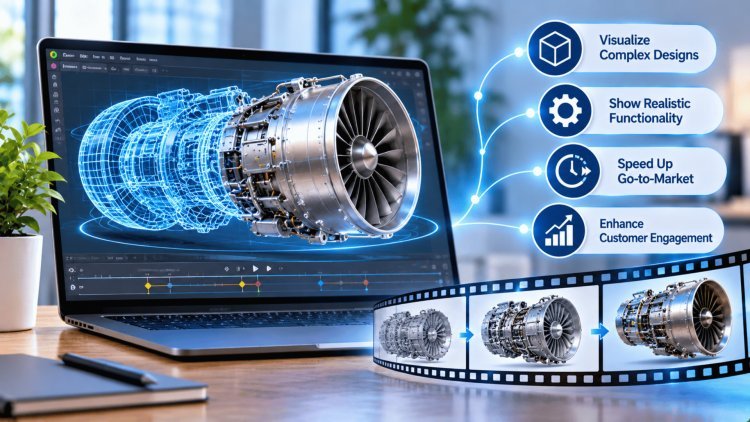
CGI removes the camera's physical limitations, allowing brands to reveal hidden mechanisms, visualize internal processes, isolate components, and communicate engineering advantages with perfect clarity.
The CGI Advantage: Beyond Physics
Computer-generated imagery, built directly from CAD data, operates entirely outside the physical world's constraints. There are no camera rigs to position, no lighting setups to arrange, no sealed housings to disassemble. Every component, every surface, every internal pathway is fully accessible — and fully controllable. The result is a visualization toolkit that can communicate engineering complexity with a clarity and precision that no traditional production method can match.
Exploded Views
Components separate in precise assembly order, pulling apart layer by layer to reveal the structural logic of the entire product. Every fastener, gasket, and sub-assembly floats in perfect spatial relationship, allowing viewers to understand how the product is built and why that construction matters. This technique is especially powerful for demonstrating quality of materials, precision of tolerances, and complexity of engineering that justifies a premium price.
Cross-Section & X-Ray Reveals
A virtual blade slices through solid housing midanimation, exposing internal workflows without disassembly. Fluid paths, airflow channels, circuitry layers, and mechanical linkages all become visible simultaneously. Unlike physical cut-away models, CGI cross-sections can be animated in real time — showing fluid moving through a valve or heat dissipating across a heatsink — giving buyers a live window into how the product behaves under real operating conditions.
Invisible Process Visualization
Some of the most compelling engineering advantages are entirely invisible: pressure distribution, electromagnetic fields, acoustic dampening, thermal management, signal propagation. CGI can render these non-physical phenomena as vivid, color-coded overlays — heat maps, flow particle systems, signal pulse animations — transforming abstract technical concepts into immediate visual intuition. What was once communicated only through data tables and engineering reports becomes a compelling, memorable visual narrative.
The most powerful aspect of modern technical CGI is not just its visual fidelity — it is its credibility. Unlike artistic interpretations or stylized illustrations, production-grade technical animation is built directly from the same CAD files used by the engineering team. Every valve, screw, bearing, and sensor is rendered with mathematical accuracy. This means the animation is not just beautiful — it is defensible, accurate, and trusted by both technical specifiers and end consumers alike.
When a product animation is derived from actual engineering files, every dimension is correct, every component relationship is true to the physical product, and every moving part behaves as it does in reality. This level of fidelity eliminates the risk of misleading buyers or misrepresenting capabilities. For regulated industries — medical devices, safety hardware, industrial machinery — this accuracy is not optional; it is a prerequisite for use in technical documentation, compliance submissions, and specifier approval workflows. CGI grounded in CAD data can serve simultaneously as a marketing asset and a technical reference, dramatically expanding its commercial utility and return on investment.
Two case studies illustrate the tangible commercial impact of precise CGI animation in highly technical product categories:
Squire used exploded CGI sequences to demonstrate the layered internal security mechanism of their flagship Inigma lock line. By visually pulling apart each security layer — anti-pick pins, hardened shackle, anti-drill plates — they communicated a level of protection that no lifestyle photograph could convey. The result was a dramatic reduction in the need for lengthy verbal explanation during sales presentations and a measurable lift in specifier confidence.
Plumis used labeled component breakdowns and animated water-mist dispersion sequences to prove the safety efficacy of their domestic fire suppression nozzles. Building control officers and fire safety specifiers — who require technical proof before approving installation — could see precisely how the system activates, how the mist pattern forms, and which components are responsible for which safety outcomes. Approval cycles shortened significantly as a result.
Dimensionally accurate component rendering
True-to-engineering mechanical motion
Legally defensible product representation
Usable in technical specs and compliance docs
Reusable across all marketing and sales channels
Credibility with engineers, specifiers, and procurement
When animation is built from real CAD data, marketing and engineering speak the same language — and buyers notice the difference.
Engineering Confidence into Sales
CAD-Grounded Accuracy: Why It Matters
Proven in Practice: Real-World Applications
Squire Locks – Inigma Series
Plumis Automist – Fire Suppression System
What CAD-Based CGI Delivers
What's Your Reaction?