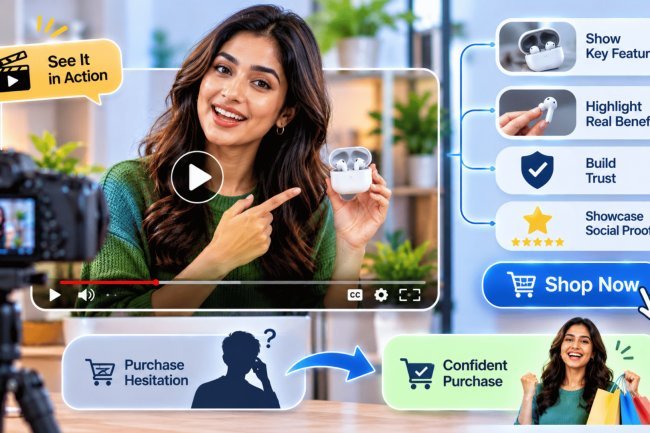
Founder-Led Video Advertising: Turning Business Stories Into Brand Trust
In a world flooded with polished, committee-approved advertising, the most powerful marketing asset a company can deploy is often the simplest: the founder telling the truth. This presentation explores how business leaders can transform their personal stories, hard-won lessons, and genuine convictions into video content that builds lasting brand trust — and drives real conversions.

The Trust Gap: Why Polished Ads Fail
Modern consumers have developed an almost reflexive resistance to traditional advertising. The more polished and produced a brand ad feels, the faster audiences scroll past it. Standard brand advertising suffers from three compounding problems: it feels like an ad the moment it starts, it carries no personal accountability — no real face, no real name behind the promise — and it focuses relentlessly on features and benefits rather than the human reasoning that led to the product's creation.
The Modern Trust Equation
01
The Problem with Standard Brand Ads
Traditional advertising is engineered by committees to minimize risk and maximize broad appeal — which inevitably strips out the specific, human details that make a message believable.
Viewers recognize the formula instantly. The moment they sense they're being "sold to," trust evaporates.
Skippable ad formats have made this dynamic even more punishing: you now have fewer than three seconds to earn attention before audiences opt out entirely.
When a founder appears on screen and says "I built this because I had this problem," something fundamental shifts. A real name and a real face attach personal accountability to every claim.
The viewer understands that this person's reputation, livelihood, and credibility are on the line.
That accountability is impossible to fake, and audiences — even subconsciously — recognize and respond to it.
03
Selling the Reasoning, Not the Features
The deepest shift in founder-led video is a philosophical one: moving from what the product does to why it was built.
Features can be listed on a spec sheet. Reasoning requires a human being.
When a founder explains the specific frustration they couldn't shake, the failed solutions they tried first, and the precise insight that finally cracked the problem, they aren't just marketing — they're making a case that resonates because it mirrors the viewer's own unspoken experience.
Traditional Brand Ads
Corporate Messaging
Feature-Focused
Committee Approved
Anonymous Claims
Immediate Skepticism
Founder-Led Ads
Personal Story
Reasoning-Focused
Real Experience
Visible Accountability
Authentic Trust
Why Founder-Led Content Works
Personal Problem → Personal Story → Credibility → Conversion
Foundational Insight
Trust is not created by polish. Trust is created by accountability, specificity, and human reasoning.
The most persuasive founder-led videos don't sell products first. They explain problems, reveal motivation, and invite the audience into the journey that led to the solution.
Story → Trust → Credibility → Action
Founder-Led Video Advertising
Crafting the Narrative Arc
Effective founder video advertising isn't simply switching on a camera and talking. It follows a carefully engineered narrative structure that earns attention in the first seconds, anchors the story in credible specificity, and builds toward a revelation that makes the product feel inevitable rather than pitched. Every second of a well-crafted founder ad is doing deliberate work.
1
0–3 SECONDS
The Hook: Drop Viewers Into the Problem
The single most common mistake in founder video is starting with an introduction. "Hi, I'm the founder of…" wastes the only seconds that matter. Instead, start mid-thought, mid-frustration, mid-question. Open with the customer's most persistent pain point stated as lived experience:
"Every time I tried to [do X], I'd spend hours just to end up back at square one."
Or open with a category-defining question that makes the viewer feel immediately seen:
"Why does [common, broken process] still work this way in 2024?"
You are not introducing yourself — you are holding up a mirror.
2
3–15 SECONDS
The Origin Story: Anchor in Specific Scenes
Once attention is secured, the origin story must justify why this founder deserves to be heard. The key is radical specificity. Vague struggles — "I was frustrated with the status quo" — register as generic and forgettable. Specific, scene-based details do the opposite: they signal authenticity and make the story memorable.
"I was sitting at my kitchen table at 11pm, staring at a spreadsheet that still didn't add up, knowing I had to call a client in the morning."
Name the room. Name the failure. Sensory and situational detail collapses the distance between the founder's experience and the viewer's own.
3
THE FINAL ACT
The Mechanism Reveal: Why Existing Solutions Failed
The final act of the narrative arc is the pivot that makes the product feel earned rather than sold. The founder must explain — with equal specificity — why every existing solution fell short: too expensive, too complex, built for enterprises rather than small teams, treating symptoms rather than root causes.
03
Built for enterprises rather than small teams
04
Treating symptoms rather than root causes
This "mechanism reveal" accomplishes two things simultaneously: it validates the viewer's own failed attempts to solve the problem, and it sets up the product as a logical, even obvious, response.
The question isn't "do you want to buy this?" but "given everything we've just established, what else could we have built?"
The Proof of Conviction
Compelling narrative gets viewers to lean in — but narrative alone does not close the trust gap. The second layer of effective founder-led video is proof: concrete, visual, and specific evidence that the founder’s conviction is grounded in reality, not rhetoric. [855][856][859]
01
Proof Layer
Show the Making
Cut to the physical reality behind the claim: hands working an ingredient, a team iterating on a workflow, components being assembled, or a whiteboard of rejected ideas. [856][857][862]
02
Proof Layer
Real Data,
Real Customers
Replace abstract claims with named customers, specific outcomes, and verifiable numbers. Specificity reads as credibility. [855][857][859]
03
Proof Layer
Honest
Imperfection
Acknowledge an early mistake, a failed version, or a limitation still being worked on. Strategically shared imperfection is a trust accelerant. [856][861][868]
Show the Making
Show the work,
not just the claim.
Visual Evidence
The most powerful trust signal in video advertising is not what the founder says — it is what the camera reveals behind them. Cutaways to physical reality transform verbal claims into visual evidence, communicating craftsmanship, care, and investment without a single word of copy. [856][857][862]
The Credibility Bridge
Real Customer
“Sarah’s team cut reporting time from six hours to forty minutes in the first week.”
Real Data
Cite a specific, verifiable data point from your own experience — with the method or source stated. [855][857][859]
Real Mistake
“Version one was actually terrible.” Honest admission signals that you are living conviction, not performing confidence. [856][861][862]
Abstract success claims — “thousands of happy customers” — no longer move the needle. What builds genuine credibility is specificity with the rough edges intact. [855][859][866]
Avoid the Résumé Trap
Your credentials earn
attention.
The customer earns trust.
The Silent Buyer Question
Viewers do not watch founder videos to learn about your MBA, previous exit, or industry awards. They are asking one silent question: “Does this person understand my problem well enough to have actually solved it?” Organize the story around the customer’s problem from start to finish. [859][861][867]
The Founder Proof Structure
Start With
Customer Friction
→
Show the
Making
→
Prove With
Specifics
→
Admit a
Limit
→
Invite the
Next Step
Start at the moment of friction, show the work, prove the outcome with specifics, acknowledge an honest limit, then invite the viewer to take the next step. [856][862][865]
The Bottom Line
Conviction is not claimed — it is evidenced.
Show the making, name the customer, cite the number, and let honest imperfection make the confidence believable.
From Story to Conversion
Founder-led video works best when it bridges the gap between awareness and action. Its purpose is not to explain every feature or close the entire sale. Its role is to create trust at the exact moment a prospect is deciding whether the people behind the product are worth believing.
Awareness
→
Founder Video
→
Conversion
The Mid-Funnel Reality
Founder content performs best after prospects already understand the product category and problem. At this stage, decision-making shifts from understanding functionality to evaluating trust. The viewer is no longer asking what the product does. They're asking whether the people behind it are credible. Founder-led communication answers that question more efficiently than almost any other content format.
Best Placements: Retargeting • High-Intent Landing Pages • Email Nurture Sequences
Conversion Rule
One Door.
Clearly Marked.
After trust is established, make the next action obvious, simple, and frictionless.
High-Converting CTA Principles
Start a Trial
Low-friction product experience.
Book a Demo
Continue the conversation naturally.
Download a Guide
Extend value before the sale.
Final Takeaway
Authenticity Outperforms Production Value
Stay Authentic, Stay Specific
As founder video budgets increase, the temptation is to replace conversational honesty with polished corporate messaging. Resist that impulse. Specific details, personal experiences, and natural language consistently outperform scripted brand-speak because they feel credible, human, and relatable.
Core Principle
The founder is not the hero.
The customer is.
The founder's role is to act as a trusted guide who encountered the problem first, found a path through it, and now helps others reach the same outcome. That perspective transforms founder content from personal storytelling into a powerful conversion asset.