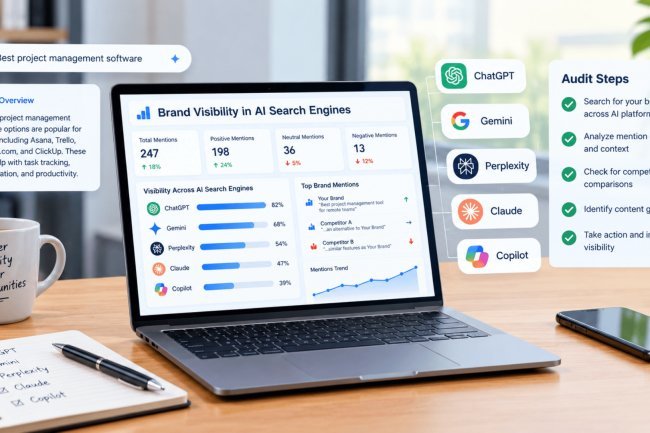
AI Product Discovery Starts on Your PDP
The way shoppers find products is undergoing a fundamental shift. AI-powered assistants — from ChatGPT Shopping to Google's AI Overviews to voice-enabled agents — are increasingly acting as the first point of contact between a buyer and a purchase decision. And they all start by reading your Product Detail Page.

The Stakes: "SEO" Is No Longer Enough
Traditional search engine optimization was built around a simple premise: earn authority, target keywords, rank on page one. But the rise of AI-powered shopping assistants has rewritten the rules of product discovery entirely.
These systems don't just crawl for keywords — they compare, evaluate, and recommend based on the richness and reliability of machine-readable signals embedded in your product pages.
Product Discovery Has Changed
AI shopping agents — including ChatGPT Shopping, Google's AI Overviews, Perplexity Commerce, and voice assistants — parse structured product data to answer specific shopper queries.
A query like "best waterproof hiking boot under $150 with wide toe box" isn't resolved by a backlink profile. It's resolved by PDPs that contain measurable, verifiable attributes.
Page authority still matters for organic reach, but it is no longer the decisive factor for AI-assisted discovery.
02
The New Ranking Signals
Unlike keyword-only SEO, AI discovery rewards a fundamentally different set of signals that help machines understand, compare, and confidently recommend products.
Completeness
Every attribute field filled, with no blank specifications, missing dimensions, or incomplete product information.
Structure
Machine-readable schema and organized product data that AI systems can interpret without ambiguity.
Consistency
Matching SKU information, pricing, specifications, and availability data across websites, feeds, and marketplaces.
Recency
Fresh inventory availability, current pricing, and recently updated review information that AI systems can trust.
Credibility
Verified reviews, meaningful ratings volume, and authentic user-generated content that validate product claims.
Traditional SEO Signals
Keywords
Backlinks
Domain Authority
Organic Rankings
Search Visibility
AI Discovery Signals
Structured Data
Complete Attributes
Consistent Information
Verified Reviews
Trusted Product Facts
The New Competitive Advantage
The brands winning AI-driven discovery aren't necessarily those with the biggest ad budgets — they're the ones whose product data is the cleanest and most complete.
Strategic Reality
AI agents act as the new comparison shopper. If your PDP can't answer their questions programmatically, a competitor's will.
Data → Structure → Trust → Discovery
GENERATIVE ENGINE OPTIMIZATION
Build the GEO Foundation: Your Product's "API" to AI
Generative Engine Optimization (GEO) begins with structured data — the layer of machine-readable markup that lets AI agents, search engines, and marketplace algorithms read your product as a data object rather than a web page. Think of it as building a public-facing API for each of your products. The more complete and accurate this layer, the more discoverable your product becomes across every AI-powered surface.
1
Comprehensive Schema Markup
Implement Product schema from Schema.org at a minimum, and go beyond the basics. Required fields include: name, brand, SKU, GTIN, MPN, image URLs, price, priceCurrency, availability, and AggregateRating (including reviewCount and ratingValue). Each additional field you populate reduces ambiguity for AI agents comparing your product against alternatives. Use JSON-LD format — it's the most reliable for crawlers and the easiest to maintain without touching your HTML.
Product Schema JSON-LD AggregateRating
2
Merchant Feed Sync & Policy Fields
Your structured data must be in sync with your Google Merchant Center feed, Meta Catalog, and any marketplace listings (Amazon, Walmart, etc.). Discrepancies in price, availability, or product title across channels create conflicting signals that AI agents penalize or ignore. Critically, include shipping speed, return window, and return cost in your schema — these are increasingly used by AI shopping assistants to filter and rank recommendations based on shopper constraints.
Google Merchant Center
Meta Catalog
Amazon & Walmart
3
Treat Structured Data as Priority #1
Among all the factors that influence AIpowered discovery, structured data carries the highest weight. A product with perfect schema and thin copy will outperform a product with beautiful marketing prose and no markup in AI search results. Audit your existing PDPs using Google's Rich Results Test and Schema Markup Validator, and prioritize fixing errors and gaps before any other optimization. Set a schema completeness score target — aim for 100% field population on your top-selling SKUs first.
100%
schema completeness score target for top-selling SKUs
✓
Once your schema foundation is solid, every other signal layer you build on top of it — copy, reviews, media — becomes amplified. Without this foundation, even brilliant product copy won't be surfaced by AI agents operating on structured queries.
Write PDPs Like You’re Answering
Real Shopper Constraints
The most underestimated lever in AI-driven product discovery is the copy on your PDP. AI shopping assistants do not respond to brand voice or aspirational language — they parse the page for specific, verifiable answers to the questions real shoppers ask. Replace thin copy with attribute-rich, constraint-aware content that works for both humans and language models. [768][770][780]
Attribute-Rich Specifics
Answer the question:
“Does this meet
my exact needs?”
Replace Generic Claims
Include materials and construction, precise dimensions and weight, compatibility, use cases, sizing guidance, and care instructions. Avoid unsupported superlatives such as “premium quality” or “best-in-class”; AI agents discount unsupported claims and reward verifiable facts. [768][774][776]
The PDP Attribute Checklist
Materials & Construction
Fabric weight, finish, composition percentages, and construction details.
Dimensions & Weight
Precise measurements in both imperial and metric units.
Compatibility
Device models, operating systems, vehicle years, makes, and models.
Use Cases
Specific activities, environments, or scenarios the product is designed for.
Sizing Guidance
Fit notes, size charts linked inline, and model measurements.
Care & Maintenance
Machine wash, hand wash, dry-clean-only, and other care requirements.
Google Merchant Center supports detailed product descriptions and optional product-detail attributes for technical specifications and additional details. Structured data helps Google retrieve current product information directly from landing pages. [768][769][774]
Natural-Language Intent
Write for questions,
not keyword strings.
Constraint-Driven FAQ
Map buyer personas to high-intent journeys and answer the questions they ask in natural language. Add a brief FAQ to each PDP that addresses constraint-driven questions such as compatibility, sizing, weather suitability, and direct product comparisons. [768][780][781]
Questions Your PDP Should Answer
“Can I use this with [specific device/model]?”
State exact compatibility and exclusions.
“Will it work if I’m between sizes?”
Give fit guidance, measurements, and sizing tradeoffs.
“Is this suitable for outdoor use in rain?”
Specify water resistance, materials, and intended conditions.
“How does this compare to [competitor product]?”
Use factual, verifiable comparisons — never unsupported claims.
Google Merchant Center offers optional conversational attributes — including question-and-answer, related product, variant option, and document link — designed to help AI systems and conversational agents understand product nuances across AI-driven surfaces. [780][781][774]
Operationally Critical Social Proof
Show the proof,
not just the stars.
Verified Evidence
Surface verified review volume and recency directly on the PDP — not just a star rating. Authentic UGC, including photos, video reviews, and Q&A, adds structured proof that reinforces human confidence and AI comprehension. Aim for at least 15–20 verified reviews per SKU before prioritizing that product for AI-discovery campaigns. [770][773][780]
Make Proof Machine-Readable
Product
Structured Data
Price &
Availability
Aggregate
Rating
Review
Volume & Recency
Use Product structured data and Merchant Center feeds to make price, availability, ratings, and detailed attributes machine-readable. Google recommends following review-snippet and AggregateRating guidelines, and review markup should refer clearly to the specific product. [770][773][779]
The Bottom Line
A high-performing PDP is not a brochure — it is a constraint-resolution system.
Answer the shopper’s requirements with verifiable attributes, natural-language FAQs, and structured social proof.
Keep Signals Fresh, Then Iterate Fast
AI-powered discovery rewards brands that continuously improve their product data ecosystem. Winning visibility is no longer about one-time optimization. It is about maintaining clean signals, consistent information, and rapid improvement cycles that compound over time.
Signal Quality
Consistent taxonomy, pricing, attributes and inventory status.
AI
Discovery
Rapid Iteration
Testing, learning, and scaling winning optimizations.
01
Unify Your Taxonomy
Create a single source of truth for product information. Align merchandising, marketing, technology, and content teams around one authoritative dataset to eliminate conflicting product signals.
02
Audit Inventory & Pricing
Keep inventory availability and pricing synchronized in near real time. AI systems lose confidence quickly when product information is outdated or inconsistent.
03
Discovery Sprints
Optimize a small SKU group, measure AI visibility improvements, document outcomes, then expand proven tactics across the catalog.
Sprint-and-Scale Framework
Select 10–20 SKUs
→
Apply GEO Stack
→
Measure Lift
→
Scale Winners
AI-Referred Sessions
Measure discovery traffic originating from AI platforms.
Search-to-Cart Rate
Track conversion performance after AI-driven discovery.
AI Comparisons
Monitor product appearances in AI-generated recommendations.
Long-Term Advantage
It's an operational capability that compounds.
Brands that continuously refine data quality, inventory accuracy, pricing competitiveness, and discovery optimization build durable visibility advantages that become increasingly difficult for competitors to replicate.