Video Localization at Scale: Adapting Campaigns for Global Audiences
In today's borderless digital economy, the brands that win globally are the ones that speak locally. Video localization is no longer a luxury reserved for Fortune 500 budgets — it is the operational backbone of any high-performing international content strategy. Whether you're expanding into European markets, Southeast Asia, or Latin America, the ability to adapt your video campaigns with cultural precision and production speed is the defining competitive advantage of the modern era.

The Evolution of Global Reach
The international marketing landscape has undergone a fundamental transformation over the past decade. What was once a slow, expensive, and often culturally tone-deaf process has given way to intelligent, automated, and creatively nuanced pipelines capable of delivering localized content at remarkable speed and scale.
Global Marketing Transformation
01
From Manual Cycles to Automated Pipelines
Traditional localization relied on expensive agency retainers, freelance translators, and weeks-long feedback loops between regional offices. A single campaign adaptation could consume six to eight weeks of calendar time and tens of thousands of dollars in production overhead.
Today, automated localization pipelines compress that timeline to days, enabling brands to launch in multiple markets simultaneously without sacrificing creative quality or brand consistency.
02
The "One-Size-Fits-All" Cultural Trap
One of the most persistent mistakes in global marketing is assuming that a campaign that resonates in one culture will land equally well in another. Humor, color symbolism, gender dynamics, and even pacing preferences vary dramatically across regions.
A tagline that inspires confidence in North America may read as arrogant in Japan, or confusing in Brazil. The "one-size-fits-all" approach consistently produces cultural disconnects that erode trust with local audiences and undermine campaign ROI at scale.
03
The Modern Requirement: Locked Masters, Regional Flexibility
The gold standard for global video production today is maintaining a single, locked creative master — a definitive version of the campaign that preserves brand identity, emotional arc, and visual language — while enabling regional teams to swap out elements like voiceover, on-screen text, cultural references, and setting-specific visuals.
This approach ensures creative coherence across markets without requiring brands to rebuild campaigns from scratch for every territory. Explore Digiverse Studio's full content production capabilities to understand how this model is operationalized at scale.
Traditional Localization
Regional Rebuilds
Long Approval Cycles
High Production Costs
Inconsistent Execution
Slow Market Launches
Modern Localization Model
Locked Creative Master
Regional Flexibility
Faster Deployment
Consistent Brand Identity
Simultaneous Global Launches
Regional Adaptation Framework
Master Creative → Local Adaptation → Cultural Relevance → Global Scale
Strategic Conclusion
Global growth no longer depends on choosing between efficiency and localization. Modern content pipelines make it possible to preserve a unified brand identity while adapting intelligently to the expectations of every market.
Consistency + Localization + Automation = Global Reach
Global Video Strategy
The Three Pillars of Modern Localization
Effective video localization at scale rests on three interconnected disciplines. When these pillars work in concert, brands can expand into dozens of markets without diluting creative integrity or overwhelming internal production teams.
PILLAR 01 ✍
Creative Transcreation
Transcreation goes far beyond translation. It involves rewriting taglines, scripts, and calls-toaction so they carry the same emotional weight and cultural resonance in the target language as they do in the source. A direct translation of "Just Do It" may be grammatically correct in French, but a transcreated version will capture the defiant, motivational spirit that makes the line iconic.
Skilled transcreators work at the intersection of copywriting, cultural anthropology, and brand strategy — ensuring that every word earns its place on screen. This is the difference between a campaign that feels imported and one that feels made for a local audience.
Synthetic voice technology, led by platforms like ElevenLabs, has revolutionized the economics of multilingual voiceover production. Where once a brand needed to book studio time and native voice actors in every target market, AIdriven voice adaptation now enables the preservation of tone, cadence, and emotional delivery across 75+ languages at a fraction of the traditional cost.
The result is a consistent brand voice that feels natural and native — not robotic or generic. Critically, AI voice tools allow production teams to iterate rapidly, adjusting pacing or emphasis without re-booking talent, which dramatically accelerates campaign deployment timelines across global markets.
Core Focus
Tone, cadence, and emotional delivery across 75+ languages.
PILLAR 03 ▧
Visual Versioning
Visual localization is the most sophisticated pillar of the three. It requires locking the core creative elements — the protagonist, brand color palette, product hero shots, and overarching visual identity — while systematically swapping regional variables such as on-screen text, wardrobe choices, background settings, and culturally specific props or scenarios.
A construction worker in Munich looks and dresses differently than one in São Paulo, and these details signal authenticity to local viewers. Advanced production pipelines build modular video architectures from the outset, designing scenes with clear "swap zones" that can be regionalized in post-production without requiring a full reshoot.
Case Study
Thinking Local to Scale Nationally
Theory is one thing — execution is another.
The most instructive examples of localization at scale come from real production decisions that balance authenticity with operational efficiency. Here is how a hybrid localization approach translates into measurable campaign performance across distinct regional markets.
Approach One
The Hybrid Filming Approach
One of the most effective techniques for markets with strong linguistic and cultural identities is to film two distinct versions of the same creative, rather than relying solely on post-production dubbing or voiceover swaps.
One creative, filmed twice
↙ ↘
Version B
French-speaking Switzerland or Belgium
By incorporating either of these, the production signals deep respect for local culture rather than a cost-cutting adaptation:
A bilingual cameo A regionally resonant supporting character
This hybrid approach is particularly powerful in markets where audiences are acutely sensitive to "dubbed" content and will disengage the moment they perceive the material as foreign.
Approach Two
Cultural Archetypes & Regional Relevance
Beyond language, the characters and scenarios that populate a video campaign carry enormous cultural weight. Swapping a generic "everyman" protagonist for a regionally recognizable archetype instantly elevates a campaign's credibility with local viewers — for example:
A specific type of tradesperson A familiar community figure A regionally recognizable name
These are not cosmetic changes. They represent a fundamental commitment to understanding who the audience is, what they value, and how they see themselves reflected in the content they consume.
Approach Three
Operational Strategy for High-Volume Systems
Scaling this level of cultural nuance across dozens of markets requires a robust content operations infrastructure. Every decision made early in production either enables or constrains localization speed downstream.
At scripting
Modular scene planning
→
In post
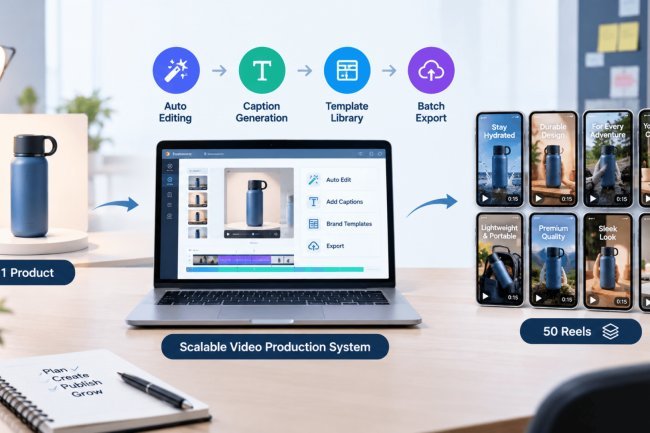
Automated asset management workflows
Check our full service capabilities at Digiverse Studio to explore how high-volume content systems are architected to support localization at national and international scale without compressing creative quality.
75+
Languages Supported
AI-driven voice and text adaptation across major global markets.
6x
Faster Deployment
Automated pipelines vs. traditional six-week agency cycles.
2x
Audience Engagement
Culturally adapted content consistently outperforms direct translations.
The Takeaway
The most successful global campaigns are the ones that make every market feel like the primary audience, not an afterthought.
The Future of Content Ecosystems
Video localization is not a one-time project — it is an ongoing operational capability that must evolve alongside your brand, markets, and technology landscape. The brands that will dominate global markets are building content ecosystems engineered for speed, cultural intelligence, and centralized creative control. [543][544][549]
01
Global Framework
Centralized Creative Control
The future of global content is centralized intent with distributed execution. Lock campaign emotional arcs, brand voice, and core visual identity at the global level, then give regional teams latitude to resonate locally within a defined framework. [544][549][551]
02
Production Layer
Operational Efficiency at Scale
Automate deployment of bumpers, watermarks, lower-thirds, and market-specific CTAs across hundreds of video variants. Structured localization workflows can generate market-ready versions from a master asset and variable data without manually editing every file. [543][547][553]
03
Discovery Layer
GEO & AI SEO Visibility
Localized video is only as valuable as its discoverability. Build market-specific landing pages, multilingual FAQs, regional entity signals, and structured metadata so AI systems can understand and surface localized content. [542][548][554]
The Localization Model
Global intent.
Local execution.
How to Structure It
Define non-negotiable global pillars, regional angles, and local legal or cultural requirements. The central team supplies the campaign platform, brand rules, production templates, and shared assets; regional teams interpret the concept, select local talent, and decide what requires transcreation rather than simple translation. [544][549][551]
What Changes by Market
Voice &
Captions
On-Screen Text
& Lower Thirds
CTAs
& Offers
Cultural
References
Identify the layers that vary by market — language, subtitles, voiceover, on-screen text, imagery, currencies, dates, legal lines, and CTAs. Organize those variables in structured data so a master asset can generate reviewed, branded variants at scale. [543][547][552]
The Localization Workflow
Master
Asset
→
Localize
Variables
→
Human
Review
→
Deploy
by Market
→
Optimize
for GEO
Use AI for first-pass variants, then have in-market reviewers adjust nuance, references, and pacing. Feed corrections back into prompts and templates so the system improves with every market cycle. [544][548][554]
The Bottom Line
The brands that dominate global markets will build content ecosystems that are fast, culturally intelligent, and centrally governed.
Centralize the brand, localize the execution, automate the mechanics, and optimize every market for AI-driven discovery.