The Role of Digital PR in Generative Engine Optimization (GEO)
As AI-powered search engines reshape how people discover information, brands face a new visibility challenge. This presentation explores how Digital PR has become the most powerful lever for earning a place in AI-generated answers — and why traditional SEO alone is no longer enough.
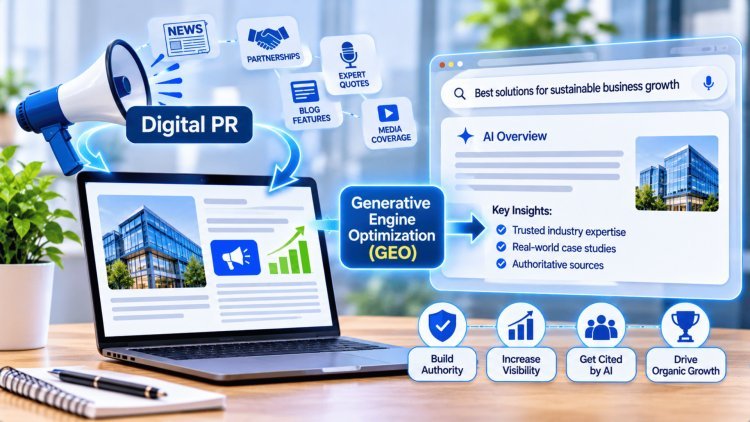
GEO Isn't Rankings — It's Being Summarized
Generative Engine Optimization (GEO) represents a fundamental shift in how online visibility works. Traditional SEO was about ranking on page one of a search results page — users would scan a list of blue links and choose where to click.
Generative engines like ChatGPT, Perplexity, Google's AI Overviews, and Bing Copilot operate differently: they synthesize information from dozens of sources across the web and deliver a single, confident, synthesized answer directly to the user.
What GEO Changes
This changes everything about what "being visible" means. In the GEO era, success is not measured by your position in a ranked list — it is measured by whether your brand is mentioned, cited, summarized, or recommended within that AI-generated response.
If the AI doesn't know about you, trust you, or have enough credible source material to draw from, you simply don't exist in that answer.
Traditional SEO vs Generative Engine Optimization
Traditional SEO
Users see a ranked list of links and self-select which result to click.
Visibility = a high position on the results page.
Click-through rates and keyword rankings are the primary KPIs.
AI synthesizes multiple sources into one authoritative answer.
Visibility = being cited, named, or summarized inside that answer.
Brand mentions, earned coverage, and source trustworthiness are the primary KPIs.
Mentioned
AI systems must encounter your brand repeatedly across credible sources before they can confidently include you in generated answers.
Trusted
Authority is increasingly established through source credibility, expert validation, media coverage, reviews, and evidence-backed information.
Summarized
Winning visibility now means becoming part of the answer itself rather than merely appearing as an option for users to click.
The Strategic Rethink
The question is no longer "How do we rank for this keyword?"
It's "How do we become the source the AI trusts when answering questions in our category?"
Why Digital PR Matters Now
For marketers and communications professionals, this shift elevates the importance of Digital PR. Earned media coverage, authoritative mentions, expert commentary, industry citations, and trusted third-party references become the raw material that generative engines use to build recommendations and summaries.
Core GEO Principle
GEO is not about ranking higher. It is about becoming part of the answer.
Brands that build credibility, authority, and machine-readable evidence across the web position themselves to be cited, summarized, and recommended by the AI systems that increasingly shape purchasing decisions.
Authority → Trust → AI Citation → Visibility
DIGITAL PR & AI VISIBILITY
Why PR Beats "Just Content" in AI Answers
Many brands have invested heavily in owned content — blog posts, whitepapers, landing pages, resource hubs — under the assumption that publishing enough high-quality content would eventually translate into AI visibility. The data tells a more nuanced story. While owned content still plays a role, large language models (LLMs) are specifically designed to weight third-party, editorially independent coverage far more heavily than content a brand publishes about itself.
THE CREDIBILITY GAP
Independent Validation Matters
When an AI model is trained or retrieves sources to build an answer, it applies implicit trust signals similar to how a journalist would evaluate a source. A brand saying something about itself carries far less weight than an independent journalist, analyst, or publication saying it. This is not a flaw — it is a feature. AI systems are built to resist self-serving claims and prioritize verified, corroborated information from credible third parties.
OWNED CONTENT & EARNED MEDIA
BRAND-PUBLISHED
Owned Content
↓
INDEPENDENT VALIDATION
Earned Media
Three Findings That Change the Strategy
LLMs prefer earned media
When describing brands, AI systems demonstrably favor third-party earned coverage over owned content. A brand's own website is often treated as a primary — but less trusted — source, while editorial mentions from authoritative outlets are treated as validation.
Unlinked mentions still matter
In traditional SEO, a backlink was the currency of authority. In GEO, unlinked high-authority brand mentions can still influence AI citations. If a respected publication references your brand or spokesperson — even without a hyperlink — that signal contributes to your AI presence.
89%+
of AI-cited links are earned
Research indicates that the overwhelming majority of sources cited by AI tools in response to commercial and informational queries are earned media placements — not paid ads, not owned blog posts, not sponsored content. Earned coverage is the primary fuel for AI visibility.
THE STRATEGIC IMPLICATION
The implication is clear: investing in Digital PR isn't just a brand-building exercise — it's directly building the source pool that AI draws from when answering questions in your category.
Digital PR Inputs
GEO’s “Trust Math”
AI models do not pull from just any source on the internet. They apply an implicit weighting system that favors editorial credibility, factual precision, structured information, and freshness. Understanding this “trust math” is essential for designing Digital PR that feeds AI visibility — not just human readers. [782][785][786]
01
Trust Input
Editorial &
Journalistic Coverage
Earn coverage from national outlets, trade publications, and established digital media. Independent editorial coverage provides corroboration beyond brand-owned pages. [782][785][789]
02
Trust Input
Structured,
Extractable Facts
Make claims specific, attributable, and easy to parse. Use named spokespeople, defined statistics, schema markup, and clear attribution. [786][791][792]
03
Trust Input
Proprietary Data
& Fresh Statistics
Publish original surveys, datasets, and industry benchmarks. Fresh, clearly sourced data gives AI systems a citable fact that can be returned to repeatedly. [786][789][794]
Editorial Coverage
A placement is
more than reach.
Independent Corroboration
High-credibility journalistic coverage can enter the retrieval pool that AI systems use when answering questions about trust, value, or category recommendations. A placement in a respected publication does not only reach its readership — it can create independent corroboration for the brand’s claims. [782][785][789]
Structured, Extractable Facts
Specific
Claims
Named
Spokespeople
Defined
Statistics
Clear
Attribution
Vague brand storytelling is difficult for LLMs to parse and cite reliably. Structured content — precise claims, named experts, defined statistics, schema markup, and clear attribution — increases the likelihood that AI systems can extract and reuse the information. [786][791][792]
Proprietary Data
Own the fact.
Become the source.
Original Research as a Citation Asset
Original, proprietary research is among the highest-value inputs into AI visibility. A unique survey finding, dataset, or industry benchmark becomes a citable fact that AI tools can return to repeatedly. Publish the methodology, sample size, time period, and source page so the claim can be verified. [786][789][791]
Freshness & Consensus
Refresh Regularly
Release updated data and revise claims when the underlying evidence changes.
Align Messaging
Keep facts consistent across owned pages, press coverage, and third-party sources.
Avoid Staleness
Google notes that rich results will not appear for time-sensitive content that is no longer relevant. [491][786][794]
Consistent messaging across multiple outlets reinforces facts and signals consensus across sources. AI visibility is inherently variable, so measure inclusion, citations, and brand mentions over time rather than treating one response as a stable ranking. [784][785][786]
The GEO-Ready PR Workflow
Create
Original Data
→
Publish
Methodology
→
Earn
Coverage
→
Structure
the Facts
→
Refresh
Over Time
Treat Digital PR as a GEO input: create citable research, earn independent coverage, structure the facts for extraction, and refresh the evidence as the market changes. [786][789][794]
The Bottom Line
AI visibility is earned through verifiable facts, independent corroboration, and fresh evidence.
Build Digital PR that gives AI systems something specific to cite — not just something human readers to admire.
The 3-Step GEO Playbook
Build → Earn → Prove
GEO success is not driven by isolated tactics. It emerges from a repeatable system that creates authoritative assets, earns trusted mentions, and continuously validates performance through real-world AI visibility measurement.
01
Build
Authoritative Assets
Create expert-led commentary, original data, structured content, schema markup, and clear messaging that AI systems can confidently extract, understand, and cite.
02
Earn
Trusted Mentions
Generate coverage through authoritative publications, respected trade media, and credible industry sources that AI systems rely on for validation.
03
Prove
Monitor & Refresh
Audit AI answers regularly, identify citation gaps, refresh content, and circulate updated information before competitors capture authority.
The GEO Authority Engine
Expert Assets
→
Media Coverage
→
AI Citations
→
Visibility Growth
→
New Authority
What Builds Citations
Original research, expert insights, structured data, schema markup, named spokespeople, proprietary statistics, and regularly refreshed content assets.
What Weakens Citations
Syndicated content, inconsistent messaging, outdated statistics, weak source credibility, and promotional content lacking evidence or expertise.
Treat AI Visibility as an Ongoing Metric
Regularly test key commercial queries across ChatGPT, Perplexity, Google AI Overviews, Gemini, and Copilot. Every inaccurate answer, missing citation, or outdated reference represents an opportunity to improve content and strengthen authority.
Generative Era Principle
The brands that win GEO
don't chase visibility.
They become the sources AI trusts.