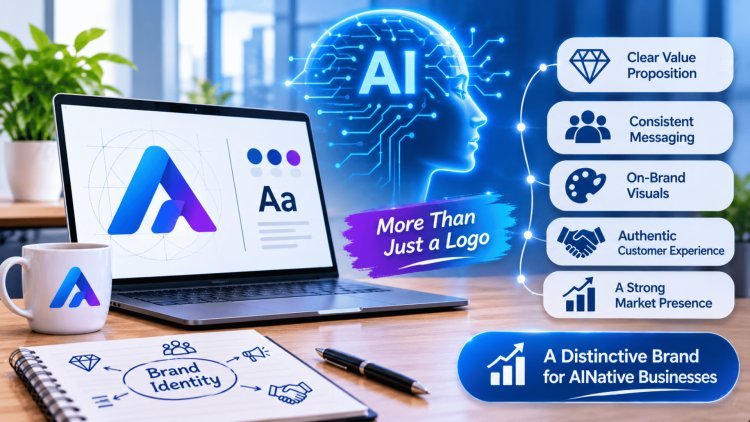
Beyond the Logo: Distinctive Brand Identity for AINative Businesses
Most AI companies invest heavily in model capabilities and product features — yet treat brand identity as an afterthought. The result is a market flooded with indistinguishable products. This presentation explores how AI-native businesses can build brands that emotionally resonate, survive rapid product evolution, and turn the interaction itself into a defining brand experience.
BRAND IDENTITY · AI-NATIVE PRODUCTS
The Shift: Brand the Interaction,
Not Just the Look
Traditional brand identity focused on static assets — logos, color palettes, typography applied to marketing materials. For AI-native products, this model is fundamentally insufficient. AI is experienced as a live dialogue: prompt-based, conversational, generative, and dynamic. Identity must extend into the fabric of that experience — into voice, motion, interaction states, and immersive touchpoints — not merely into the visual skin applied around it.
01 / INTERACTION
◎
Behavior as Brand Recognition
Interaction becomes identity
Google's Circle to Search
Google's Circle to Search is a masterclass in interaction branding. By anchoring its signature four-color palette directly to a gesture — the act of circling content to search — Google transformed a UI behavior into a brand moment. Users don't just see Google; they perform Google. The implication for AI products is profound: when a distinctive visual or motion pattern is tied to the moment of core value delivery, brand recognition becomes inseparable from product utility.
“ VOICE & PERSONALITY
In prompt-driven products, the words the AI chooses are as much a brand expression as any logo. A consistent, carefully defined voice — confident but not arrogant, precise but not cold, helpful but not sycophantic — differentiates at every interaction. This means brand teams must collaborate with model fine-tuning and prompt engineering teams to ensure that tone of voice is built into the product layer itself, not just the marketing copy.
02 / VOICE
◖))
Voice as a Brand Layer
03 / MOTION DESIGN
Motion as Meaning
Real-time brand signals
Static brand guidelines cannot communicate an AI agent at work. Motion design — the rhythm of a thinking indicator, the way results appear, the micro-animation on a completed task — carries emotional weight that static assets cannot. These motion signatures, when designed with intention and consistency, teach users what the brand feels like in real time. Done well, users begin to associate a specific motion pattern with safety, speed, or intelligence before a single word is read.
Thinking indicator
The rhythm of a thinking indicator
Result presentation
The way results appear
✓
Task completion
The micro-animation on a completed task
The Problem: AI Brands Drown in Monotony
Across the AI landscape, a troubling pattern has emerged: products that are genuinely differentiated under the hood become visually and emotionally interchangeable to the market.
The root cause is that most AI products were born in labs and developer environments — built to impress engineers, not consumers. As these products scale toward mass adoption, they carry forward an aesthetic vocabulary that was never designed to build trust or emotional connection.
Purple-to-blue gradients, glowing brains, orbiting particles, and minimalist sans-serif wordmarks have become the default visual language of AI.
While individually these choices may seem polished, in aggregate they create a sea of sameness. When every product looks like every other product, differentiation dissolves before trust has even had a chance to form. Users cannot remember which tool they used, let alone why they should return to it.
Overused AI Visual Tropes
Purple-to-blue gradients
Glowing digital brains
Orbiting particles and abstract sparks
Minimalist generic sans-serif wordmarks
02
Why This Matters for Growth
Brand recognition is not vanity — it is a compounding business asset. Studies in product marketing consistently show that emotionally resonant brands command premium pricing, generate stronger word-of-mouth, and retain users through feature gaps and competitive pressure.
For AI companies, where the underlying model can be replicated or surpassed within months, brand identity may be the most defensible moat available.
Generic Aesthetics Signal "Yet Another AI Tool"
Users disengage before experiencing value because nothing visually distinguishes the product from competing alternatives.
Clichéd Visual Metaphors Undermine Innovation Claims
Orbs, sparks, and neural nets communicate category conformity rather than breakthrough thinking.
Emotional Distance Drives Churn
Without emotional connection during first contact, users feel little loyalty even when the product performs well.
Enterprises Interpret Vagueness as Risk
Regulated and enterprise buyers often see unclear branding as a signal of operational immaturity.
Generic AI Brand
Familiar Visual Tropes
Category Mimicry
Weak Recall
Low Emotional Connection
Commoditized Perception
Distinctive AI Brand
Unique Visual Language
Strong Positioning
Brand Recall
Emotional Resonance
Defensible Identity
The Breakthrough Formula
Distinctive Choice → Consistent Execution → Recognition → Trust
Strategic Conclusion
The brands that break through are those that make a distinctive visual and verbal choice early — and commit to it consistently across every touchpoint, from landing page to loading state.
In a market where technology advantages can shrink quickly, memorable identity becomes a long-term competitive asset that compounds with every interaction.
Distinction → Recognition → Trust → Growth
Build a Brand System That Survives Model Updates
AI products evolve at extraordinary speed. Models improve, interfaces change, and new capabilities appear continuously. Without a durable brand system beneath that change, identity fragments over time. The goal is not to make change impossible. The goal is to make change feel consistent.
Core Challenge
Models change weekly.
Trust must remain stable.
Why Drift Happens
Each product release introduces visual and verbal inconsistency.
Marketing, support, and product experiences begin to feel disconnected.
New team members default to personal preferences instead of shared standards.
Costly rebrands become necessary every few years to restore coherence.
Identity Layer
Logos, typography, color systems, iconography, and illustration rules create the foundational visual vocabulary that remains recognizable regardless of changing product features.
Design System Layer
Tokenized design foundations, component libraries, spacing systems, and motion principles transform branding decisions into reusable engineering assets.
Product State Layer
Define consistent treatments for thinking, generating, waiting, success, and error states so users always understand what the AI is doing and why.
Trust Signaling Layer
Anchor communications in evidence, transparency, and real outcomes. Replace promises of magic with demonstrations of capability and reliability.
The Brand Infrastructure Stack
Trust Signals
Product States
Design System
Identity Foundation
Enterprise Reality
Trust Shortens Sales Cycles
Why Trust-First Branding Matters
Particularly in regulated and enterprise sectors, buyers evaluate more than features. They assess stability, competence, risk, and operational maturity. Consistent branding across product experiences becomes a signal of organizational reliability.
Closing Principle
Features will change.
Interfaces will evolve.
A strong brand system ensures trust remains recognizable.
The companies that survive constant model updates are not the ones that resist change. They are the ones that design consistency deeply enough that every change still feels unmistakably like them.
The Playbook: Five Decisions From Promise to Motion
Strong AI brands are not built through isolated design choices. They emerge from a sequence of interconnected decisions that move from strategic clarity to product experience. Each layer reinforces the next, creating a system that becomes more recognizable, trustworthy, and durable over time.
1. Promise
Define one sentence that explains what you do, who you serve, and the change you create. Every branding decision should be traceable back to this single strategic anchor.
2. Voice
Choose three communication traits and define real-world do/don't examples. Voice should guide every interaction from onboarding copy to support conversations.
3. Visual System
Build a design language recognizable even without a logo. Color, typography, imagery, shape language, and motion should create immediate pattern recognition.
4. Product UI as Brand
Every state communicates identity. Loading screens, responses, empty states, and real outputs should reinforce trust through clarity and usefulness.
Making the Invisible Agent Visible
AI systems perform their most valuable work behind the scenes. Motion design translates hidden activity into visible confidence by showing when an agent is thinking, working, succeeding, or encountering uncertainty.
Brand System Dependency Chain
Promise
→
Voice
→
Visual Identity
→
Product Experience
→
Trust
Final Principle
Strong brands are not built through isolated assets.
They are built through connected decisions.
Promise defines direction. Voice creates personality. Visual systems build recognition. Product experiences reinforce trust. Motion makes intelligence visible. Together, they form a durable AI brand system that compounds in value over time.