Brand Asset Governance: Keeping Visual Identity Consistent Across Teams
Your brand is only as strong as its least consistent touchpoint. When teams operate without shared systems, visual identity fractures — silently, gradually, and at scale. This guide explores how to build governance frameworks that make consistency the default, not the exception.
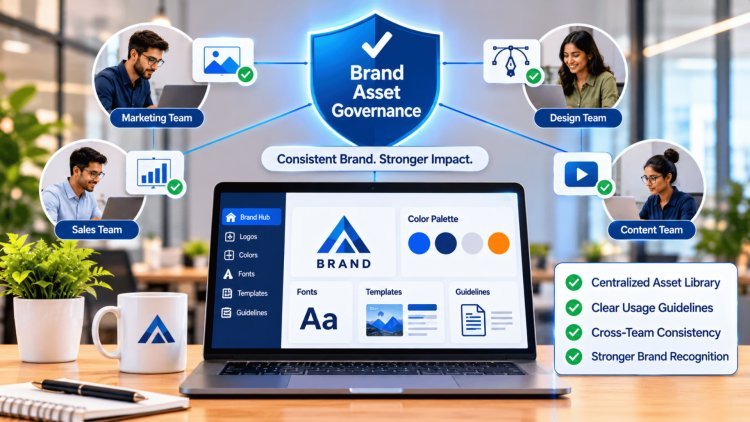
The Problem: Visual Drift Is a Governance Failure
Visual inconsistency rarely happens because someone chose to ignore brand standards. It happens because the systems that enforce those standards are missing, fragmented, or inaccessible.
When a designer in one region pulls an outdated logo from a shared drive, or a marketing contractor invents a new button color because no approved component existed — that's not carelessness. That's a governance gap.
The Root Cause
Teams don't "forget" branding — they operate with fragmented assets, no single source of truth, and unclear decision rights. Without defined controls, every team member becomes an ad hoc brand decision-maker, often without realizing it.
The result is visual drift: gradual, cumulative divergence from the established identity that compounds across campaigns, channels, and geographies.
Governance Defined
Brand governance is the deliberate, structured work of controlling how your brand is presented and used — internally and externally, digitally and physically. It encompasses who can access assets, who approves usage, which elements are locked vs. flexible, and how violations are caught and corrected. It is not a creative constraint; it is the operational infrastructure that protects brand equity over time.
Subjective Decisions
Uncontrolled Publishing
Version Confusion
Growing Inconsistency
Defined Decision Rights
Approval Controls
Version Confidence
Consistent Brand Presence
What Governance Includes (Beyond Logos)
Most teams think brand governance means keeping the logo from being stretched. In reality, effective governance spans the entire visual and verbal identity system — from pixel-level specifications to the tone used in a customer support email. A complete governance framework is both a creative rulebook and an operational process that embeds brand standards into everyday workflows.
Visual Identity Standards
Define and enforce every visual element: primary and secondary logos, clear space rules, approved color palettes with exact HEX/RGB/CMYK values, typography hierarchies, iconography systems, photography direction, and illustration styles. These are the non-negotiable fixed elements that must be locked across all usage.
Feedback & Approval Workflows
Build structured review processes so that brand-impacting work passes through defined checkpoints before publication. This includes designated brand reviewers, turnaround SLAs, revision protocols, and clear escalation paths for edge cases. Without a workflow, "approval" is informal and inconsistent by definition.
Employee Training & Activation
Guidelines only work if people understand them. Governance includes onboarding new team members, running brand literacy workshops, and creating selfservice reference materials so every contributor — from full-time designers to occasional stakeholders — can apply standards confidently without needing to ask.
Messaging & Tone of Voice
Verbal identity is as much a governance concern as visual identity. Define the brand's voice attributes, messaging pillars, approved terminology, and writing style. Ensure that how the brand sounds in a press release, a social caption, or a sales deck is as controlled and consistent as how it looks.
Visit Digiverse Studio to see how unified brand identity is applied across AI video, branding, and VFX disciplines.
Consistency That Audits Well
At enterprise scale — multiple teams, multiple brands, multiple markets — governance must move beyond culture and intention into verifiable, auditable systems.
This is the operational layer that separates mature brand organizations from teams that are simply hoping for the best.
Every asset must have a canonical, versioned master. Deprecated files must be retired from circulation immediately when updates are made.
Semantic versioning on logo packages and style guides ensures teams always know what is current and what has been superseded:
For regulated industries and enterprise organizations, knowing who accessed, modified, and distributed an asset is as important as the asset itself.
Chain-of-custody logs track asset lifecycle from creation through distribution, providing accountability and enabling rapid response when misuse is detected.
Not every team member should have access to every asset. Role-based permissions determine who can download master files, who can customize templates, and who can publish externally.
Authorization gates prevent both accidental misuse and deliberate deviation. Define tiered access — rights granted separately:
Build your asset management system to support periodic brand audits. Scheduled reviews — quarterly or biannually — should assess whether distributed assets in use across channels still match current approved versions.
Audit findings should feed directly back into governance improvements, closing the loop.
For organizations managing multiple sub-brands, agency relationships, or geographic markets, a centralized, permissioned Brand Kit is the gold standard.
This architecture achieves two things simultaneously:
The result is a system that is both efficient and enforceable — the combination that makes brand governance sustainable at scale.
What's Your Reaction?