The Psychology of Social Proof in High-Converting Video Ads
Why "Everyone Else" is the most powerful line in your creative brief — and the science behind making it work.
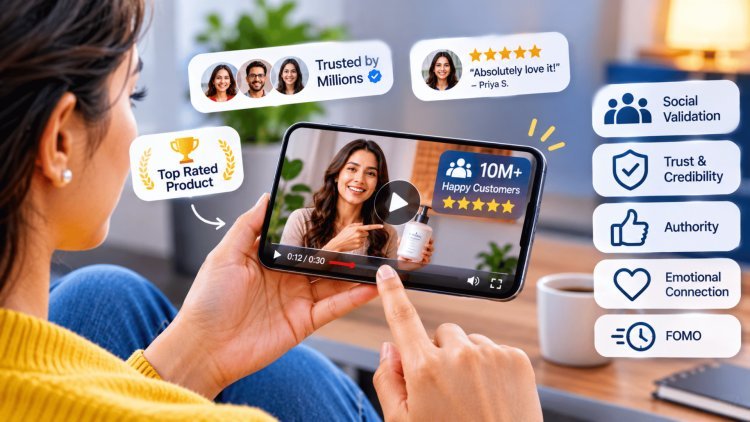
Why Social Proof Works: Uncertainty + Belonging
Social proof isn't a marketing gimmick — it's a deeply wired cognitive response. When people face uncertainty about what to buy or who to trust, they instinctively look to the behavior of others to calibrate their own decisions.
This isn't weakness; it's efficient processing under conditions of incomplete information.
The Psychology of Social Proof
Solomon Asch's landmark conformity studies revealed that 75% of participants gave an obviously wrong answer at least once when surrounded by others who agreed on the wrong choice.
People conform not just to be accepted — they conform because social consensus genuinely reshapes perceived reality.
In a purchase context, a crowd of satisfied customers isn't just comforting; it's actively convincing.
02
Verifiability Over Emotion
The instinct in ad creative is to go emotional — swell the music, flash the smiling faces. But the most effective social proof video isn't primarily emotional.
It's designed to be verifiable on-screen. The viewer needs to see something they can mentally check: a real name, a real rating, a real order confirmation.
When proof feels checkable, it bypasses skepticism in a way that pure emotion cannot.
The Two Levers of Social Proof
Informational Influence
"Others know something I don't."
Their choice becomes useful data that helps reduce uncertainty and improve decision confidence.
Normative Influence
"I want to belong."
The choice signals alignment with a trusted group, community, or social identity.
Weak Social Proof
Generic Testimonials
Stock Smiles
Anonymous Quotes
Emotional Claims
Low Verifiability
Strong Social Proof
Real Names
Real Ratings
Real Reviews
Real Transactions
Clear Verification
High-Converting Social Proof Formula
Verifiable Evidence + Social Consensus + Belonging Signal = Trust
Core Insight
High-converting ads don't choose between uncertainty reduction and social belonging. They trigger both simultaneously.
The strongest social proof gives viewers evidence they can verify and a group they want to join. That's why social proof works so consistently across categories, markets, and purchase decisions.
Uncertainty → Evidence → Belonging → Conversion
VIDEO & SOCIAL PROOF
The Six Faces of Proof — and
Why Video Makes Them Hit
Social proof takes many forms, but video amplifies each one in a unique way. The medium adds dimension, emotion, and credibility that static formats simply cannot replicate. Here's how each type performs in motion.
Testimonials are persuasionthrough-lived experience.
Watching a real person describe a transformation — including hesitation, surprise, and relief — is exponentially more credible than reading a quote. Video captures micro-expressions that written words cannot. Viewers subconsciously assess authenticity in real time.
47K+
"over 47,000 customers" outperforms "thousands of customers"
Quantified proof functions as "measured reality." The key is specificity and context: "over 47,000 customers" outperforms "thousands of customers" because it feels counted, not estimated. Pair stats with the unit of measurement and time frame on screen — always.
REAL PERSON UNPROMPTED UNPOLISHED
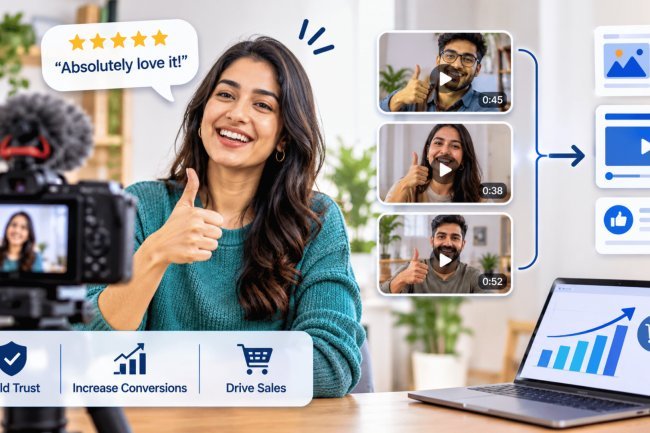
User-generated content and peer demonstrations earn the highest trust scores of any proof format. The viewer watches a real person — unprompted, unpolished — choosing and reacting. The imperfection is the point. It signals that no brand script exists, which makes the choice feel genuinely voluntary.
Star ratings are among the fastestprocessed cognitive shortcuts in purchasing decisions. In video, they hit hardest when shown with a recognizable source — Trustpilot, G2, Google — because the thirdparty platform lends independent authority. Anonymous ratings shown without context lose much of their persuasive weight.
The Video-Proof Rules:
Make It Attributable,
Observable, Datable
Social proof can backfire when it feels manufactured, vague, or anonymous. The difference between proof that converts and proof that erodes trust comes down to three non-negotiable properties: attributable, observable, and datable. [885][886][897]
01
Proof Rule
Attributable
Put a name and face to the source. Use a first name and city, verified review badge, or LinkedIn headshot so the viewer can anchor the claim to a real person. [885][886][897]
02
Proof Rule
Observable
Show the fact, not just the assertion. Demonstrate the product in hand, show texture, display an order confirmation, or use a before-and-after side-by-side. [885][886][887]
03
Proof Rule
Datable
Anchor proof in time. Use “since January,” show review timestamps, or display an order-history screenshot with a visible date. [885][886][897]
Attributable Proof
Put a real person
behind the claim.
Traceable Source
Anonymous voice-overs, unlabeled stock footage, and generic “satisfied customer” copy all trigger the same skeptical response: who is this, really? Every proof element needs a traceable source. The more identifiable the source, the more weight the claim carries. [885][886][897]
Observable Proof
Product
In Hand
Texture
Demonstrated
Order
Confirmation
Before &
After
“It works great” asserts a claim. Showing the product in hand, demonstrating texture, flashing an order confirmation, or displaying a before-and-after makes the claim visually verifiable. Observable proof removes the gap between assertion and evidence. [885][886][887]
Datable Proof
Make the experience
recent and relevant.
Time Context Restores Credibility
Undated testimonials feel timeless in the worst sense — they could be years old, cherry-picked from an outlier cohort, or written before the product changed. Time context signals that the experience is recent, relevant, and representative. [885][886][897]
Specific Language Over Generic Praise
Vague Proof
“I loved it!”
Activates fraud-detection instincts; feels manufactured or unverifiable. [885][886][897]
Specific Proof
“I lost 11 lbs in my first 6 weeks.”
Use exact lines, real captions from actual reviews, and genuine on-camera reactions — not softened rewrites. [885][886][897]
Vague proof is worse than no proof because it activates the viewer’s fraud-detection instincts. Specificity is the antidote. [885][886][897]
Compliance Guardrail
The FTC treats endorsements and testimonials as advertising messages consumers may believe reflect another party’s experience. If a consumer endorsement concerns a central product attribute, it may be interpreted as representing typical results; material connections between endorser and advertiser must be disclosed. [885][886][890]
Use Real,
Consented Proof
Disclose
Material Connections
Avoid Implying
Typical Results
The Bottom Line
Proof converts when it is real, visible, dated, and specific.
Make every claim attributable, observable, datable, and precise — then let the evidence do the persuading.
From Psychology to Conversions: Placement, Stacking & Measurement
Understanding why social proof works is only the starting point. The real leverage comes from knowing exactly where proof should appear, how multiple trust signals should be layered together, and how performance should be measured to validate impact.
The Trust Architecture
Proof Statement
↓
Product Demonstration
↓
Trust Reinforcement + CTA
Principle One
Proof-First Sequencing
Lead with a statistic, transformation, testimonial, or outcome before revealing the product. Curiosity created by proof pulls viewers deeper into the story.
Principle Two
The Trust Sandwich
Open with proof, follow with a demonstration, then reinforce credibility immediately before the CTA. Trust surrounds the decision point from both directions.
15–40%
CTR Lift
Improvement from strong, specific social proof compared to generic creative.
10–25%
Conversion Lift
Gains achieved when proof is integrated into the structure, not added at the end.
How to Measure Trust-to-Action
VTR
Does proof retain attention beyond the critical scroll threshold?
CTR
Does trust framing improve click behavior?
Conversion Rate
Compare identical creatives with and without proof layers.
Variant Testing
Test testimonials, statistics, and UGC against each other.
Testimonial
Human credibility
Demonstration
Product proof
Statistics
Quantitative trust
Final Principle
Don't just add proof.
Engineer a proof architecture.
When proof appears at the right moments, in the right sequence, and is measured systematically, trust compounds across the entire funnel and transforms attention into action.