UGC Ad Fatigue: How to Refresh Creative Without Losing Your Message
User-generated content is one of the most powerful performance advertising tools available — but even the most resonant creative has a shelf life. When your winning ad stops winning, the instinct is often to panic and rebuild from scratch. This guide breaks down a smarter, more surgical approach: diagnosing fatigue precisely, refreshing strategically, and building systems that keep your brand message alive long after the original creative has peaked.

The Anatomy of Ad Fatigue
Ad fatigue is one of the most misdiagnosed problems in performance marketing. When results start to slide, teams often assume the product messaging is broken, the audience has changed, or the platform algorithm has shifted against them.
In the vast majority of cases, the reality is simpler and more solvable: your audience has reached saturation point. They have seen your creative enough times that it no longer registers as new information — and their brains have learned to scroll past it before the hook even lands.
Fatigue has a recognizable fingerprint in your data. The most reliable early warning signs appear in a specific combination of metrics that move together as saturation builds across your audience segments.
Tracking these three metrics together on a weekly cadence gives you a reliable early warning system. Viewed in isolation, each metric can be misleading. Together, they tell a clear story about audience saturation and creative decay.
The "Total Reset" Trap
The most costly mistake brands make when they detect fatigue is killing a winning ad entirely rather than isolating the specific variable causing the decline. This is the Total Reset trap, and it is surprisingly common — even among experienced performance teams.
When you delete a fatigued ad and start over with an entirely new creative, you lose everything that was working: the proven script structure, the emotional arc that drove conversions, the social proof framing that built trust.
You are essentially throwing away validated creative equity in a moment of panic.
Rewrite Everything
Replace Messaging
Ignore Learnings
Restart From Zero
Refresh The Hook
Test New Openings
Retain Winning Structure
Extend Creative Lifespan
The data almost never supports a full reset. What it supports is a targeted intervention — changing the one or two elements that have burned out while preserving the structural foundation that generated results in the first place.
The goal is not to build a new ad. The goal is to make your existing winning ad feel new again to an audience that has memorized it.
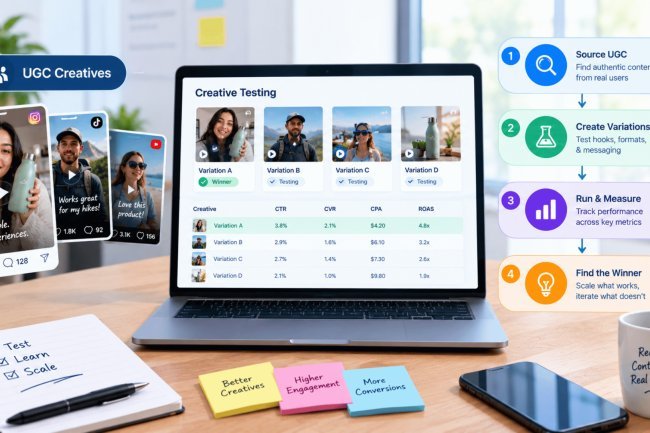
Refreshing fatigued creative is not an art — it is a discipline. The Creative Testing Framework gives you a structured method to isolate failing variables without discarding the successful baseline that your budget already proved out. Rather than guessing which element is broken, you systematically test one variable at a time against a control, moving through a clear priority order that reflects where viewer burnout actually originates. Explore more about applying this methodology through the UGC creative testing resources at Digiverse Studio.
The opening three seconds of your ad carry a disproportionate share of the creative workload. They determine whether a viewer pauses or scrolls, and they are the element your audience encounters most frequently — which makes them the primary source of burnout. When CTR begins to decline while your body content remains strong, the hook is almost always the culprit. Swap in a new opening line, visual, or question while keeping everything downstream intact. A single new hook can extend a proven ad's effective lifespan by weeks.
Human pattern recognition is exceptionally fast. Audiences who have seen the same face deliver the same message multiple times begin to filter it out at a nearly subconscious level — the familiar face triggers a "seen this" response before the words even register. Changing the creator or on-screen talent while keeping the proven script intact is one of the most effective and efficient refresh strategies available. The message resonance is preserved; the novelty signal is restored. This is especially powerful in UGC-led campaigns where the creator's authenticity is a core part of the value proposition.
The deepest level of refresh involves repositioning the value proposition itself — not changing what the product does, but changing which benefit you lead with and which emotional motivation you address. This becomes necessary when the core audience motivation has shifted, or when you are expanding into adjacent audience segments who respond to different pain points. Angle refreshes require the most careful creative thinking, but they also unlock entirely new pools of audience engagement without requiring you to abandon your proven product demonstration or social proof structure.
The Surgical Refresh Framework
Priority 1 — The Hook
Priority 2 — The Actor or Creator Face
Priority 3 — The Angle or Value Proposition Frame
What's Your Reaction?