How to Design Product Demonstration Ads That Reduce Purchase Hesitation
Most ads fail not because the product is bad — but because the viewer doesn't believe it will work for them. Product demonstration ads are the most powerful antidote to purchase hesitation, but only when they're engineered to build trust at every frame. This guide breaks down the four-part framework for designing demo ads that convert skeptics into buyers.
Start by Attacking the Hesitation, Not the Brand
The biggest mistake brands make in demo ads is leading with themselves — their logo, their tagline, their story. Buyers don't care yet. What earns attention in the first critical seconds is a problem the viewer already lives with.
When you open with the exact friction your buyer recognizes — the stain that won't shift, the tool that slips, the skin that won't clear — you accomplish two things simultaneously: you earn attention, and you self-select your highest-intent audience.
The Demo Ad Attention Flow
The first two seconds of your demo ad must do one job: show the problem or the result with enough clarity that a viewer instantly knows what they're about to see.
This is not the time for a branded intro or a lifestyle montage.
The viewer's brain makes a subconscious judgment: "Is this for me?" — and your opening two seconds must answer yes.
02
Why the Problem Earns More Than the Promise
When your ad opens on a promise ("The best cleaner on the market!"), the viewer's skepticism activates immediately.
But when you open on a problem they've personally experienced, empathy activates first — and empathy is a far more receptive mental state for persuasion.
The viewer leans in rather than pulling back. They want to see what happens next.
Weak Opening
Logo Animation
Brand Tagline
Lifestyle Montage
Product Claims
Immediate Skepticism
Strong Opening
Recognizable Friction
Specific Problem
Immediate Relevance
Curiosity Trigger
Viewer Identification
Demo Ad Opening Checklist
Open on the specific, recognizable problem — not a vague pain point.
Use real-world settings, not sterile studio conditions.
Let the problem breathe for 1–2 seconds before the solution appears.
Avoid voiceover or text in the first two seconds — let the visual do the work.
The Persuasion Sequence
Problem → Empathy → Curiosity → Demonstration
Core Principle
The strongest demo ads do not begin with the brand. They begin with the buyer's frustration.
Every second of brand-building before the proof is a second of lost trust capital. Lead with the problem, earn attention through recognition, and let the demonstration create belief.
Friction → Attention → Proof → Conversion
Visual Proof & Conversion
The "Money Shot" Kills Doubt Fast
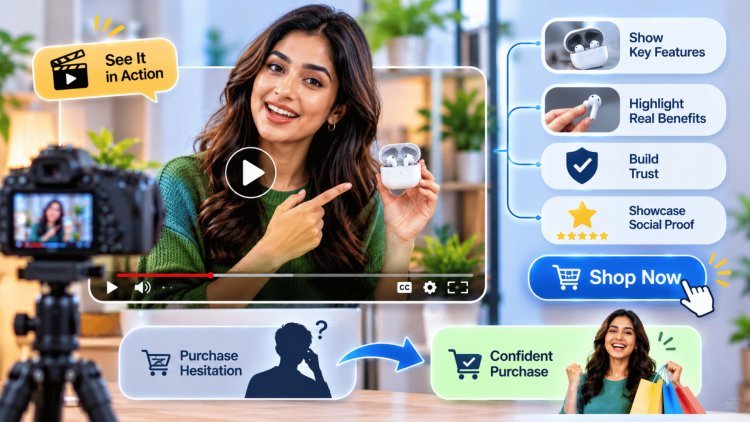
If the problem opening earns the viewer's attention, the money shot is what converts that attention into belief. The money shot is the single most convincing visual proof moment in your entire ad — the visible wipe, the before-and-after reveal, the mechanism clicking into place. It must arrive early, and it must be undeniable.
01
PROOF FIRST
Lead With Your Best Proof
Place your most convincing visual proof within the first 3–5 seconds after the problem is established. Counterintuitively, withholding your best moment to "build up to it" causes drop-off. Viewers who see the proof early stay to understand how it happened — which is exactly the cognitive journey that builds purchase confidence. Don't bury your headline.
02 / AUTHENTICITY ↔
Maintain Cause-to-Effect Continuity
After the money shot, the viewer's natural skepticism kicks in: "Was that edited?" Your job is to follow the proof moment with enough continuous, uncut footage for the viewer to trace the full cause-to-effect chain. A single jump cut at the wrong moment can undo seconds of built trust.
Show the full action — the wipe, the mix, the fold — without suspicious gaps that imply the hard part was hidden in the edit.
03 / SEQUENCE →
Engineer the Viewing Arc
The ideal demo ad has a clear arc: problem → money shot → continuity → proof stacking → risk removal. Each element is engineered to answer the viewer's next subconscious objection.
01 Problem
02 Money shot
03 Continuity
04 Proof stacking
05 Risk removal
THE VIEWER'S SUBCONSCIOUS QUESTIONS
MONEY SHOT
"Does it work?"
WHAT COMES NEXT
"Will it work for me?"
When you design this arc deliberately, you're not just showing a product — you're walking the viewer through a structured trust-building sequence that collapses the purchase decision timeline.
Stack Proof Like a Contract:
Real → Believable → Human
A single impressive demo moment is a claim. Multiple layered proof moments — from different angles, users, and surfaces — become evidence. The goal of proof stacking is to systematically dismantle every remaining doubt the viewer could have after the money shot. [870][871][872]
01
Proof Layer
Another Angle
Answer: “Is this real or edited?” Show the same result from a second camera angle or in continuous real time without cuts. [870][874][878]
02
Proof Layer
Another Surface
or User
Answer: “Will it work for me?” Show a second surface, user type, or application scenario so viewers can project themselves into the demo. [870][872][878]
03
Proof Layer
Process-Focused
Demo
Answer: “Could I do this?” Show the journey — application, wait, and reveal — so viewers mentally rehearse using the product. [870][871][873]
Another Angle
Make the result
impossible to dismiss.
Authenticity Signal
The first proof layer after the money shot should address the most common skepticism: that the footage was manipulated. A wide-angle shot followed by a tight close-up of the same action — viewed simultaneously or sequentially — signals authenticity in a way a single polished take cannot. [870][874][878]
Another Surface or User
Second Surface
Show the product working on a different material, environment, or condition.
Second User Type
Show a different skin tone, hair type, body type, or user context where relevant.
Second Scenario
Show a different application scenario so viewers can see themselves in the result.
Showing the product on one surface, skin tone, hair type, or use case leaves a gap: “Sure, but what about my situation?” Variety in demonstration contexts signals versatility and builds universal confidence. [870][872][878]
Process-Focused Demo
Show the journey,
not just the reveal.
Cognitive Flow
Research comparing process-focused demos with outcome-only showcases finds that step-by-step demonstrations can increase purchase intention through cognitive flow and narrative transportation. When viewers watch each step, they mentally rehearse doing it themselves, lowering the perceived effort barrier. [870][871][873]
The Proof-Stack Sequence
Money Shot
Claim
→
Second Angle
Real?
→
Second User
For Me?
→
Process
Can I?
→
CTA
Belief
Each proof moment should answer a distinct objection: Is it real? Will it work for me? Could I do it? Together, they produce a verdict of believability. [870][871][872]
The Bottom Line
One great result is a claim. A stack of proof is a case.
Show it from another angle, on another person, and through the process — then let the viewer reach the verdict themselves.
End With Risk Removal + Replication
By the end of a demo ad, belief is no longer the obstacle. The viewer has seen the product work, understood the outcome, and absorbed the proof. What remains is uncertainty. The final stage exists to remove risk, reinforce confidence, and make the next action feel inevitable.
Attack Hesitation
→
Money Shot
→
Stack Proof
→
Remove Risk + CTA
Keep the Ending Sharp and Purposeful
The closing seconds of a demo ad are not the time for additional storytelling, feature lists, lifestyle montages, or corporate messaging. The viewer has entered a decision state. Reinforce the offer, state the value proposition clearly, and remove uncertainty with a simple, direct risk-reduction statement such as a guarantee, trial period, or return policy.
One Product. One Promise. One Next Step.
Final Objection
“What if
it doesn't work
for me?”
Guarantees and trials answer the last unspoken question.
One-Line Offer Summary
Distill the product, outcome, and value proposition into one sentence. Remove jargon and complexity completely.
Risk Removal Statement
Clearly communicate guarantees, free trials, refund policies, or return windows. Confidence grows when risk visibly decreases.
Replication-Oriented CTA
Use action language that mirrors the product demonstration and encourages the viewer to experience the result personally.
CTA Psychology: Continue the Demo
Generic CTAs
• Learn More
• Shop Now
• Contact Us
Replication CTAs
• Try It Yourself
• Start Free
• Book Yours
• See It Work
Conversion Principle
The viewer just watched the instructions.
Make the CTA feel like the next step, not a sales pitch.
Great demo ads finish by removing uncertainty, reinforcing simplicity, and inviting action. When the final message mirrors the experience the viewer just witnessed, conversion becomes the natural continuation of the story.