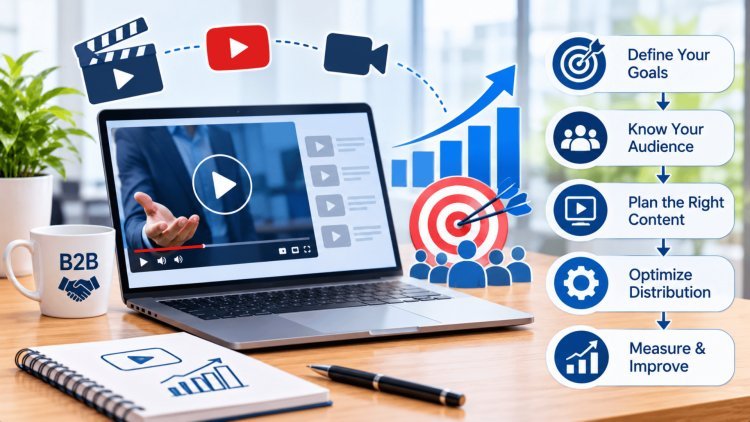
How to Build a Video Content Strategy for B2B Lead Generation
Video is no longer optional in B2B marketing — it's the highest-converting content format available. Yet most B2B brands treat video as an afterthought: a one-off webinar recording, a product demo buried on a pricing page, or a social clip made without a clear goal. The result? Effort without outcomes. This presentation walks you through a proven, systematic approach to building a video content strategy that generates qualified leads, accelerates pipeline, and compounds over time. From defining your funnel-stage content mix to implementing the S.T.A.R.T. framework and building scalable production systems, every step is designed to turn video from a cost center into a growth engine for your business.
From Tactic to Engine: The Strategy Shift
Most B2B marketing teams produce video reactively — a sales request here, a conference recap there. This ad-hoc approach burns budget without building momentum. The shift from tactic to engine requires viewing video as a system: interconnected assets that serve specific audiences at specific stages of the buyer journey, measured against defined business outcomes.
Build a Brief-First Culture
Before any camera rolls, every video must answer three foundational questions: Who is the specific audience segment? What funnel stage are they in? What single action do we want them to take after watching?
A disciplined video-first brief system eliminates wasted production cycles and ensures every asset has a measurable purpose. Without this foundation, even beautiful video sits unwatched and unconverted.
Design for Discoverability with GEO & AI SEO
Publishing without optimization is whispering in a crowd. Modern search has evolved beyond keywords — AI-powered engines and generative search experiences now surface content based on topical authority, structured metadata, and contextual relevance.
Integrating GEO and AI SEO principles into your video strategy means optimizing titles, transcripts, chapter markers, and embedding contexts so your content is found by both human searchers and AI recommendation engines. Discoverability is the multiplier that turns good content into consistent lead flow.
Treat Video as Infrastructure, Not Output
The mindset shift that separates high-performing B2B video programs from the rest is simple: video is infrastructure. Like your CRM or your website, it requires architecture, governance, and iteration.
That means establishing production templates, approval workflows, distribution checklists, and review cadences — not just a camera and an editor. When video operates as infrastructure, it scales. When it operates as output, it stalls.
Isolated Assets
Unclear Objectives
Irregular Distribution
Difficult To Measure
Connected Assets
Defined Outcomes
Repeatable Distribution
Measurable Growth
The Funnel-First Content Mix
Effective B2B video strategy maps content to buyer intent. A prospect who has never heard of your brand needs a radically different video experience than one evaluating you against a competitor. The funnel-first content mix ensures you're never showing the wrong video to the wrong person — and that every stage of the buyer journey has dedicated assets working on its behalf.
Awareness
Lead with curiosity or high-stakes problems. Your audience doesn't know they need you yet — your job is to make them feel the cost of inaction. Short-form videos (60–90 seconds) that name a specific pain point, challenge an industry assumption, or deliver a surprising stat perform best here. Prioritize thumb-stopping hooks and platform-native formats. Reach matters more than depth at this stage.
Consideration
Provide educational tutorials, expert breakdowns, and honest comparisons to build trust and demonstrate authority. Your prospect is actively researching — they want proof that you understand their problem deeply. Long-form explainers (5–15 minutes), webinar recordings, and thought leadership interviews work especially well here. Depth signals credibility and separates you from competitors who only publish promotional content.
Decision
Remove buyer objections with testimonials and product demos that speak directly to final-stage fears: implementation complexity, ROI certainty, and switching costs. Case study videos with specific metrics, side-by-side demos, and personalized video outreach from sales teams are the highestconverting assets at this stage. Every second of hesitation costs you a deal.
Retention
Foster loyalty and expansion revenue through onboarding walkthroughs, feature adoption stories, and community-building content. Retained customers are your most valuable lead generation asset — they renew, expand, and refer. Videos that celebrate customer milestones, explain advanced product features, or share peer success stories dramatically reduce churn and increase lifetime value. Retention video is the most underinvested category in B2B, and therefore your greatest opportunity.
Architecting for Results: The S.T.A.R.T. Framework
Great B2B video isn't accidental — it's engineered. The S.T.A.R.T. Framework is a production and scripting methodology designed to maximize watch time, trust, and conversion across every video asset your team creates. Apply it consistently and your content stops being hit-or-miss and starts performing predictably.
When every person on your team — from the strategist to the editor — applies S.T.A.R.T., your quality floor rises dramatically and your best ideas have structure to land in. Consistency compounds.
Run every script through the five checkpoints before production begins.
If any checkpoint fails, revise before filming — not after. Post-production fixes for structural problems are expensive and rarely effective.
What's Your Reaction?