The Art of Clarity: Visual Storytelling in Explainer Videos
In a world flooded with information, the most powerful explainer videos don't just communicate — they transform. They take complex ideas, dense data, and abstract systems and render them into something human, memorable, and emotionally resonant. Visual storytelling is the craft at the heart of this transformation: a discipline that combines narrative structure, character design, motion graphics, sound, and strategic simplicity into a unified experience that moves audiences from confusion to clarity — and from clarity to action.

The Anatomy of a Narrative
Every great explainer video is built on the same fundamental architecture that has driven compelling storytelling for centuries: a clear beginning, a conflict-driven middle, and a satisfying resolution. This three-part structure is not a creative constraint — it is the scaffolding that makes complex information digestible, emotionally engaging, and ultimately persuasive.
When an explainer video abandons this structure in favor of pure information delivery, it risks losing the viewer within the first thirty seconds.
1
Beginning: Set the Scene
The opening moments establish the world, introduce the central character, and define the context. The viewer should immediately recognize the scenario and feel oriented.
A strong introduction answers:
Who is this for?
What is their world like right now?
The goal is instant relatability — the viewer should lean in and think, "That's me."
2
Middle: Surface the Conflict
This is the emotional engine of the video. The middle section dramatizes the problem — the familiar frustration, the inefficiency, the unmet need.
Conflict is not negativity; it is the honest acknowledgment of a real pain point.
By articulating the struggle with precision and empathy, the video earns the viewer's trust and builds genuine appetite for a solution. The more specifically the conflict mirrors the viewer's real experience, the more powerful this section becomes.
3
End: Deliver the "Aha" Moment
The resolution is where clarity lands. The product, service, or idea is revealed not as a feature list, but as the natural answer to the tension that has been building.
Done well, the conclusion creates an unmistakable "aha" moment — a cognitive and emotional release where everything clicks into place.
This is the moment a viewer converts from passive observer to active believer.
Beginning
Establish Context
Build Relevance
Create Identification
Middle
Surface Pain
Build Tension
Earn Trust
End
Deliver Solution
Create Clarity
Drive Action
Why Narrative Works
Context → Conflict → Resolution → Action
Foundational Insight
The three-act structure works because it mirrors the way the human brain naturally processes and retains information — through tension and release, not through feature lists.
Story → Emotion → Understanding → Belief
Character-Driven Storytelling
The Role of the Relatable Character
Characters are the single most powerful tool in an explainer video's creative arsenal. They serve as the audience's proxy — a stand-in through whom abstract technical problems become tangible, felt human experiences. When a viewer sees a character navigate a struggle that mirrors their own, something powerful happens: cognitive distance collapses. The problem is no longer being described at them — it is being lived by someone like them.
Effective character design is an act of empathy before it is ever an act of artistry. The character's visual language, body posture, environment, and emotional arc must all be calibrated to reflect the specific frustrations, aspirations, and context of the target audience. A financial professional, a small business owner, and a student all carry different pressures — and a character that feels generic will connect with no one deeply.
The Three Drivers
Why Characters Drive Engagement
01 / EMPATHY
Empathy Before Artistry
The character's primary job is not to be visually appealing — it is to be emotionally accurate. Audiences connect with characters who reflect their real struggles, not idealized versions of success. This requires deep audience research before a single frame is designed.
02 / EXPERIENCE
Turning Abstraction into Experience
Technical systems, data pipelines, software features — these are inherently abstract. A character interacting with these concepts gives them human scale. The viewer doesn't need to understand the system architecture; they need to see someone like themselves frustrated by it, and then relieved by the solution.
03 / TRUST
Trust Follows Connection
Viewers who see themselves in a character extend trust to the brand presenting that character. This is not manipulation — it is authentic resonance. When a company demonstrates that it truly understands its audience's experience, credibility is established long before any product claim is made.
Visualizing the Invisible
Some of the most important things a business needs to communicate are inherently invisible: data flows between systems, organizational processes, software logic, and abstract value propositions. These ideas collapse under text-heavy slides or jargon-laden narration. Animation gives shape, movement, and meaning to what the human eye cannot otherwise see. [840][843][846]
01
Animation Principle
Simplify
Complexity
Render multi-step systems, workflows, and technical architecture as intuitive visual sequences. Animation reveals sequence, causality, and relationships that static design cannot show. [841][843][846]
02
Animation Principle
Direct
Attention
Use motion deliberately to guide the viewer’s gaze to the right place at the right moment. A pulsing highlight, drawing line, or character turn is a precision tool for comprehension. [840][847][854]
03
Animation Principle
Sound as
Emotional Anchor
Music sets emotional temperature; sound effects give visual moments tactile weight. When audio and visual rhythm breathe together, the experience becomes immersive. [843][846][852]
Animation Simplifies
Make the invisible
understandable.
From Architecture to Metaphor
Motion graphics can turn a multi-step data pipeline into a smooth, intuitive sequence. By translating technical architecture into animated metaphor — moving particles, flowing arrows, expanding nodes — animators collapse the learning curve that text alone cannot. [841][843][849]
Motion Directs Attention
Visual Hierarchy
Organize elements by importance so viewers can distinguish primary content from secondary detail. [840][842][854]
Use pulses, draws, transitions, and character movement to guide the eye toward key information. [840][847][852]
Progressive Reveal
Reveal information in sequence so the viewer builds understanding frame by frame. [841][846][849]
The human eye is wired to follow movement. Skilled motion designers exploit this deliberately — ensuring the most critical points register clearly and completely. [840][848][854]
The invisible half
of every explainer.
Music, Effects & Rhythm
Music sets emotional temperature before a single word is spoken. Sound effects punctuate visual moments with satisfying tactile weight, reinforcing what the eye is processing. The synchronization of audio rhythm with visual rhythm creates a felt sense of momentum that keeps viewers engaged. [843][846][852]
The Explainer Workflow
Identify the
Invisible Idea
→
Choose a
Metaphor
→
Reveal in
Sequence
→
Direct
Attention
→
Sync
Sound
Identify the invisible idea, choose a metaphor, reveal it in sequence, direct attention with motion, and sync sound to reinforce meaning. [841][846][852]
The Bottom Line
Animation is not decoration — it is a system for making complexity visible.
Use motion to simplify, direct attention, and anchor emotion — so the audience understands not just what you said, but how it works.
Crafting the Final Impact
Great explainer videos are not defined by how much they contain, but by how much unnecessary complexity they remove. Every visual, transition, line of narration, and call-to-action must earn its place. Clarity is the final competitive advantage.
Balancing Logic and Emotion
Facts establish trust through proof, data, and outcomes. Emotion creates relevance by connecting with ambitions, frustrations, and desires. The strongest explainers combine both, making audiences feel while giving them reasons to believe.
Radical Simplicity
Every unnecessary visual, sentence, and feature explanation steals attention from the core idea. Simplicity is the disciplined elimination of everything that doesn't move understanding forward.
The Call-to-Action
The CTA completes the story. It converts attention into action by providing one clear next step that feels like the natural conclusion of everything the viewer has just experienced.
Measurement & Iteration
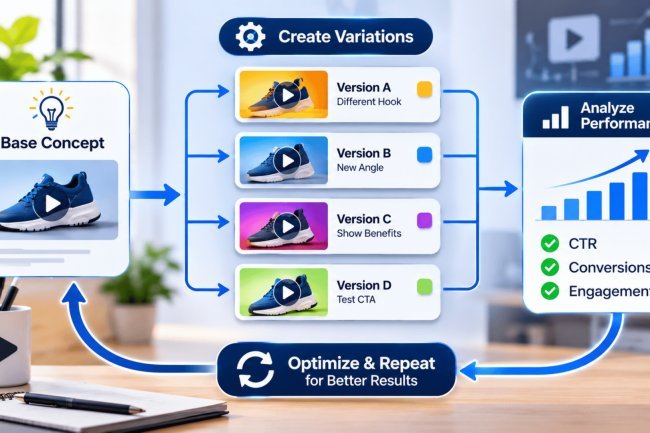
View duration, drop-off points, CTR, and conversion metrics reveal where the story works and where it breaks. Launch is not the finish line. It is the start of optimization.
The Explainer Impact Pyramid
Action
Clarity
Trust
Attention
Final Takeaway
Great explainer videos are not made through production.
They are made through relentless clarity.
Every edit should strengthen understanding. Every scene should support the message. Every second should move the viewer closer to action. When clarity becomes the standard, conversion becomes the outcome.