How to Build a Repeatable Video Ad Variation System
A disciplined, structured approach to testing video ads that turns creative guesswork into a science — so every dollar spent teaches you something, and winners compound over time.
Start With a Winner — and Freeze the Meaning
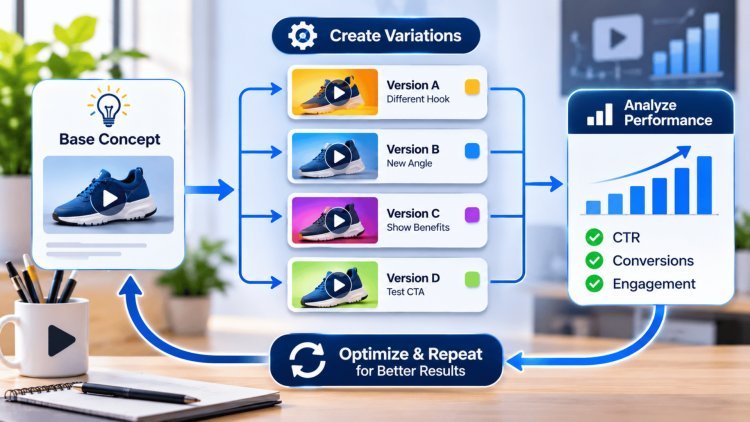
Before you can test anything, you need a stable foundation. The entire variation system depends on having a single "control" ad — a proven performer that serves as your benchmark for every future experiment.
If you don't yet have a winner, your first priority is finding one. Iterating off a weak ad just amplifies noise. Once you have a control, the system kicks in.
Scientific Ad Testing Framework
Use one proven winner as your control ad. If you don't have one yet, finding it must come before any variation work.
A true control is an ad that has demonstrated reliable cost-per-result performance across sufficient volume — not just a "pretty good" performer from a small spend window.
Without a real control, you're just iterating on luck.
02
Change Exactly One Thing
Every challenger variation must change exactly one element from the control — and everything else stays frame-for-frame identical.
This is non-negotiable. When two things change simultaneously, you can't attribute the result to either variable.
The discipline of one-variable-at-a-time is what transforms ad testing from creative opinion into actionable data.
Example of a Valid Test
Control
Existing hook, same script, same visuals, same CTA.
Challenger
New opening hook, identical script, visuals, pacing, and CTA.
Result
Clear attribution of performance difference to the hook.
03
Keep the Winner Running
Never pause your control while challengers compete against it. Pausing and switching breaks the platform's learning phase and destroys the head-to-head signal you need.
The control runs continuously — it's both your business engine and your scientific baseline.
Challengers run in parallel until the data speaks clearly.
Bad Test Design
Multiple Variables Change
New Script + New Hook
New CTA + New Visual
Control Paused
Unclear Results
Good Test Design
One Variable Changes
Controlled Environment
Parallel Testing
Continuous Benchmark
Interpretable Results
Scientific Testing Principle
Control + One Variable + Parallel Testing = Learnings
The Golden Rule
If you can't tell why a variation won or lost, the test was designed wrong.
Frozen meaning creates interpretable results. Keep the control stable, change one variable at a time, and let the performance data reveal what actually drives outcomes.
Control → Variation → Evidence → Scale
Creative Testing Framework
The 5-Layer Ladder: One Change, Ordered for Learning
Not all variables are created equal. Some changes are expensive and high-signal; others are cheap and tactical. The 5-Layer Ladder organizes variables by their production cost and strategic impact — so you test in the right order, extract maximum learning per dollar, and never waste a reshoot on a question a caption change could answer.
5 LAYER 5
Offer Framing
How the offer is stated to the viewer. Reframes the entire argument. Changing pricing, terms, or guarantee language effectively creates a new offer — treat it as a strategic test, not just a copy tweak. This is the highest-stakes layer because it touches business model logic, not just creative execution.
Captions, primary text, and headline copy. The cheapest layer to change — no reshoots required, often no new creative assets. Test benefitled vs. curiosity-led headlines, long vs. short captions, or social proof vs. feature copy. High iteration speed makes this ideal for rapid refinement once deeper layers are locked.
Aspect ratio, video length, and pacing. Delivers a different viewing experience without rewriting the argument or re-recording the presenter. A 15-second cut vs. a 60-second cut of the same script can perform dramatically differently across placements — test format before assuming the script is the problem.
Who speaks on camera. Swapping the face and voice changes who feels addressed by the ad — it's an audience-fit signal as much as a creative one. A new presenter can dramatically shift resonance with specific demographics, existing customers vs. cold audiences, or trust profiles. Requires new recording but preserves the script.
1
LAYER 1
Hook (First 3 Seconds)
The opening frames decide who keeps watching. This is the highest-leverage, highest-production-cost test. A new hook may require a full reshoot or dedicated footage, but the payoff is enormous — improving hook retention rate compounds every downstream metric. Test hooks only after lower layers are optimized.
↘
Reading the ladder
Start from Layer 4 (text) and work downward only when you've exhausted learning at a given layer. Reserve Layer 1 hook tests for when you need a step-change in performance, not incremental gains.
Run Each Round Like a
Controlled Experiment
The variation system only produces reliable learning when each round is structured like a real experiment: defined variables, sufficient data volume, appropriate run time, and clean naming conventions. Shortcuts here cause teams to make confident decisions based on bad data. [828][832][838]
1
Test Structure
Control
Use your current best-performing creative or a strong baseline. Everything except the tested variable remains identical. [828][836][838]
3
Test Structure
Challengers
Run one control plus up to three challengers per round. This provides useful variance without diluting budget across too many variables. [828][830][836]
2
Test Structure
Weeks
Run each round for approximately two full weeks before evaluating results. Early performance rarely reflects steady-state delivery. [830][832][836]
100
Test Structure
Optimization Events
Plan for at least 100 optimization events per ad set before drawing conclusions on cost per result. [832][837][838]
Experiment Discipline
One variable.
One answer.
Isolate the Change
Meta’s A/B testing guidance says only one variable should change while the rest of the campaign, ad set, or ad remains identical. If the control and challenger differ in three ways, you will not know which change moved the result. [828][830][838]
The Event Math Rule
Learning Phase
Meta says an ad set generally needs about 50 optimization events within seven days of its last significant edit for costs to become more stable. [825][829][837]
Reliable Read
Meta’s A/B testing guidance indicates results become more reliable once at least 100 events are observed for the cost-per-result metric being tested. [832][837][838]
Low-Volume Fix
If volume is too low, extend the round, consolidate budget, or temporarily optimize for a higher-funnel event to accelerate signal. [830][832][836]
Pulling the plug at 20 purchases is not a valid test — it is a gut check dressed up as data. Plan budget per round with the event minimum in mind before launch. [830][832][836]
Naming Convention
Make every test
auditable months later.
Name by Variable, Not Vibe
Use a consistent pattern such as CONCEPT_L#-LAYER_value_v##_YYYY-MM-DD. This makes the ad library searchable, the logs auditable, and the team aligned on what was tested and when. [830][832][838]
Preserve Institutional Knowledge
Log the
Variable
Record the
Result
Promote the
Winner
Set the Next
Control
Always log which value becomes the next control after a round concludes. The system compounds only if institutional knowledge is preserved. [830][832][836]
The Bottom Line
A creative test is only as good as its structure.
Isolate one variable, run long enough, collect enough events, and name the result so the learning survives the campaign.
Package, Ratchet, and Know When to Stop
Creative testing is not about endlessly producing variations. It is about systematically identifying winners, packaging proven learnings, and recognizing when a concept has delivered all the value it can. Sustainable scaling comes from disciplined progression, not perpetual experimentation.
→
Ratchet
Lock winning learnings
→
Scale
Expand winners only
Launch Alongside the Winner
Never pause a top-performing control while testing challengers. Release new variations in structured weekly batches so performance comparisons remain clean and statistically useful.
Package Strategically
Only combine formats, messaging, and creative layers after controlled testing identifies reliable winners. Learning comes first. Scale comes second.
Know When to Stop
Great creative operators recognize diminishing returns early and redirect resources toward higher-opportunity concepts before efficiency declines.
The Three Stop Signals
01
No New Winners
Two consecutive testing rounds fail to produce a stronger challenger.
02
Creative Fatigue
Cost per result doubles versus historical baseline due to audience exhaustion.
03
New Concept Territory
The next change targets an entirely different audience, offer, or creative angle.
Ratchet Principle
Every round should move forward.
Why the System Works
Every test produces value. Winning variants scale performance. Losing variants eliminate uncertainty. Both outcomes improve the system because they sharpen future decisions and reduce wasted experimentation.
Closing Principle
Great testing is not about endless iteration.
It's about knowing exactly when to scale and when to move on.